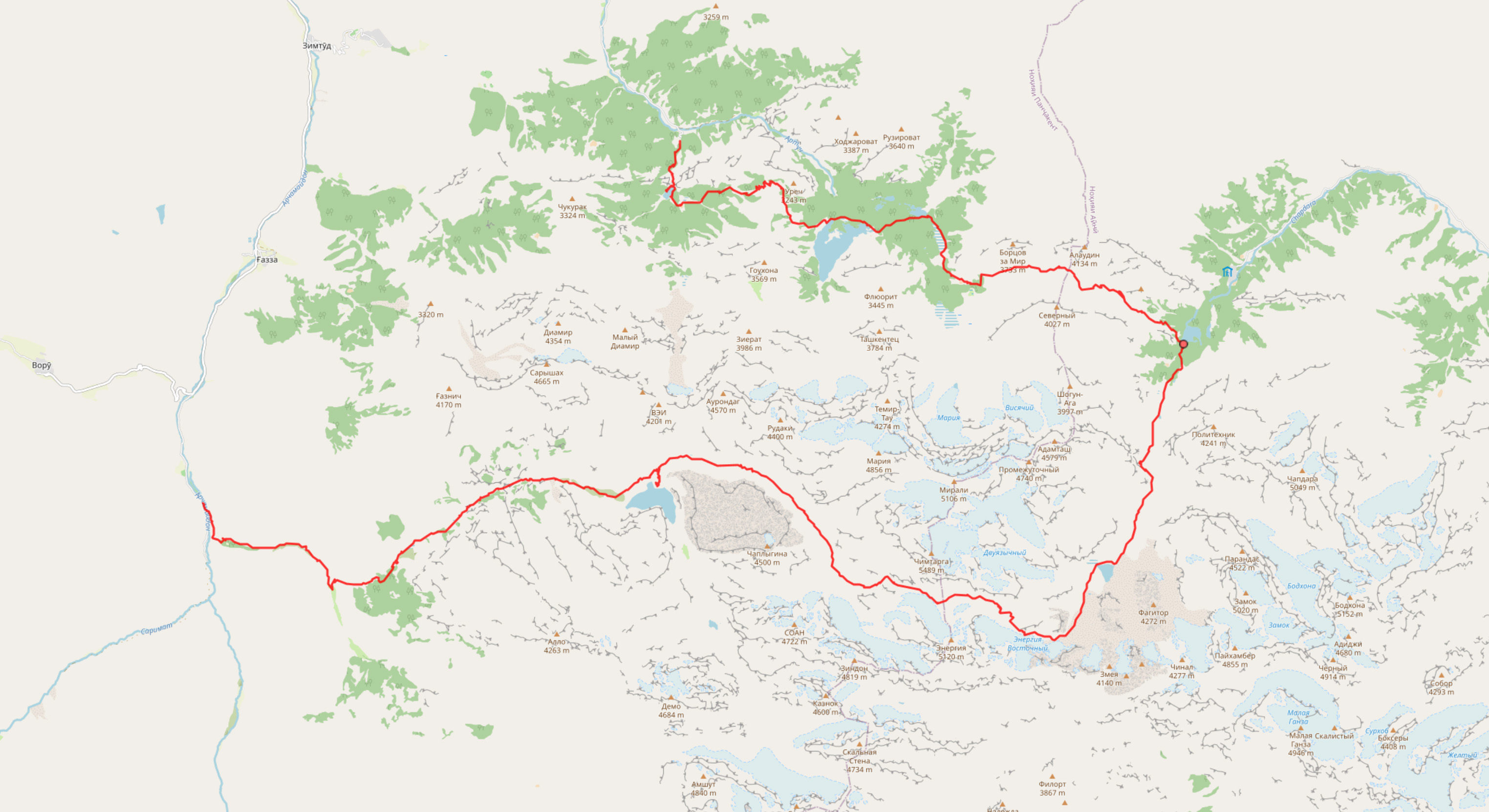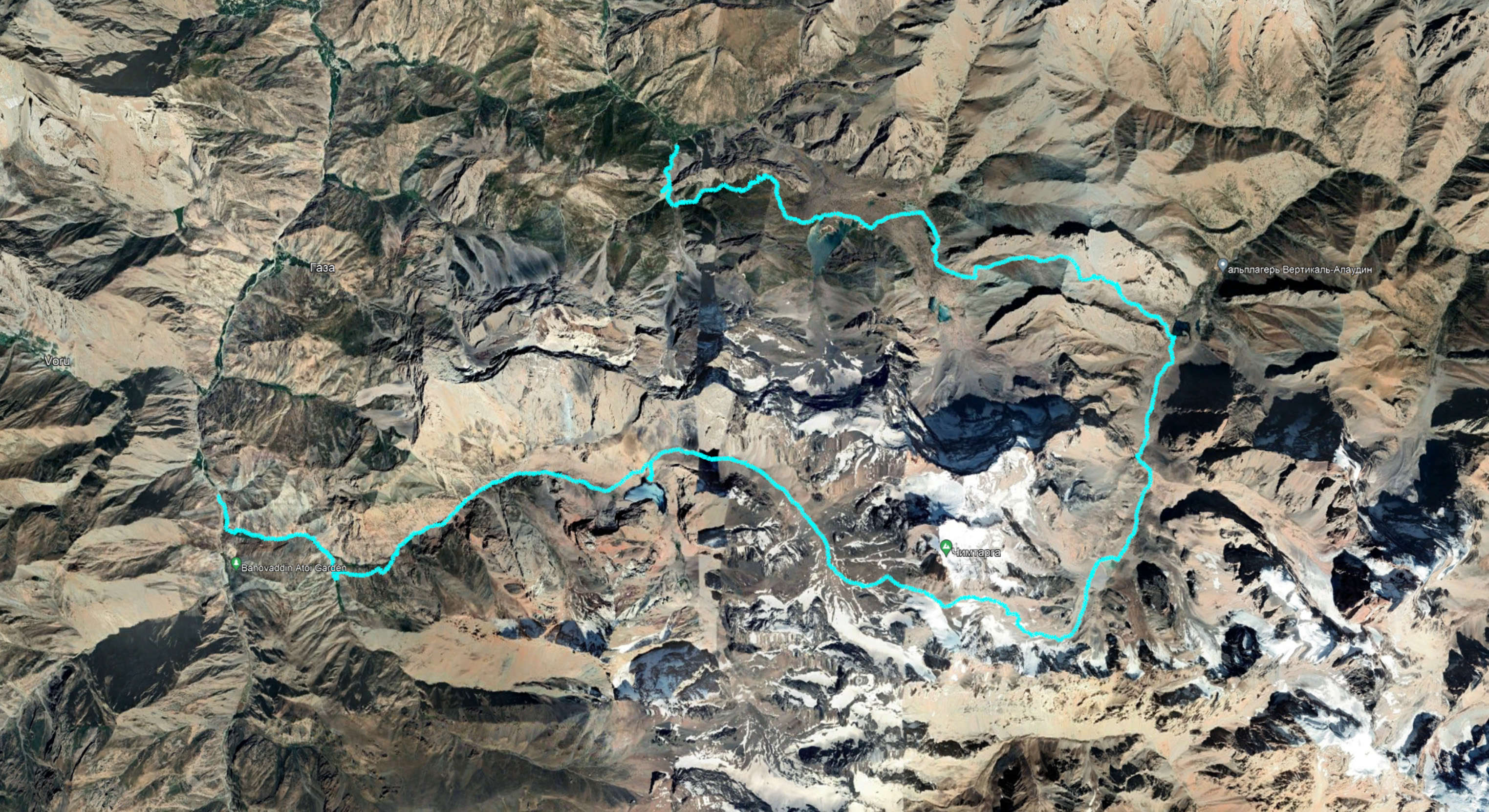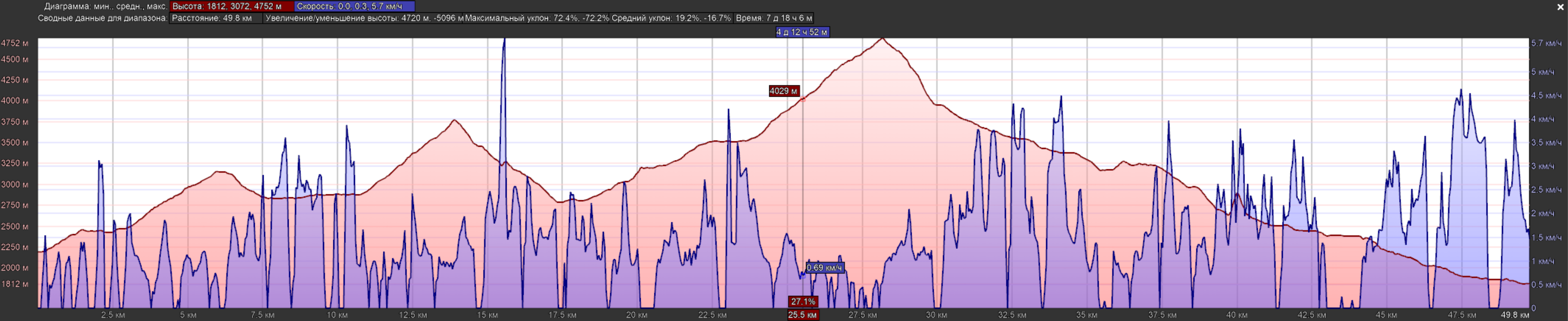
After the last year’s self-guided hike to Arkhyz, we wanted to try ourselves higher in the mountains. Of all available and safe options, in terms of comfortable temperatures and easy mountain passes (that are possible to pass without additional equipment), we chose the Fann Mountains. According to the descriptions, these are very warm mountains for such heights, insanely beautiful, and it is quite easy to reach them. We had a flight from Moscow to Samarkand (4 hours). And straight from the airport we took taxis that took us to the starting point (another 4 hours).
Active preparations for the trip, not counting planning, took 3 days before the flight to Samarkand. During this time, it was necessary to make a meal planning, purchase products (some things were ordered in advance so that they could arrive before the trip, for example, stew, dried and freeze-dried meat, dried vegetables), compile and fill a first aid kit, stock up on batteries for GPS and flashlights, buy a sun cream. A water bottle with a filter was ordered from Decathlon in February in reserve, expecting that the store will close in the Russian Federation soon. I successfully bought a white long-sleeved T-shirt from the SportMaster to escape the strong mountain sun.
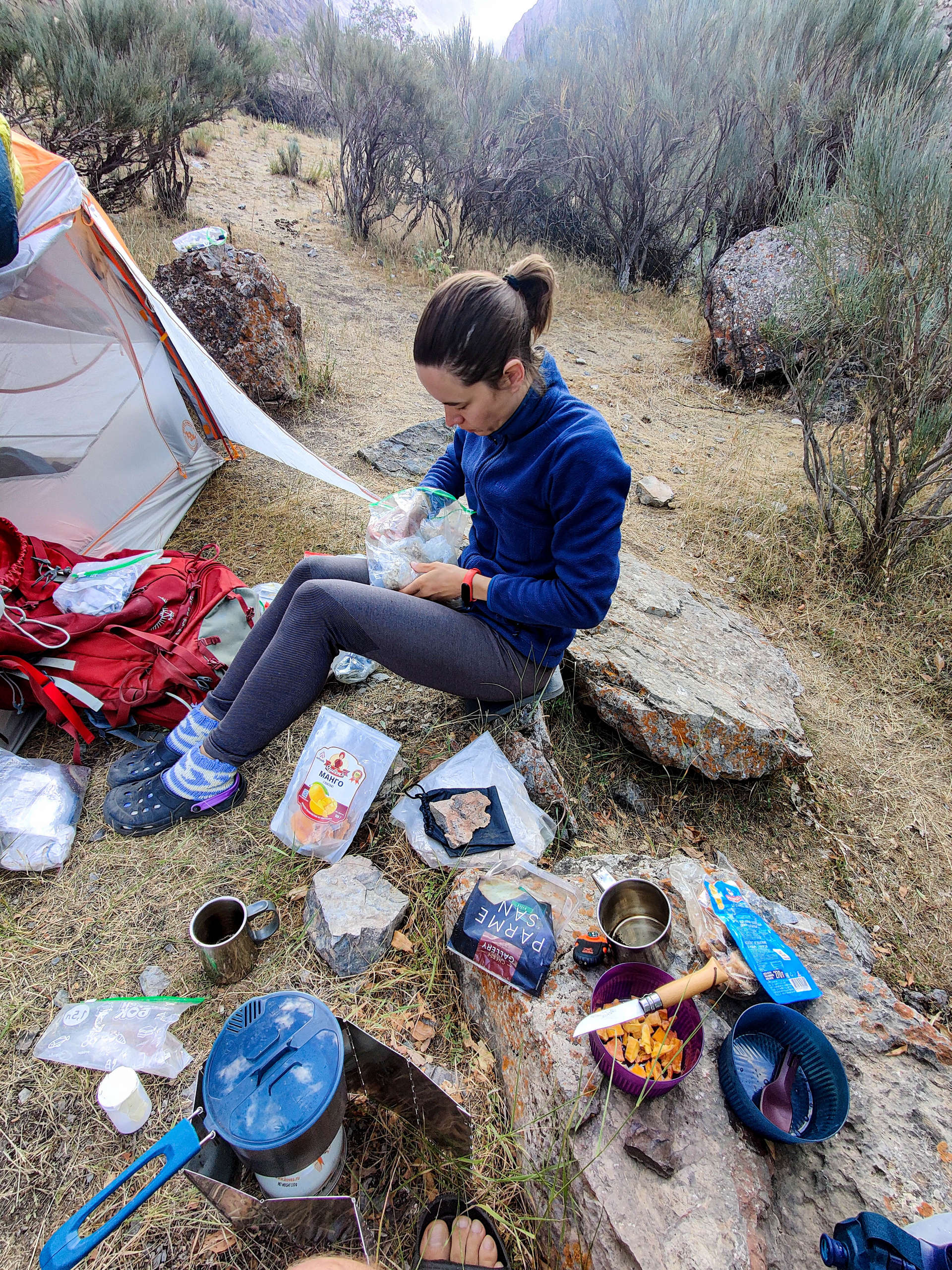
All food was successfully purchased and neatly packaged in small plastic bags. And then everything was laid out in packages with a zip lock.
We contacted the tourist center Artuch in advance to check whether it is possible to buy gas cylinders. As of August 2022, 230gr bottles cost $12 or 120 somoni. We ordered 4 cylinders, and bought a fifth one on the spot, there were no problems with this.
Transfer (taxi) from the border of Uzbekistan and Tajikistan to the Artuch camp site was also ordered in advance for a specified time, the cost was 5000 rubles per car (~$85).
Chapters
- Day 0. 2022-08-02 Tuesday
- Day 1. 2022-08-03 Wednesday
- Day 2. 2022-08-04 Thursday
- Day 3. 2022-08-05 Friday
- Day 4. 2022-08-06 Saturday
- Day 5. 2022-08-07 Sunday
- Day 6. 2022-08-08 Monday
- Day 7. 2022-08-09 Tuesday
- Day 8. 2022-08-10 Wednesday
Day 0. 2022-08-02 Tuesday
Departure at 01:15 from Domodedovo. The flight is only 4 hours, but it is difficult because it is a night flight. We were woken up, fed with beef with buckwheat, which reminded of itself all the way to Artuch. We should be thanking Uzbekistan Airways for this.
Samarkand airport is brand new, passports were stamped quickly, but we waited for some time for luggage. We were worried that during the customs inspection they could take away our dried meat and basturma, but in the green corridor nobody was interested in our huge tourist backpacks. In front of us was a man with luggage, he was asked to go through the security check. There is WiFi at the airport and there is Yandex Taxi in Uzbekistan, so it only remains to exchange some local money and drive to the border with Tajikistan. There is only one money exchanger at the airport with a wild exchange rate of 120 soʻm for 1 ruble. While the official exchange rate is 170 soʻm for 1 ruble. We decided that it is still more profitable than if a dashing taxi driver comes across and takes us according to the taximeter. Yandex Taxi estimated a trip to the border at 90,000 soʻm, which comes out to 750 rubles (~$13) with this rate. I changed 5,000 rubles for 600,000 soʻm, bought a liter bottle of water for 4,000 soʻm (~$0.5) in a stall at the airport and, pleasantly surprised by the price, jumped into a Daewoo Nexia to the border with Tajikistan. When we were getting into a taxi, some man ran up, looking like a drunkard, who asked to buy soʻm from him for rubles, well, to exchange them. He offered at the rate of 150. When I mentioned that we had already bought soʻm inside, he recoiled in shock, “but they sell soʻm for 120 in there …”.
At 07:30 the plane landed, at 08:50 we already were driving in taxi.
In Samarkand, surprisingly, the weather is fresh, pleasantly warm, and there’s no trace of the +42°C heat. The streets we drove along were wide and empty, mostly occupied by cheap Daewoo Nexias and local narrow minibuses. The deserted streets are swept by solitary street cleaners, and numerous flower beds are watered by specially trained workers. At first glance, it reminded me of Turkmenistan as it is shown on YouTube. However, we didn’t actually enter Samarkand itself but rather passed it via a kind of ring road.
Outside the city, there is poverty and constant settlements along the road. There’s no sign of nature. Only the Fann Mountains loom on the horizon to the right.
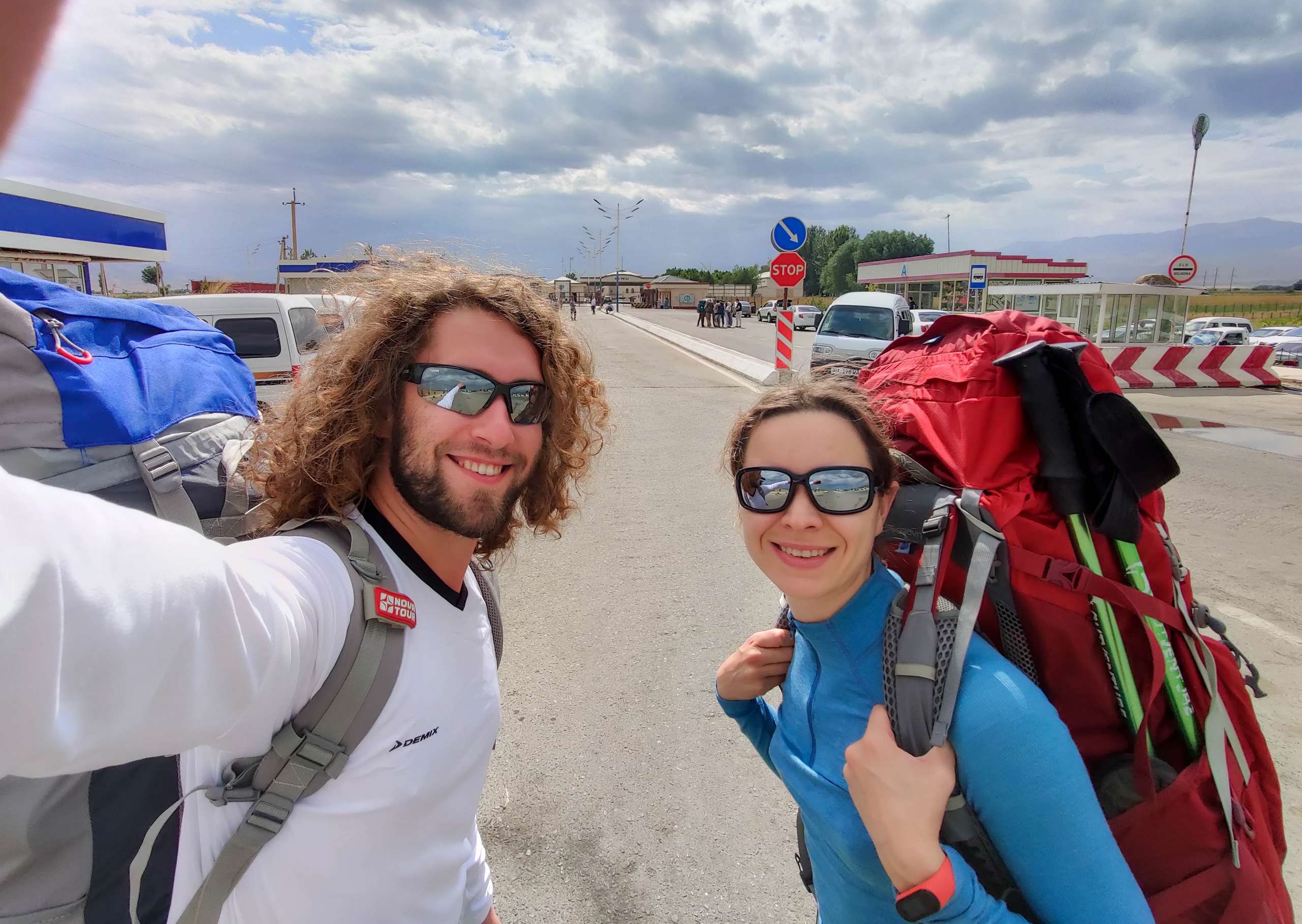
We were brought to a field near the border with Tajikistan. I handed the taxi driver 100,000 som (~$9); he honestly tried to give me change, but I let him keep it. Crossing the border on foot is an impressive and memorable experience. Everyone speaks Russian on both the Uzbek and Tajik sides, which is nice. We encountered the first group of three backpackers — either Spaniards or Italians. The question is, do they need a visa?
The border crossing route is quite simple. At the entrance, there’s a gate where they check your passport and compare it with your face. Then, you go to a building with an X-ray machine for your luggage — it’s just a regular conveyor belt, and they don’t really check what you’re carrying. Right after that, border guards on the Uzbek side stamp your exit. Then, you walk outside, following the pedestrian lines, with armed soldiers around. Next, you pass through two narrow roads with fences on both sides, and on the right, there’s a small house that we almost got missed. That’s where the Tajik border guards are. They stamp our passports without any questions, and we were free to go. The next building is bigger, and we thought there would be baggage checks and PCR test verification, which are supposedly still required in Tajikistan, but we didn’t do them beforehand. However, there was no issue — we just passed the baggage conveyor belt, which only worked in the opposite direction (Tajikistan to Uzbekistan), and headed straight to the exit gate.
Right at the exit, Daler was already waiting for us. He asked if we were going to Artuch, helped us exchange a bit of local currency (2000 rubles (~$33) for 320 som), and we set off.
We left the border at 10:00.
Unfortunately, it turned out that we weren’t alone and we were traveling in two cars. The couple in the second car was also heading to Artuch and wanted to “do everything right”… Specifically, they planned to stop at the Ministry of Emergency Situations in Panjakent city to register, then go to a bank (though it wasn’t clear why), have breakfast, and also buy a SIM card. Our driver wasn’t very keen on traveling without them, as the road to Artuch is really bad, and it is better to go in two cars together for safety.
In Panjakent, we arrived at the main building of the administration, where the Ministry of Emergency Situations (MChS) was supposedly located. We went inside, and they told us, “No one’s here right now, they’ll be in about 20 minutes.” After 20 minutes, it turned out it would be “another 15 minutes.” We waited, wandering around the area, but there was nothing to see. Finally, a young man in a suit appeared and introduced himself as the head of the tourism development department for the Panjakent district. We tried to explain that our travel companions and we ourselves want to register our routes with MChS so that if anything happens, the rescuers would come to save us.
At first, he made a lot of phone calls, then started telling us that he had been working there for only a week and didn’t know anything, but he really wanted to help. To simulate activity, he copied our passports. In the end, he proudly gave us his mobile number and said, “If anything happens, call me anytime!” When I mentioned that there’s no signal in the mountains, he assured us that he had been in Artuch a week ago and there was coverage. He also said we should buy local SIM cards because otherwise, how would we call him?
Long story short, he grabbed our travel companions and took them to buy SIM cards. We realized there was no MChS involvement here, and we had just wasted a couple of hours. We quickly left and went to the car to wait for it all to end.
Exhausted, sleep-deprived, we arrived in Artuch around 13:00. It was raining heavily, and the temperature was +11°C. Definitely not what we expected from the hot Fann Mountains. Artuch is located at an altitude of 2180 meters, and we had planned to spend the night at 4500 meters. That day, we intended to climb 250 meters up to Chukurak Lake to acclimatize for a couple of nights. But we were too tired, hungry, and just wanted to sleep, plus the rain didn’t help.
At the Artuch tourist base, we bought the gas cylinders as planned and chatted with the locals. They told us the weather had been bad recently — rain, snow on the higher peaks, and on Chimtarga pass, people had gotten thoroughly frozen two days prior, but they managed to get through. There was no food available at the base (or maybe the guy at the counter wasn’t very knowledgeable). We bought a spot for the tent for 60 som (~360 rubles = $6) and went to prepare food and set up camp.
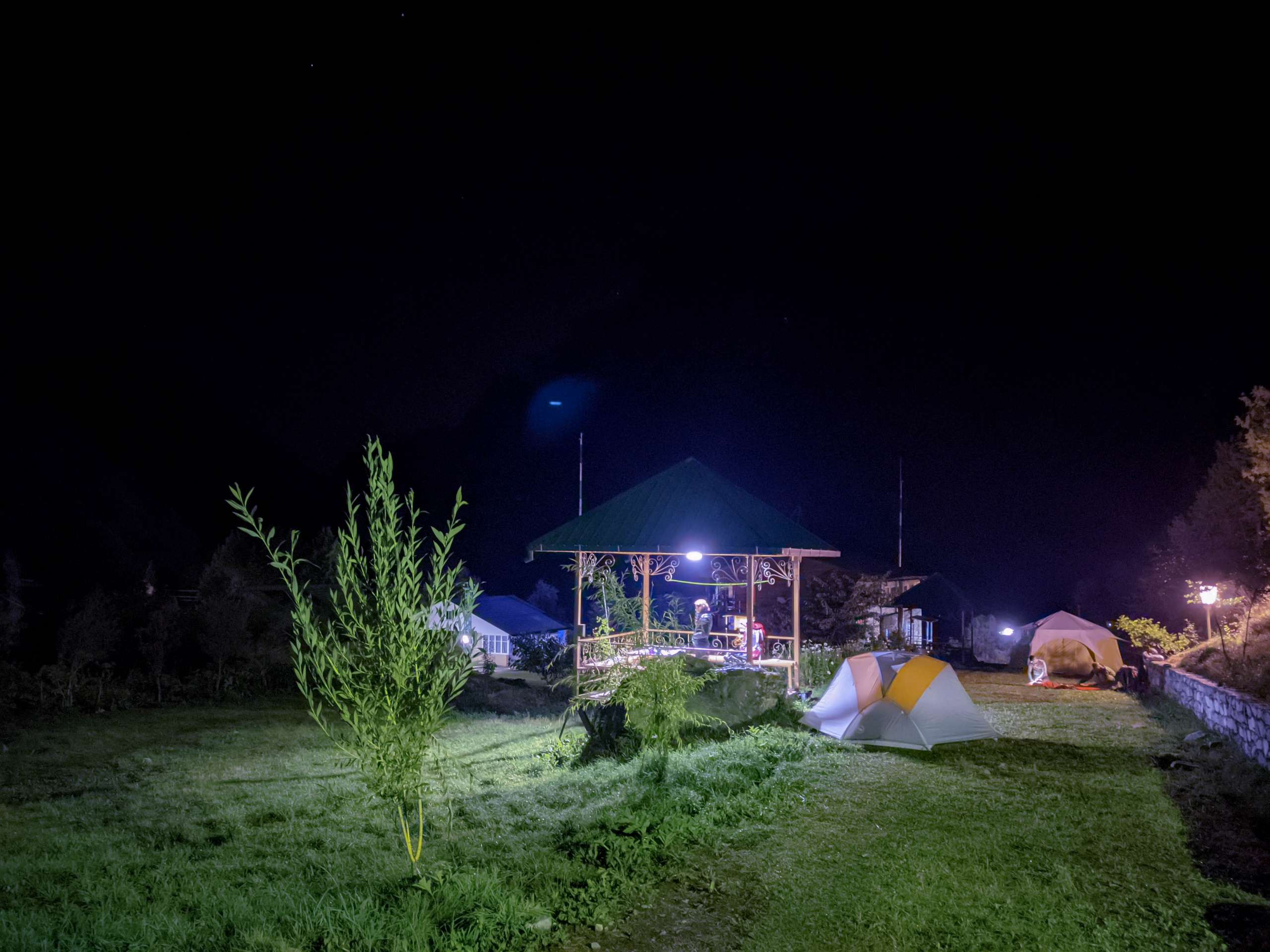
Next to our tent spot was a lovely large gazebo with a table, lights, and a socket. Later, we learned that we could use the hot shower! So, the price was well worth it. The spot for the tent was a bit sloped, though, and we found ourselves slowly sliding down during the night.
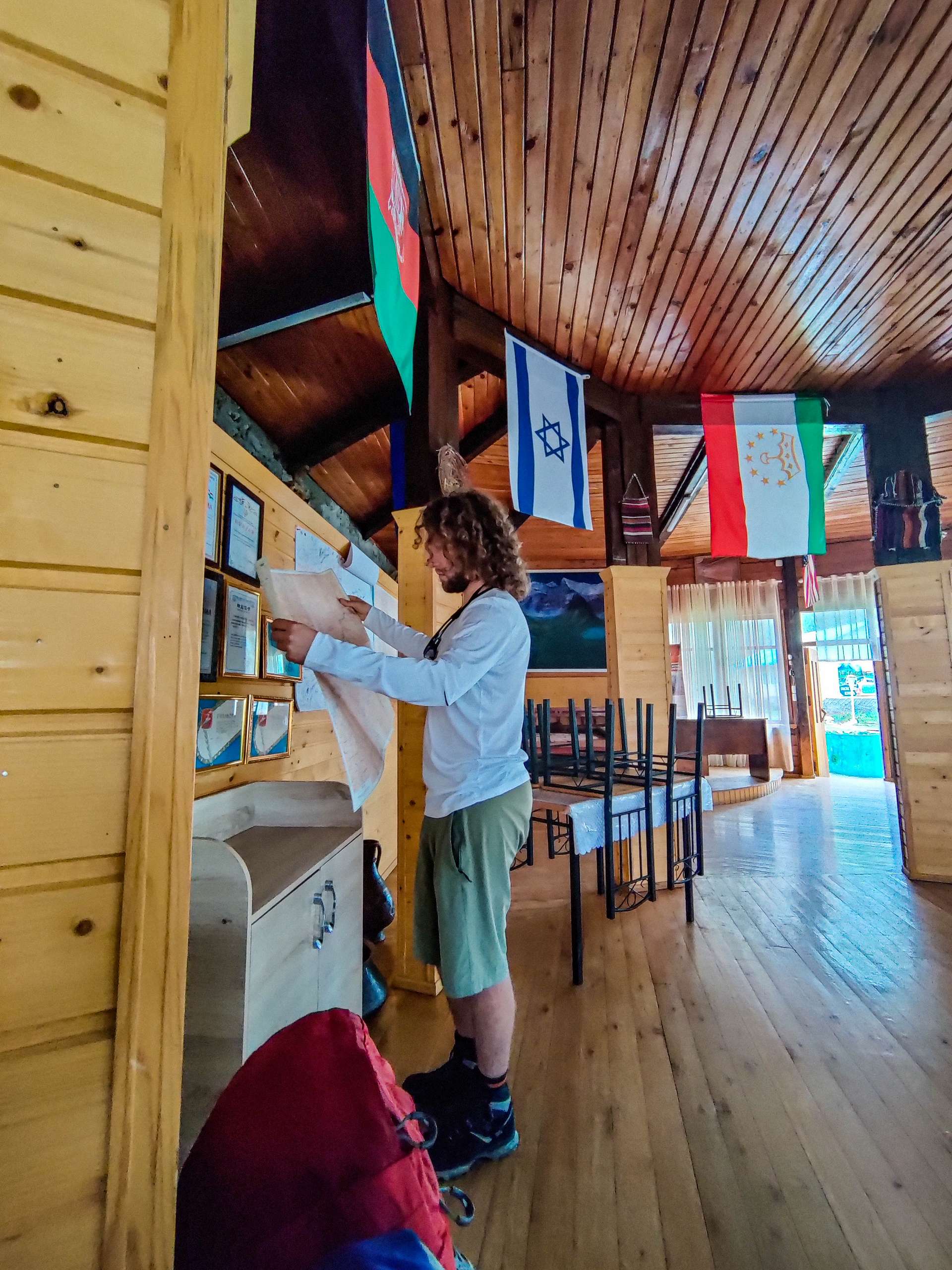
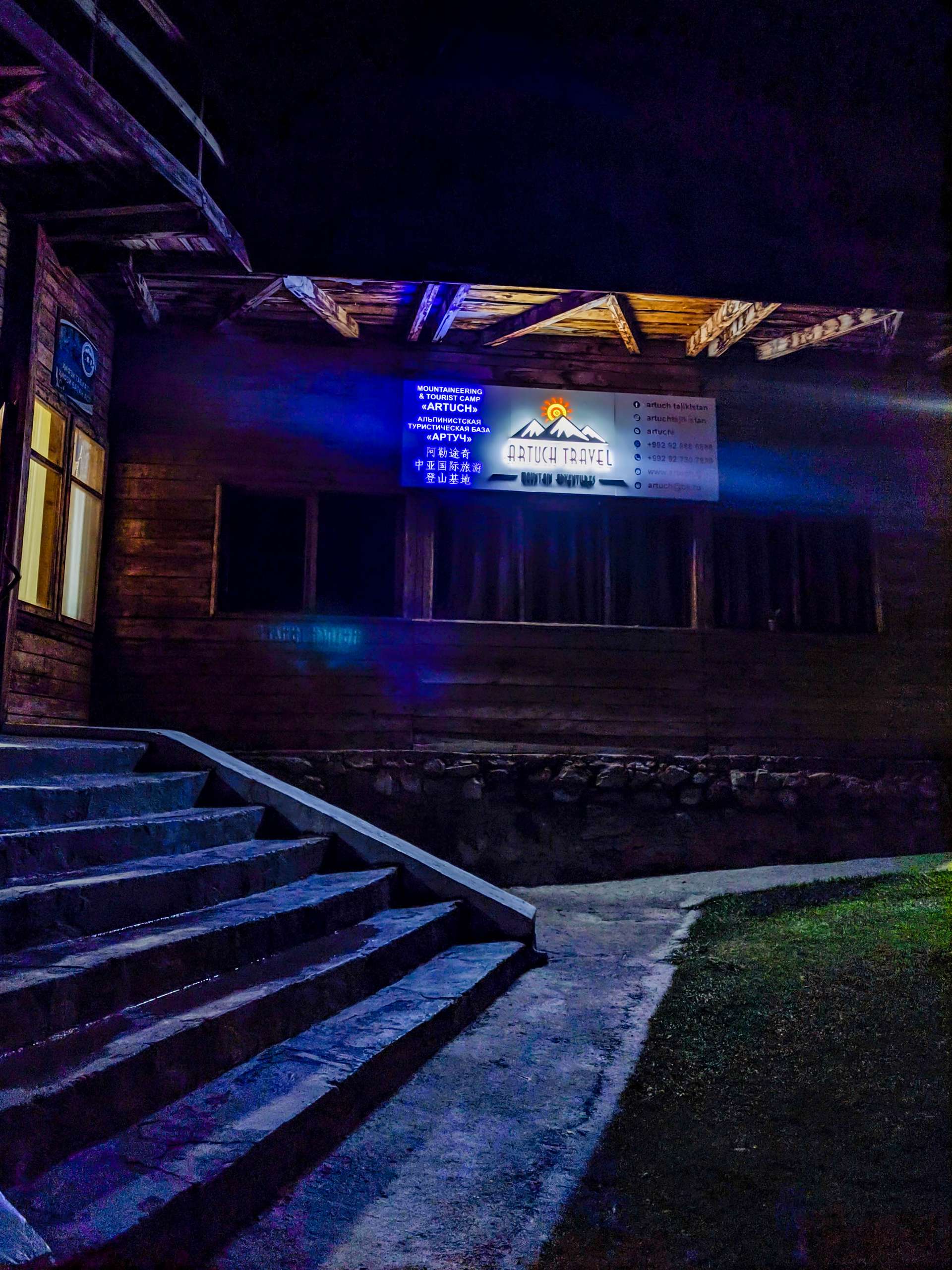
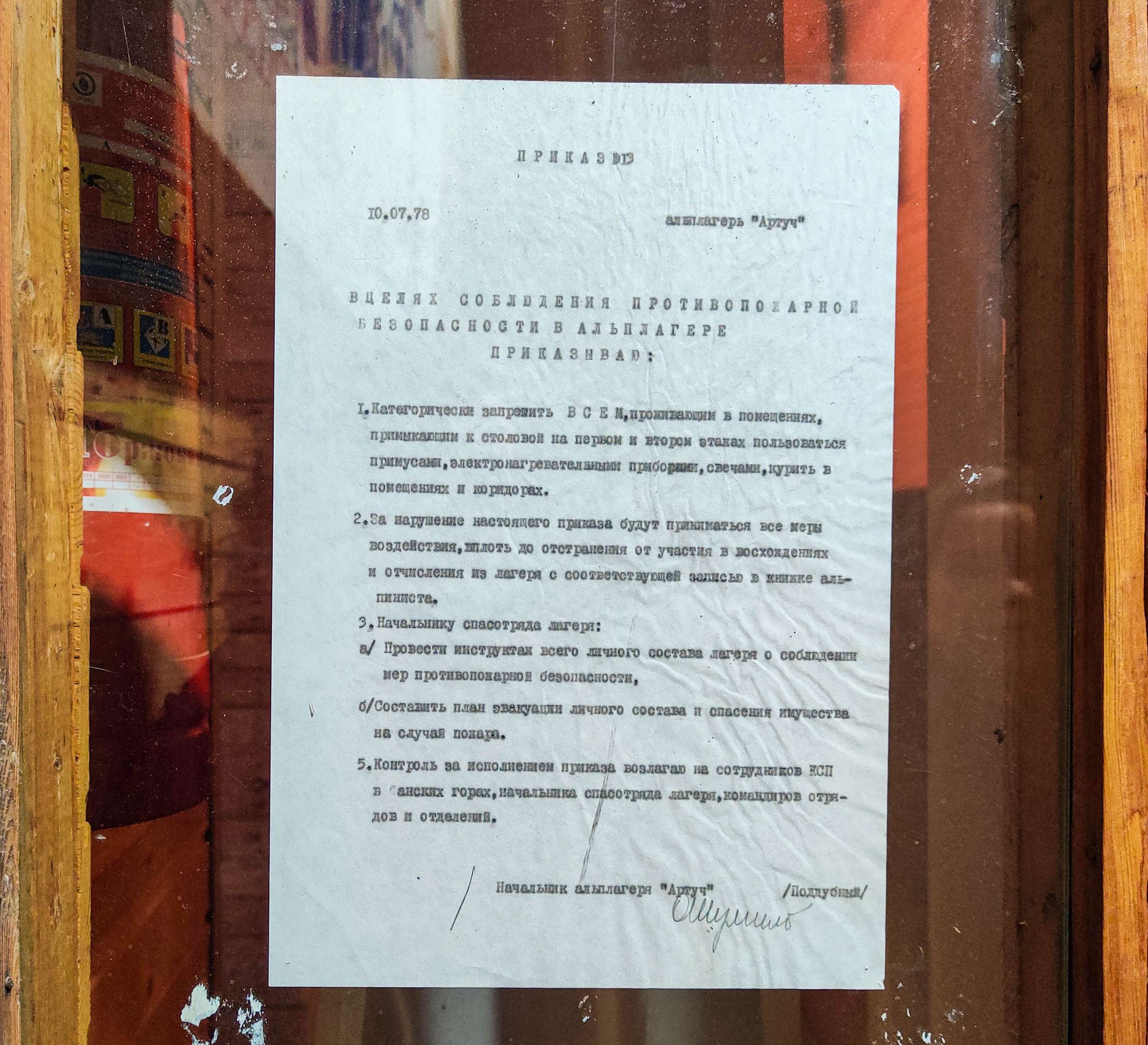
The Artuch tourist base is quite nice. They maintain the grounds as best as they can—trimming the trees, and there are washbasins and toilets. The rooms have beds with bed linen and blankets. A room costs around 4000 rubles (~$67), which is quiet expensive. There’s a large hall for meals, relaxation, and gatherings, with various maps, mountain paintings, and interesting documents hanging on the walls. In the evening, we found the local children watching The Multiverse of Madness.
Day 1. 2022-08-03 Wednseday
We woke up at 07:00, had a leisurely breakfast, took a hot shower, and chatted with the local dogs that had kept watch over us during the night. At 10:00, we set off for the climb to Chukurak Lake. The climb was short but steep, and in 1.5 hours, we reached the top and began wandering along the shore to find a spot for our tent. We found some streams above the lake that flow into Chukurak, and we filtered water from them for cooking and drinking. Drinking from the lakes in the Fann Mountains is strongly discouraged due to two factors: the large number of animals that contaminate the water, and the warm temperature, which promotes bacterial growth. Those who take the risk may face serious gastrointestinal issues and other problems caused by giardia. We also took a stroll to check out the water supply — a shepherds’ camp about 250 meters southeast of the lake has an open water tap, which we used on the second day.
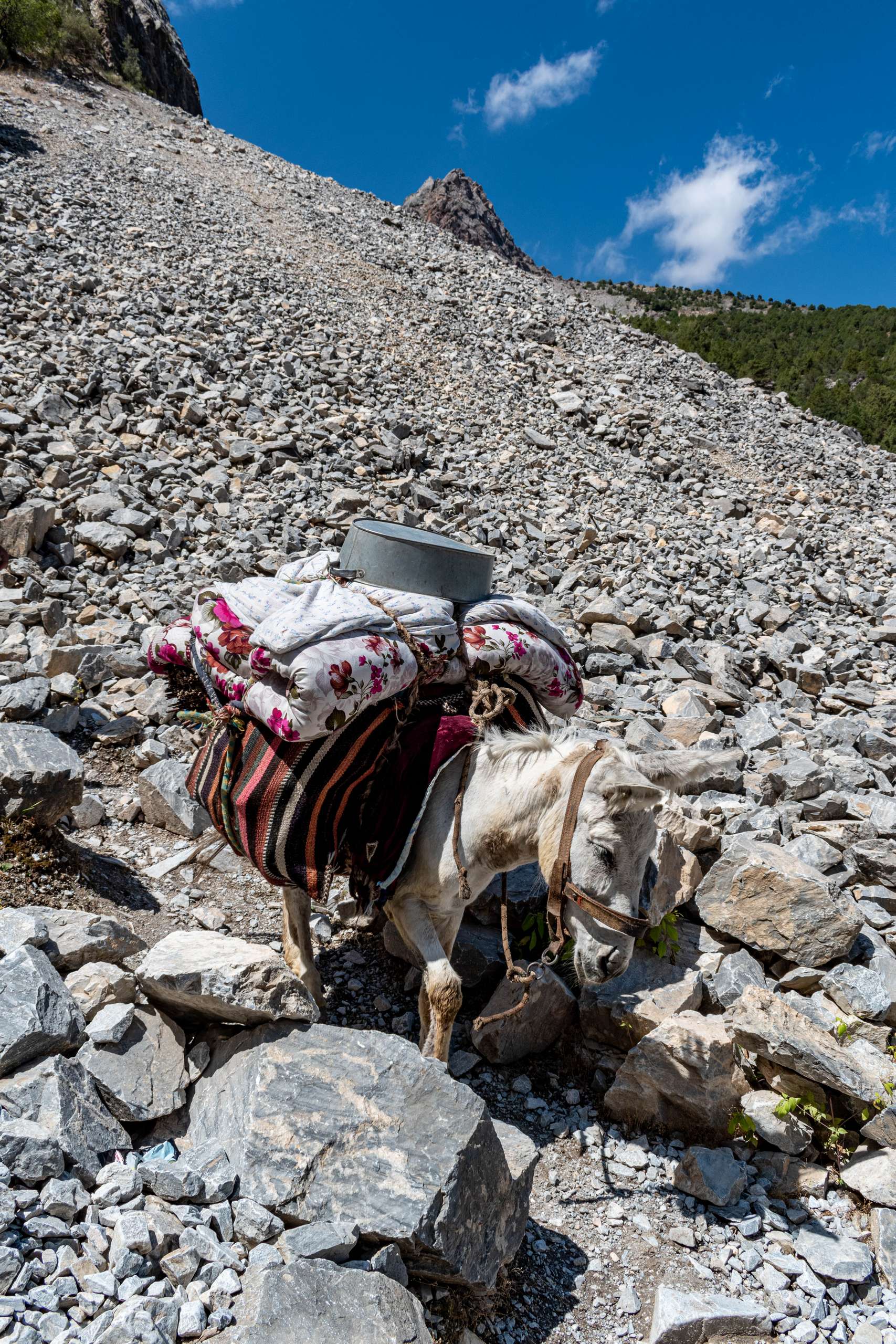
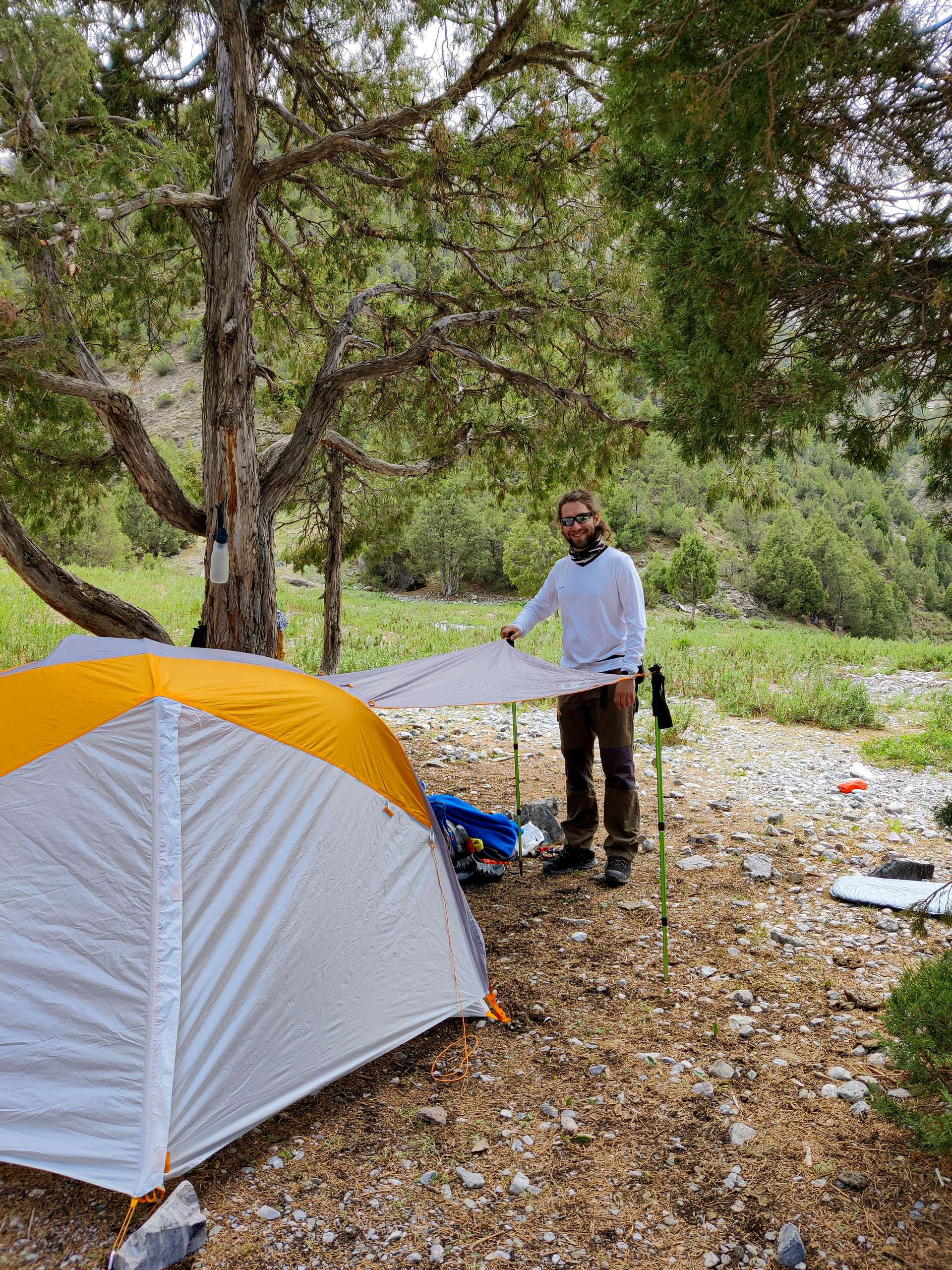
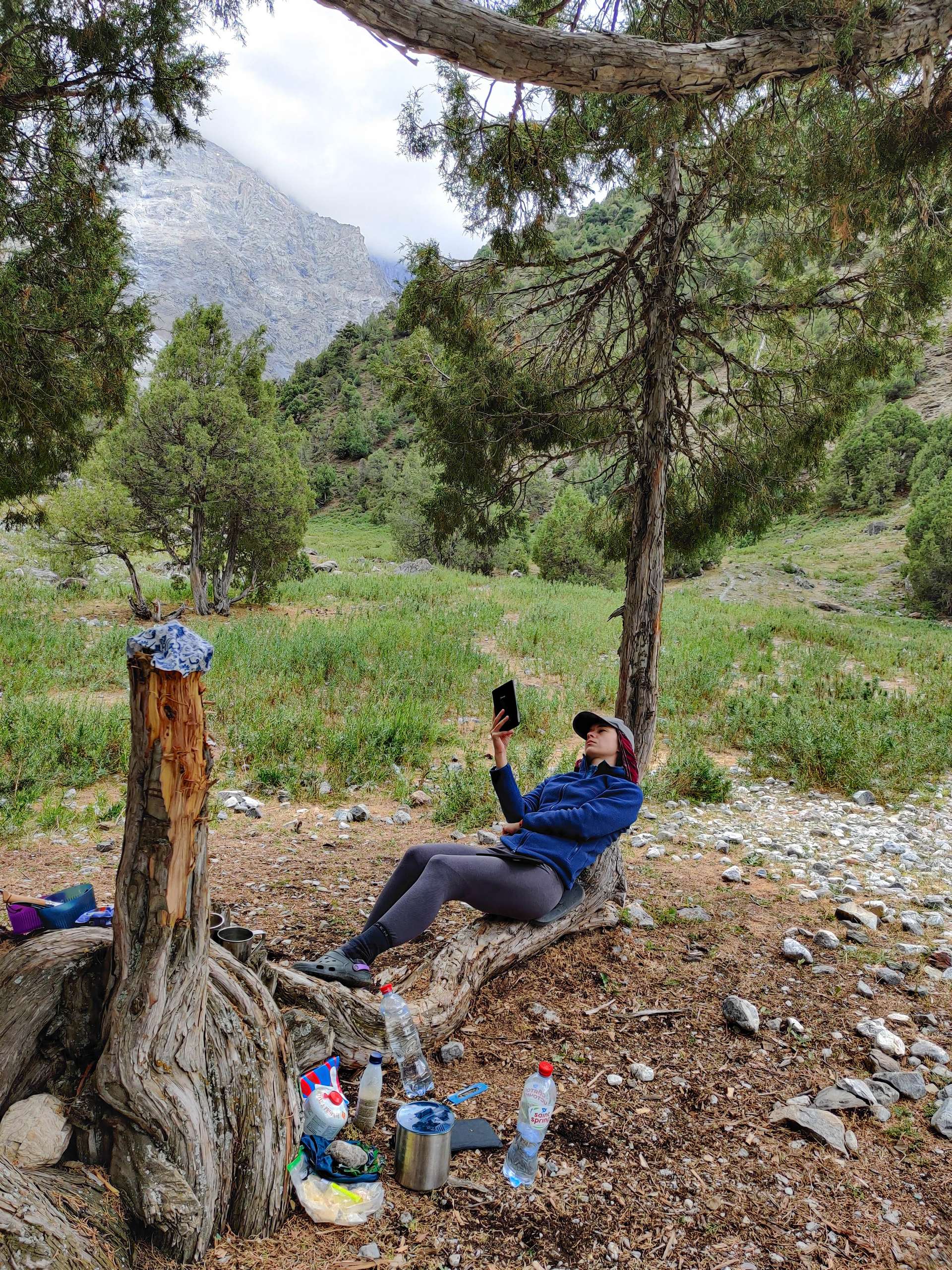
By 14:30, we had set up the tent in a juniper grove on the lake shore and started preparing lunch. We made a creamy potato soup with dried vegetables, spices, processed cheese, basturma, and croutons—delicious! After that, we indulged in reading books until evening. Katya took a walk around the area, made a few sketches, and filtered water for dinner.
In the afternoon, another tourist arrived at the perfectly empty lake (there was no one else, and there were plenty of camping spots) and set up his tent right in front of ours, blocking our beautiful view. On top of that, this unpleasant person kept coughing throughout the night, disturbing our sleep. In the evening, we decided to start a small fire to burn our trash, but this guy brought over giant juniper branches and launched a devastating smoke attack…
For dinner, we made couscous with turkey and dried vegetables, and polished it all off with herbal tea accompanied with dried mango and peaches.
A week before our departure, I had been sick for about a week, and it all started with a sore throat. And on this day, at the beginning of our hike, Katya started complaining of a sore throat…
Day 2. 2022-08-04 Thursday
Waking up at 06:00 was tough. The sun hadn’t risen yet, and it was cold. By 6:15, I crawled out of the tent and started cooking porridge. On the menu today: buckwheat with dried fruits and condensed milk, a couple of croutons with raisins and dried apricots, and some cheese. By 7, breakfast was ready, and just in time, the sun came out and began to warm us up. We packed up quickly and left the camp by 08:40.
Our neighbor guy seemed to be waiting for us to leave, and as soon as we set off, he hurried after us — for reasons unknown. It was like he wanted to give the impression of being alone in the mountains, but also kind of tagging along with us…
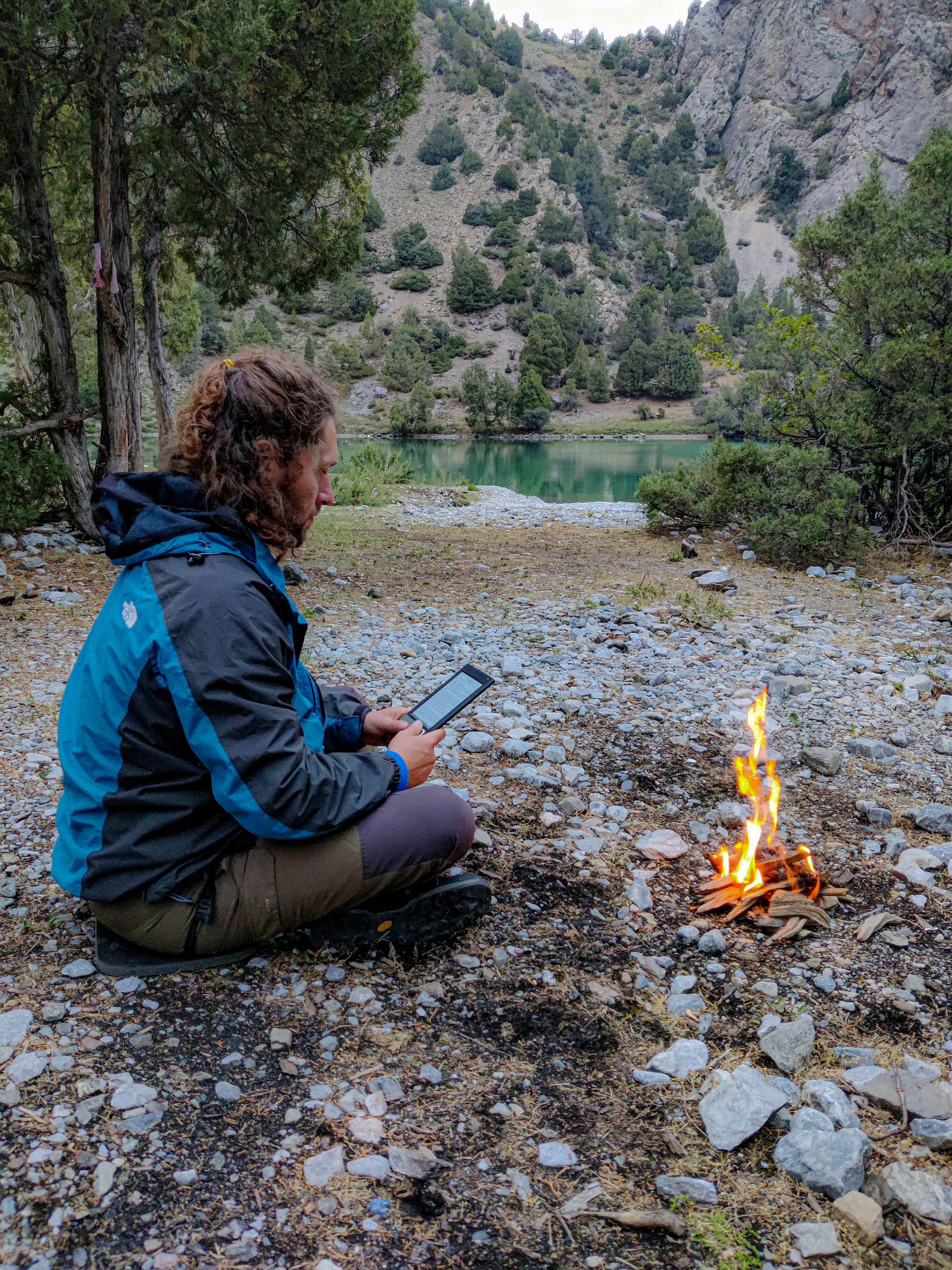
The trail to the pass runs past the water supply system, which we decided to make use of. We filled up our water bottles for the journey and washed up. The locals (shepherds and their families) didn’t seem to mind. A young local woman came by to fill a teapot—her face was tanned and wrinkled despite her youth, though she was quite pretty. The guy from the camp caught up with us, glanced at us from a distance, then checked his phone (probably his GPS), and continued on ahead.
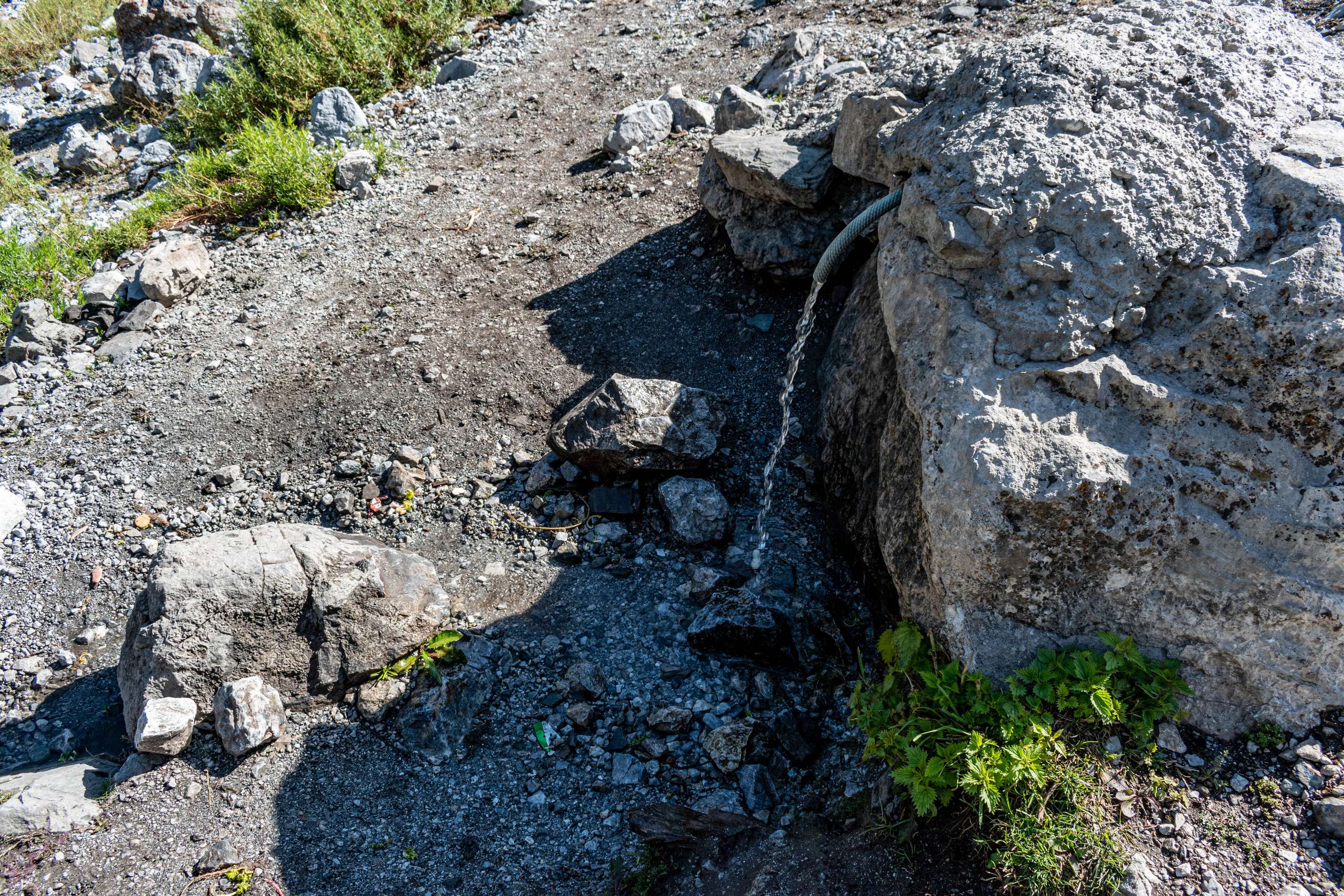
Right past the shepherds’ camp, there was a small lake, whose color made it clear that drinking this water — even filtered — was a bad idea. This was due to the large number of cows that had claimed the lake as their own. We even spotted a sitting cow — photo attached.
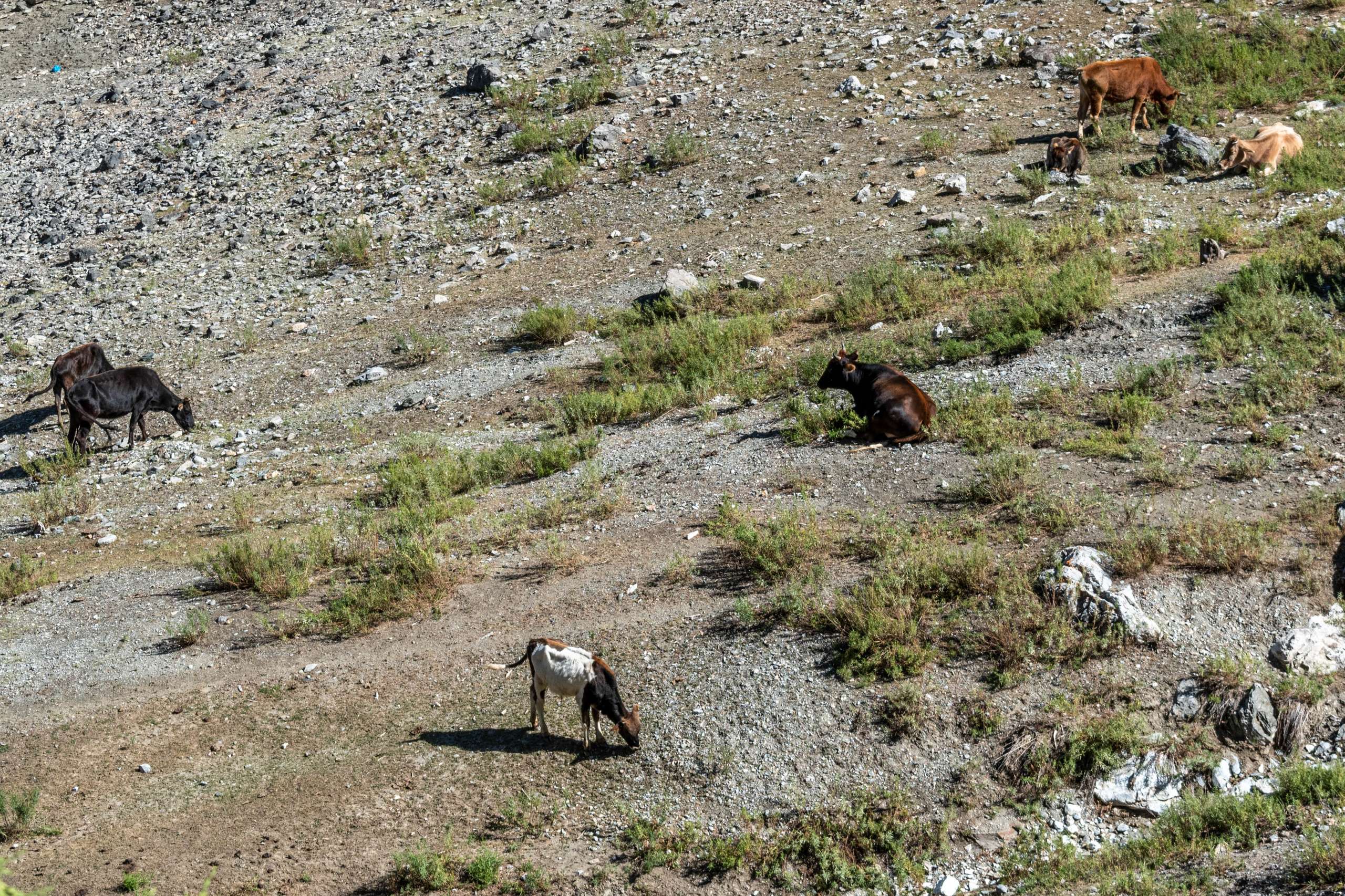
The climb from 2500 m to 2800 m follows a stream winding through rocks and trees. After that, the terrain levels out, giving way to green grass, scattered trees, and groups of cows grazing peacefully.
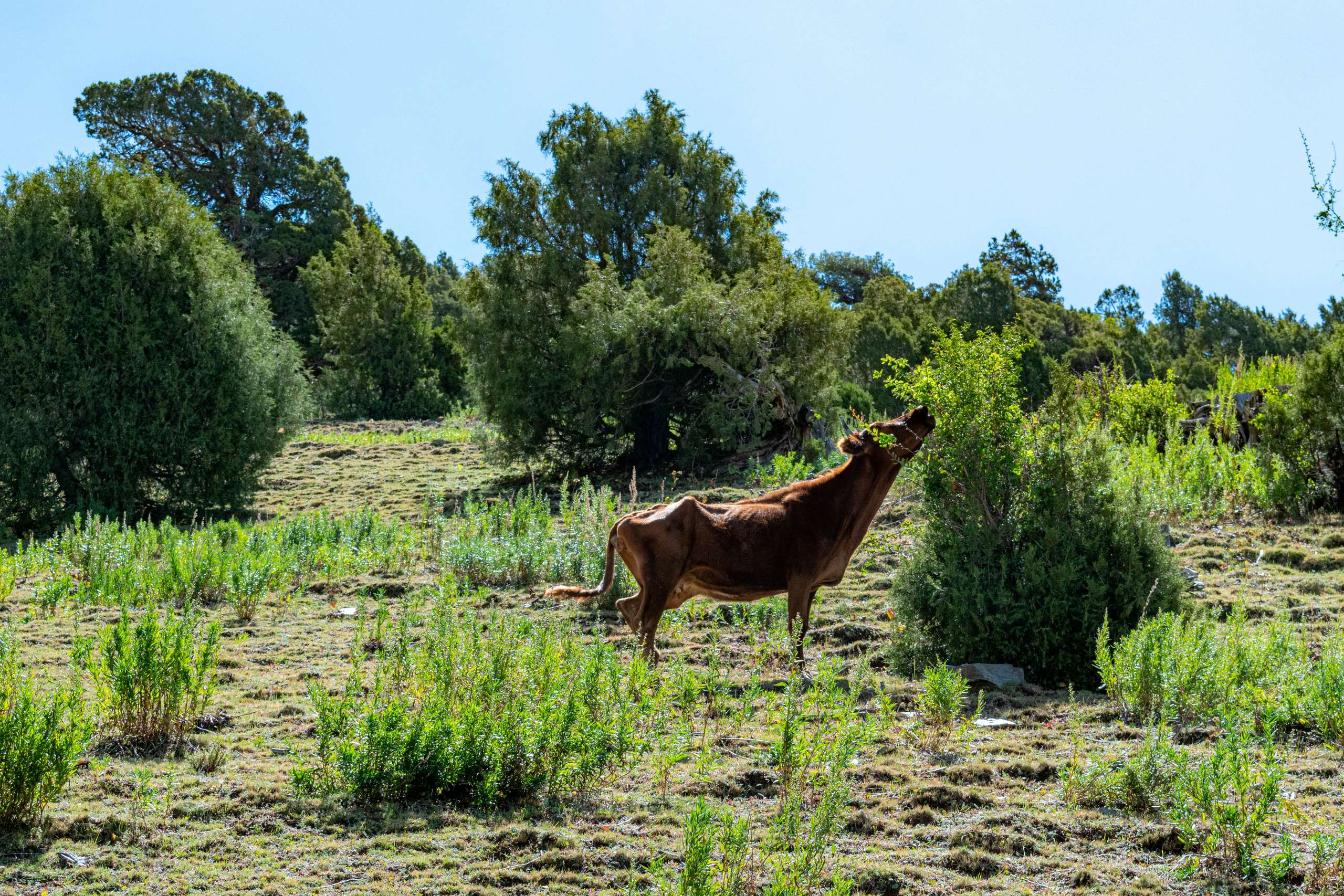
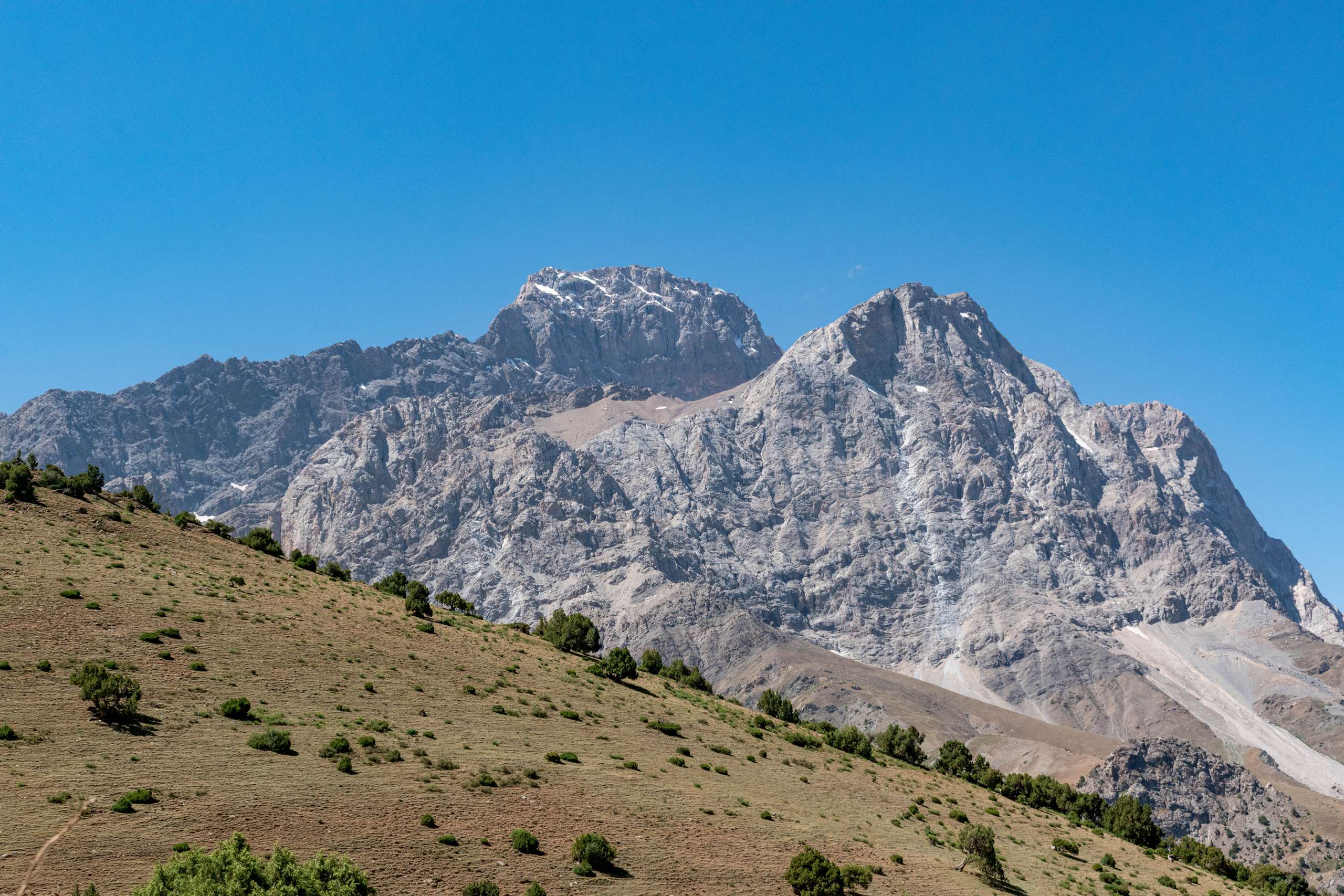
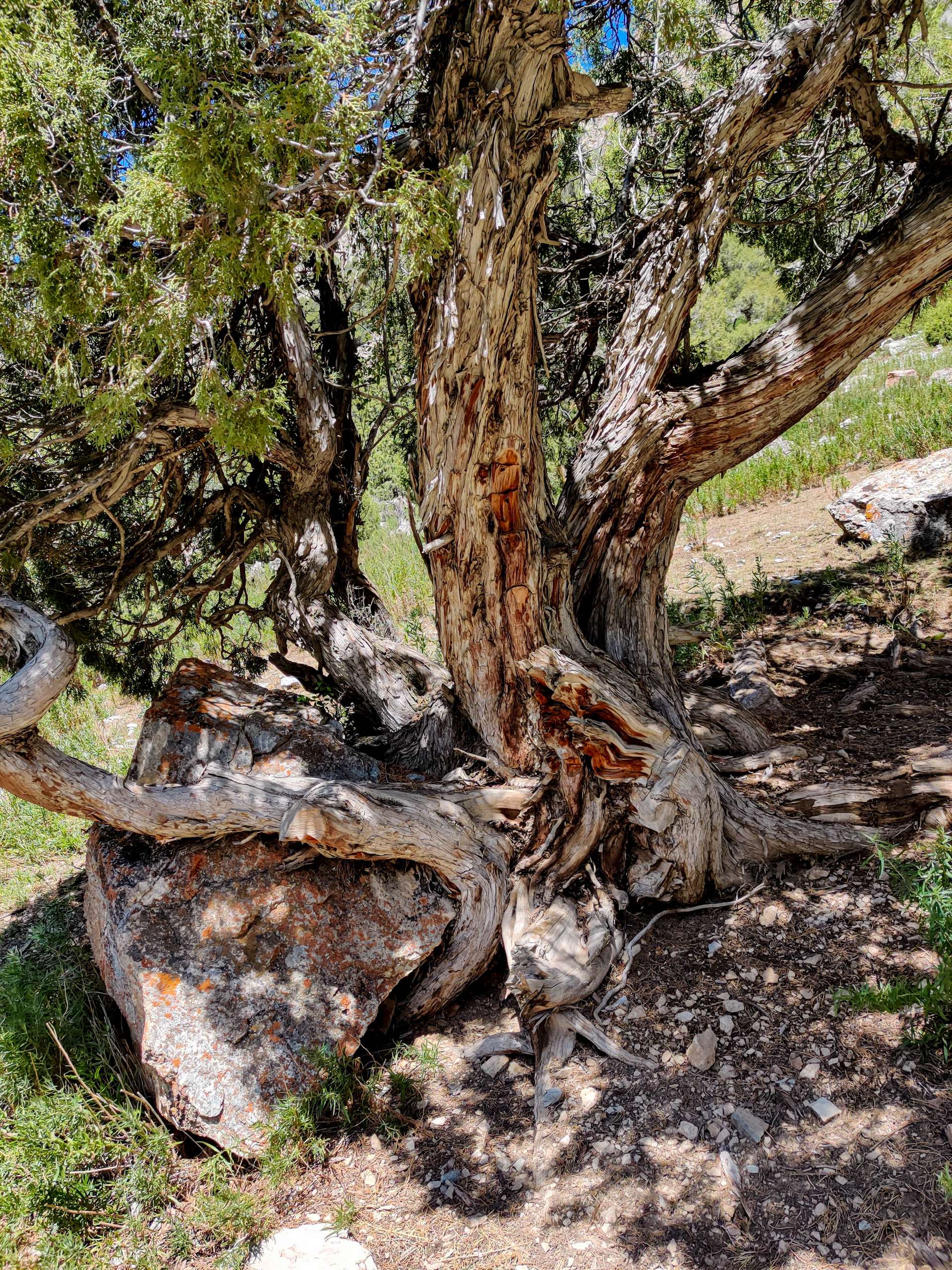
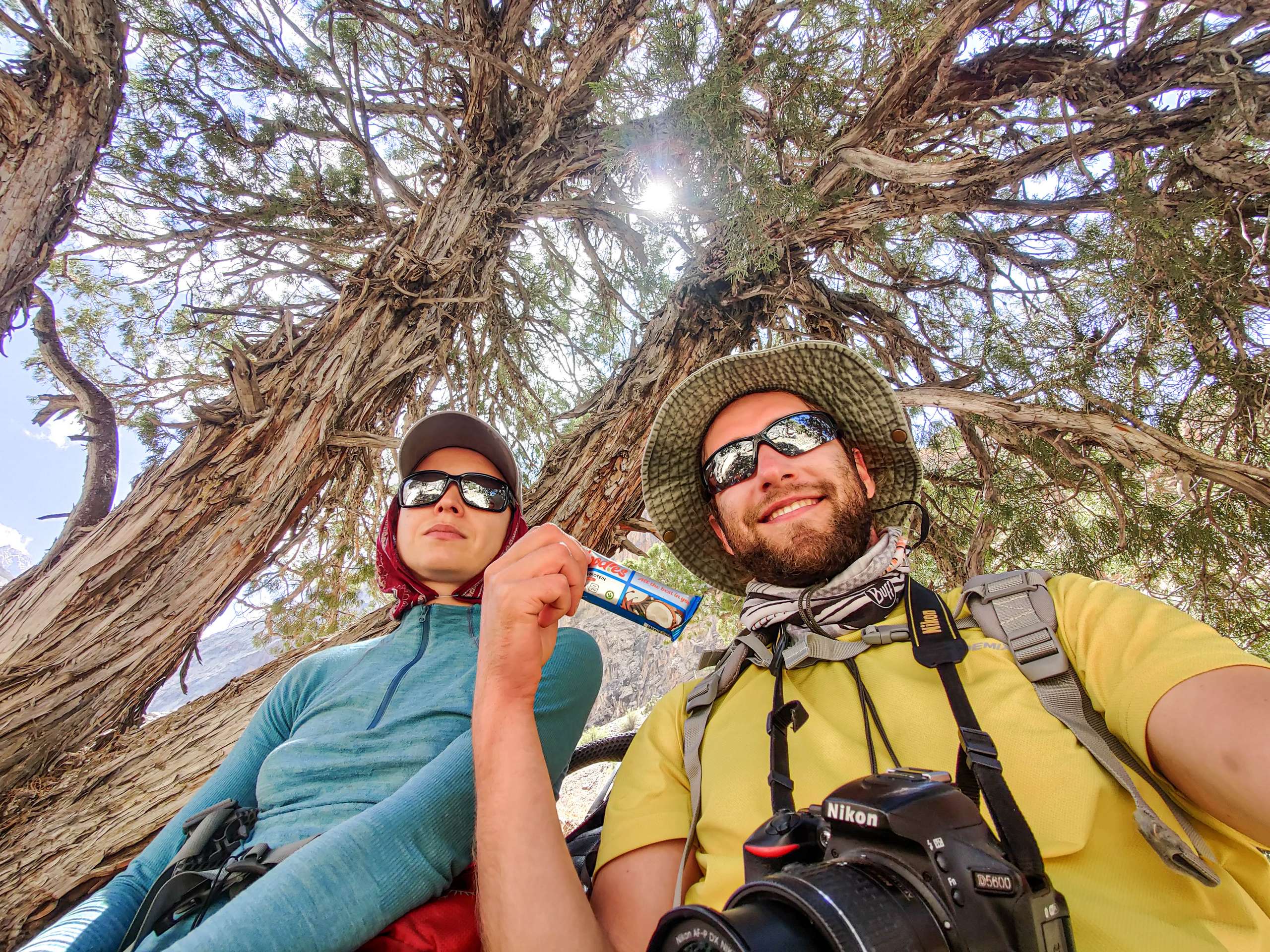
The ascent to Chukurak Pass (1A, 3175 m) is a steadily tiring climb. At first, the trail passes through an area of ancient (centuries-old?) junipers, whose roots cling to massive boulders. In the shade of one such juniper, we took a snack break with a protein bar at an altitude of 2900 m, around 11:00. Beyond this point, the trees disappeared along with the trail, forcing us to zigzag up the slope — a grueling and exhausting effort. However, the view to the right revealed snowy peaks of the Fann Mountains, offering a stunning reward. It was also here that we spotted local ladybugs for the first time, strikingly bright red in color.
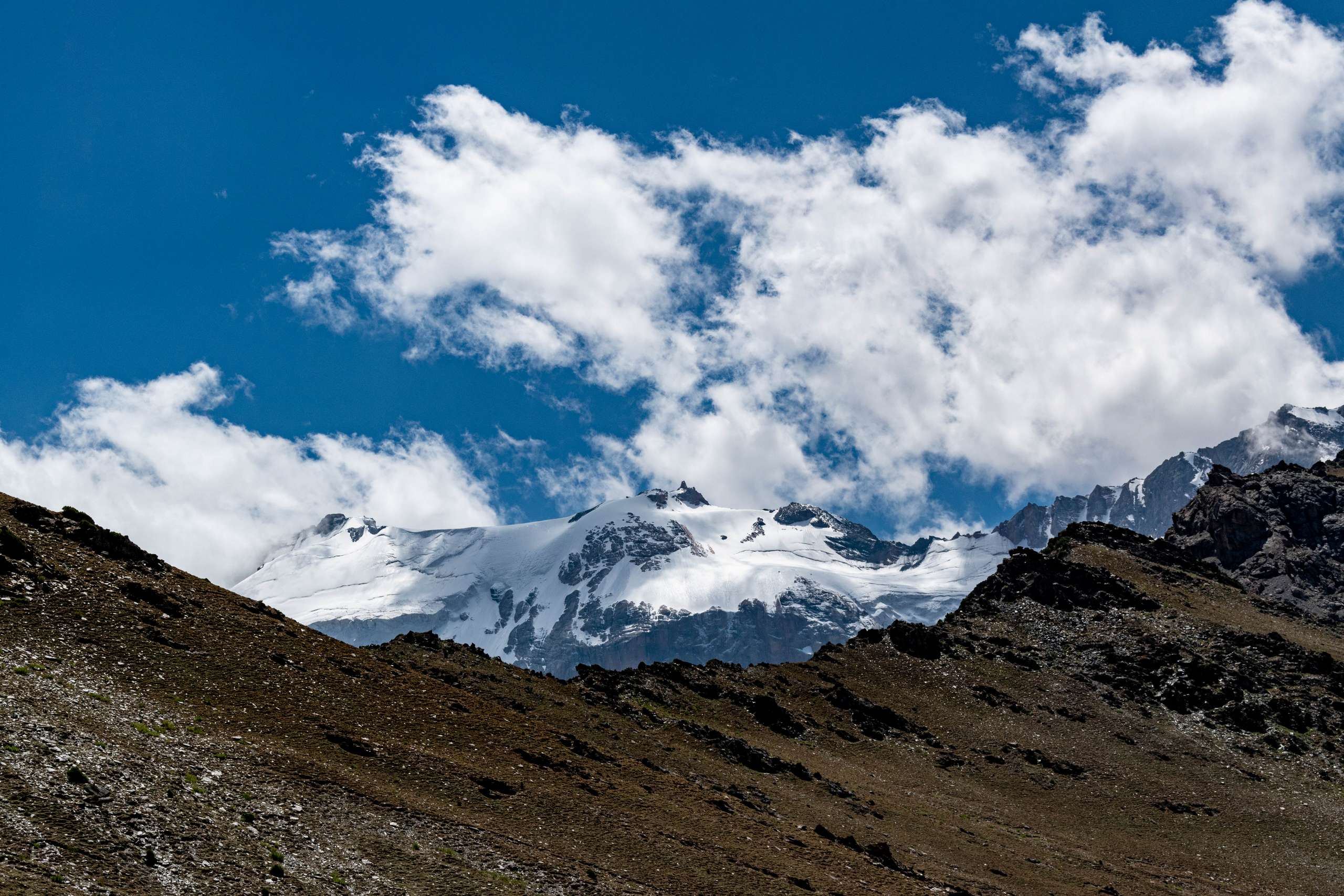
We spotted our camp guy on Chukurak Pass from afar. As we approached the saddle, he put on his backpack and started heading down, as if he had been waiting for us — but for what reason, we couldn’t say.
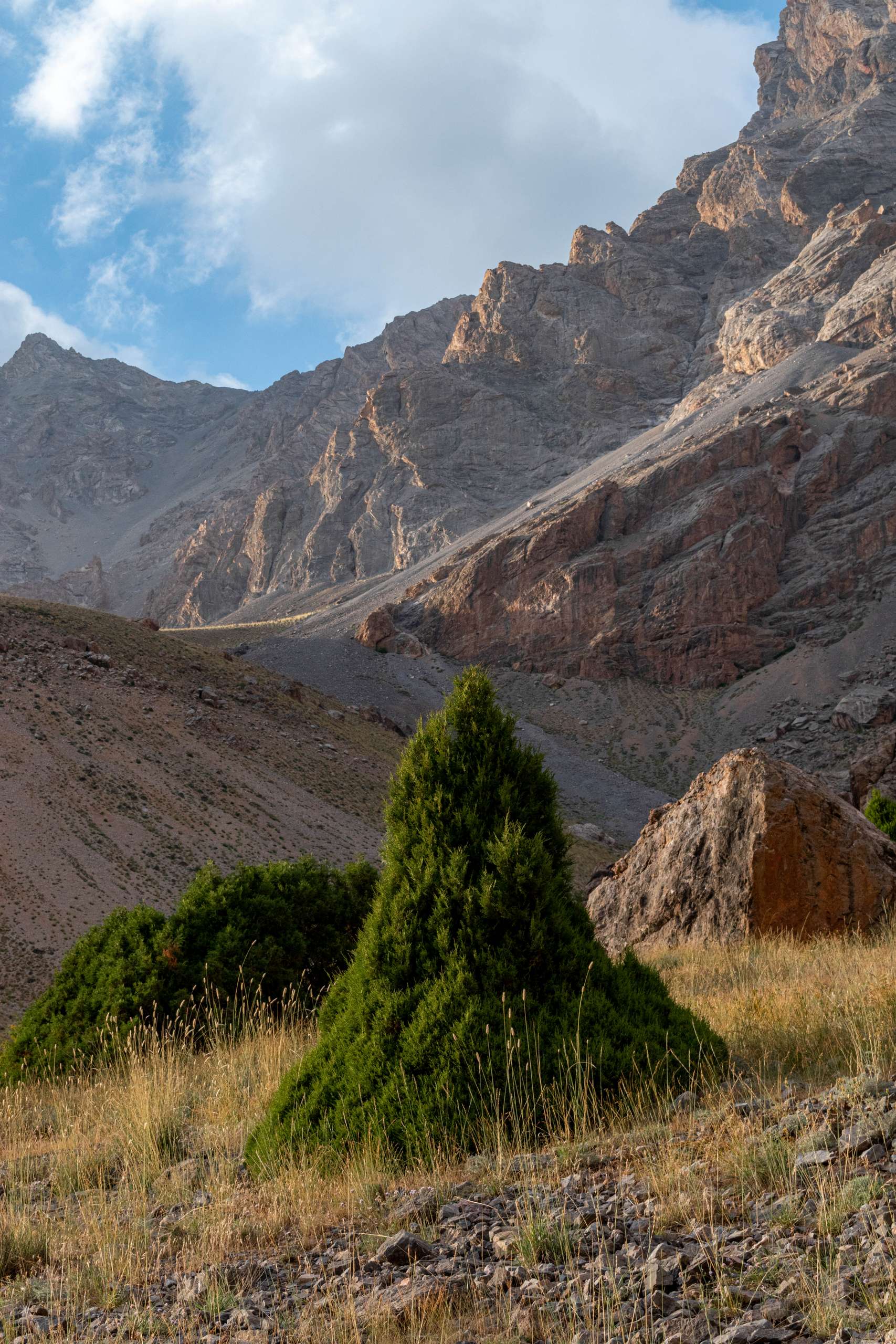
We reached the pass at 13:00, where a breathtaking view of the valley unfolded before us. It featured the lakes Kulikalon, Kulisiyokh, Bibijonat, and several smaller ones. The land in the valley and the surrounding cliffs were a grayish beige, dotted with dark green patches of juniper trees with sharply defined contours. Scattered throughout were the azure waters of the lakes, adding to the valley’s stunning beauty.
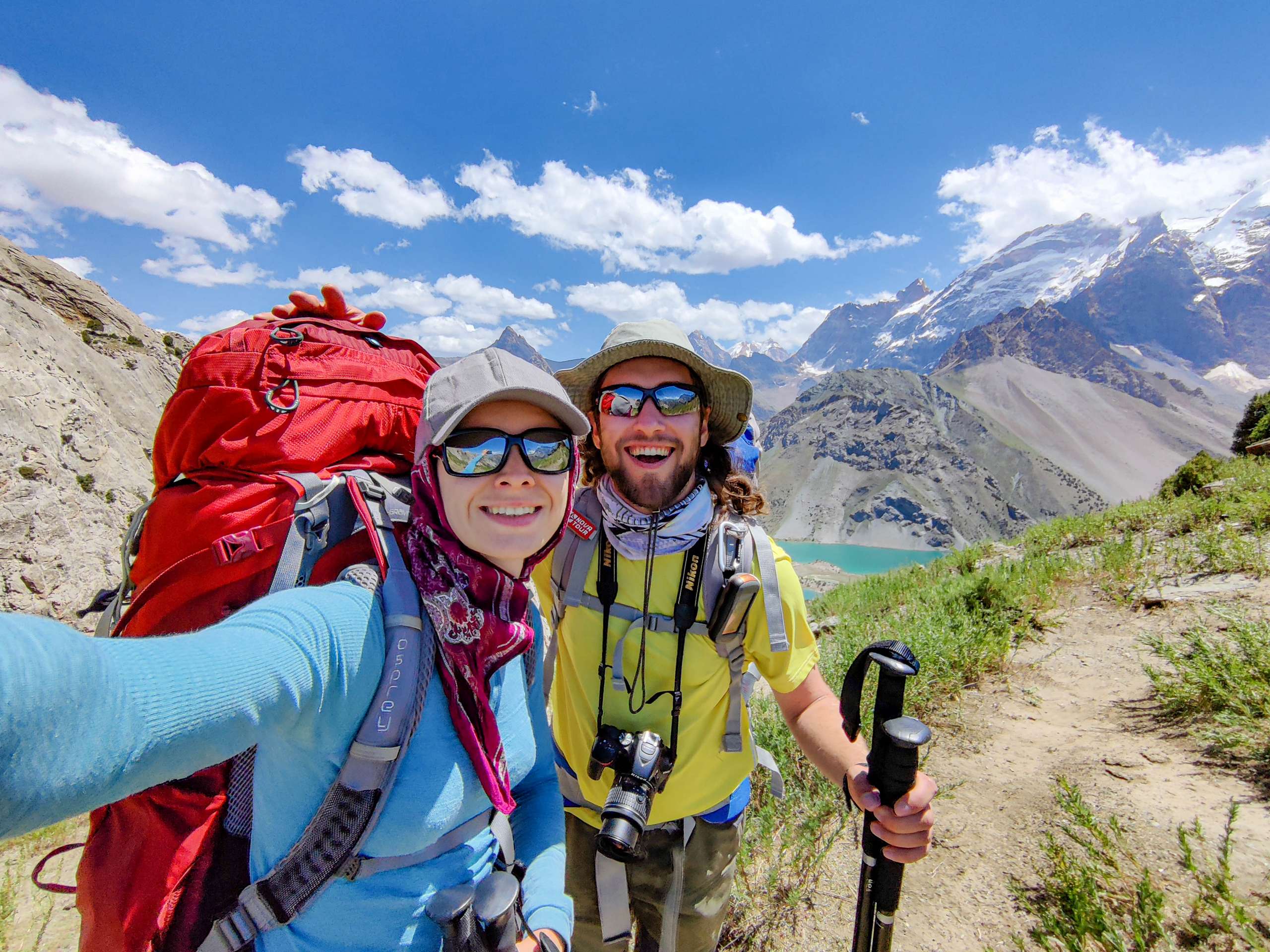
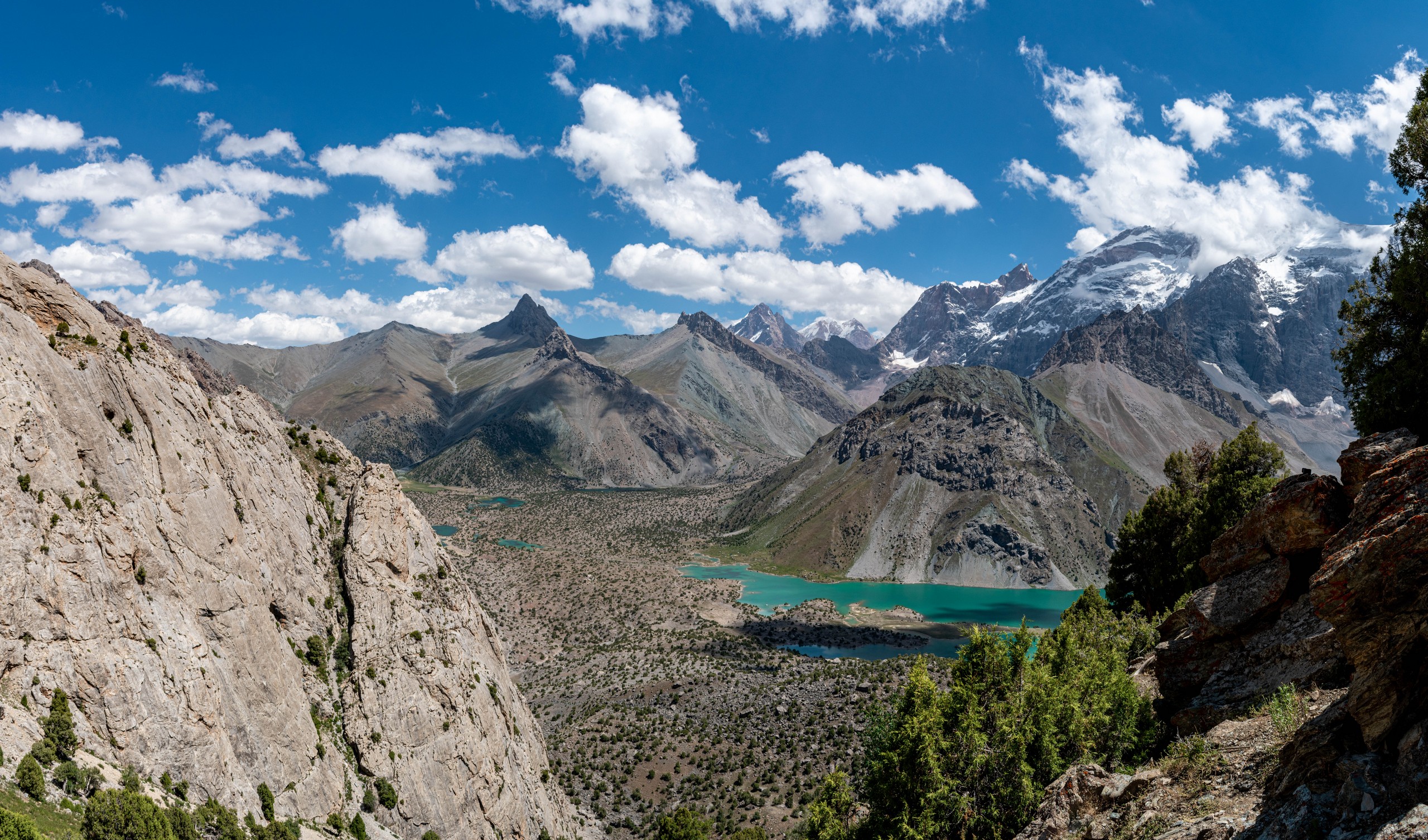
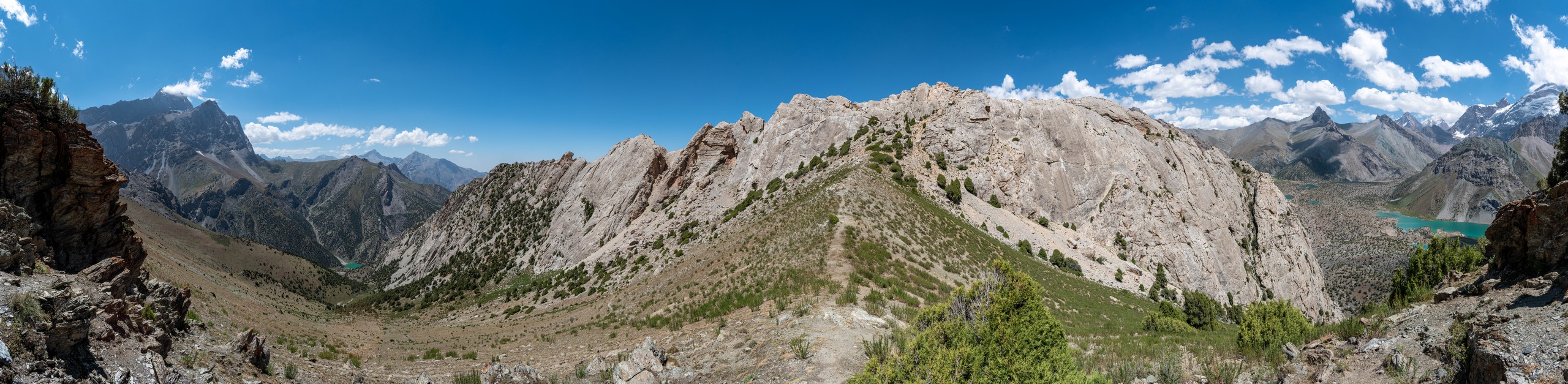
We had a snack at the Chukurak Pass — hot tea and sandwiches with basturma. While we ate, a timelapse was being recorded:
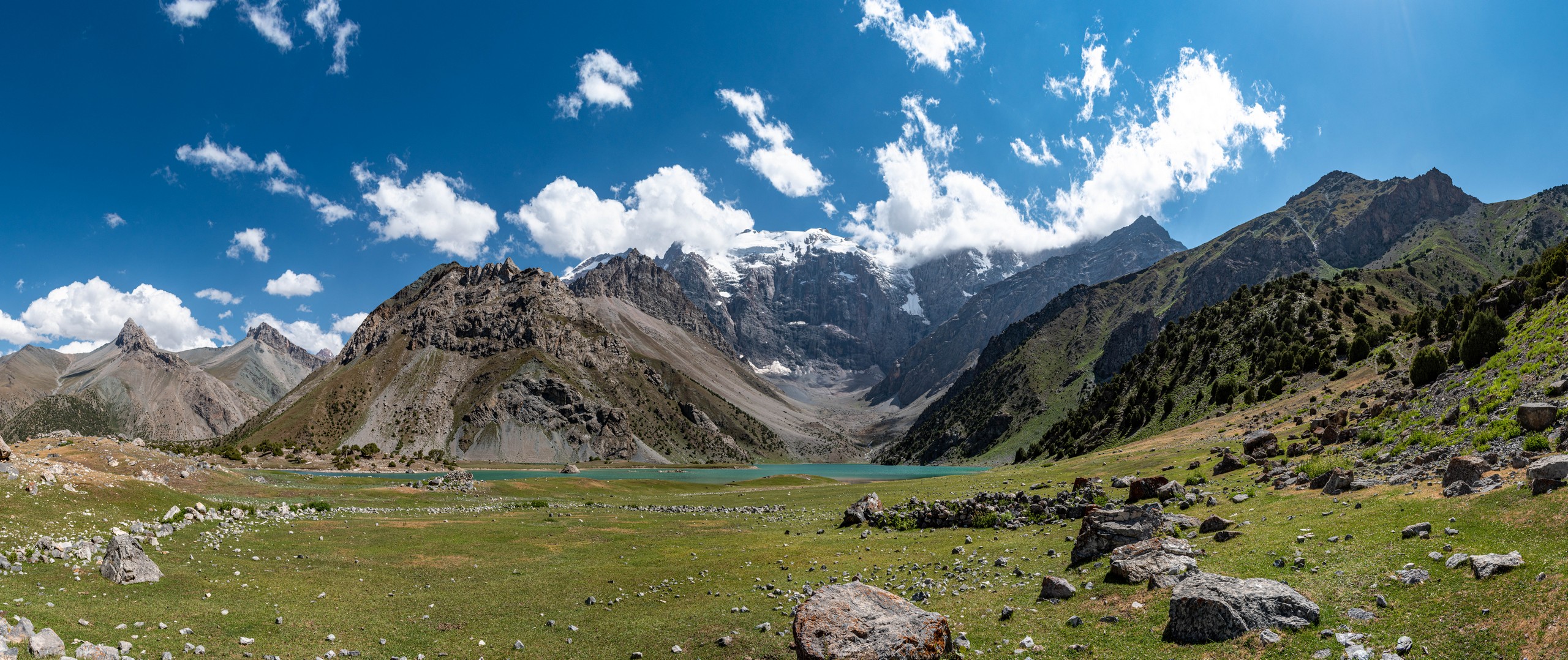
By 13:30, we continued our journey. The descent was easy and scenic, with a well-defined trail winding through the valley, passing from one lake to the next among the trees. Our plan for the rest of the day was to circle the lakes and reach the teahouse at the start of Bibijonat Lake to see what they were selling and possibly have a bite to eat. The whole way, we were dreaming of pilaf or kebabs.
At the end of the descent, as we approached Kulikalon Lake, we encountered two older men hiking lightly toward Chukurak Pass. It turned out they were Belgians, trekking from the “Vertical” base camp to Artuch. They were tackling two passes in one day — Alaudin (easy, 3780 m) and Chukurak (1A, 3175 m) — which seemed quite intense to us. They advised us against drinking water from the valley’s lakes, congratulated us on the beautiful campsite awaiting us that night, and finally asked where we were from. Upon hearing we were from Russia, they seemed to move on rather quickly — or so it felt to us.
At Kulikalon Lake, battling the heat, we soaked our heads and filtered some water to take with us. We didn’t feel like swimming, as we had expected hotter weather in the Fann Mountains based on internet reports. Overall, it’s warmer than Arkhyz, even though the altitude is significantly higher, but there’s no extreme heat, and the water in our bottles doesn’t turn into boiling hot liquid.
Next, we faced two river crossings, one larger and one smaller. We switched to slippers, crossed them, and captured it on camera.
From the other side of the lake, a local woman was shouting something to us, likely offering food or drinks. However, we were already very tired — probably due to acclimatization, the altitude, and our heavy backpacks, as it was just the beginning of the trek and we were carrying plenty of food. So, ignoring the woman, we moved straight on toward the teahouse.
A whole caravan of locals with a bunch of children was heading toward us. Donkeys loaded with belongings wandered among them. We exchanged greetings, and the head of the family asked where we were heading and where we were from. Confidently, but with no luck that people know this city, we replied that we were from Zhukovsky. Surprisingly, all the locals had heard of this city thanks to its airport. The caravan wished us luck and continued on its way.
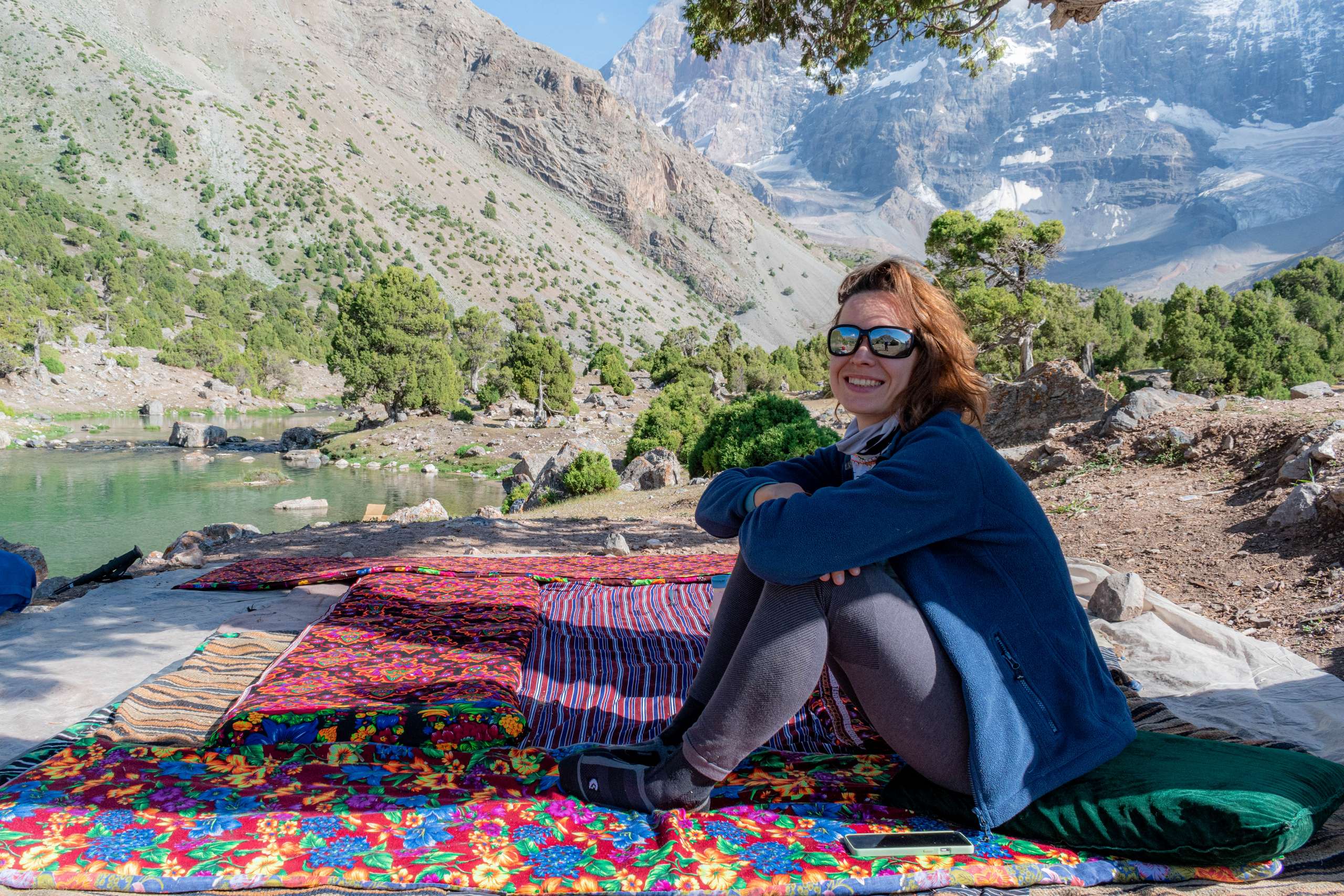
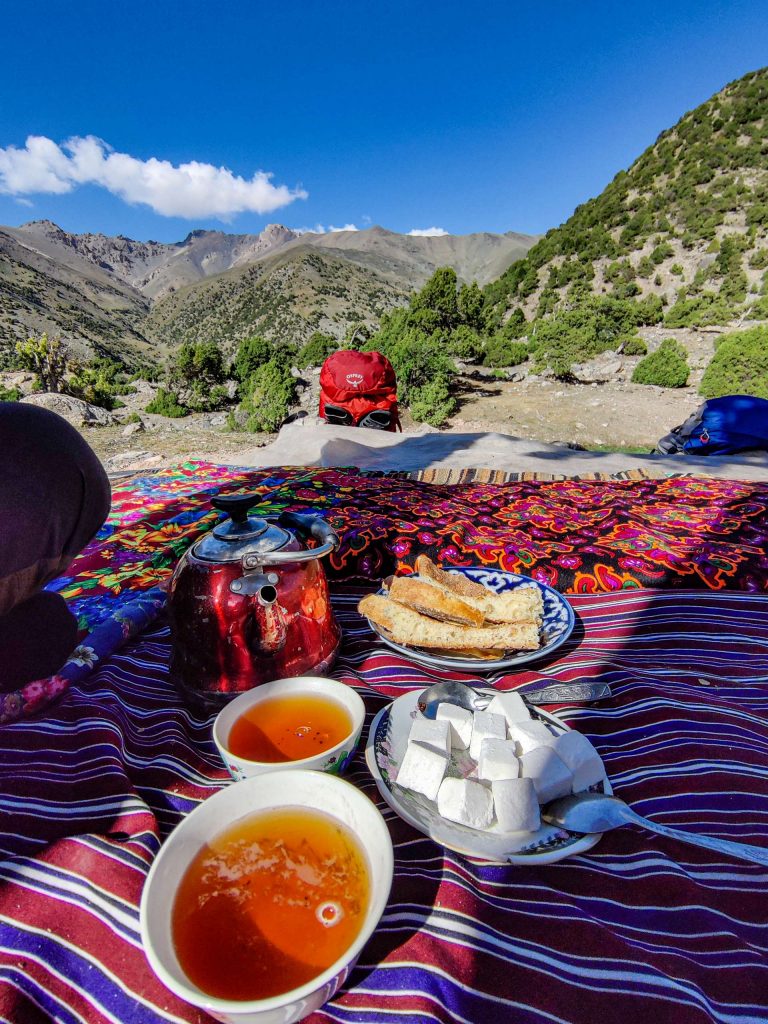
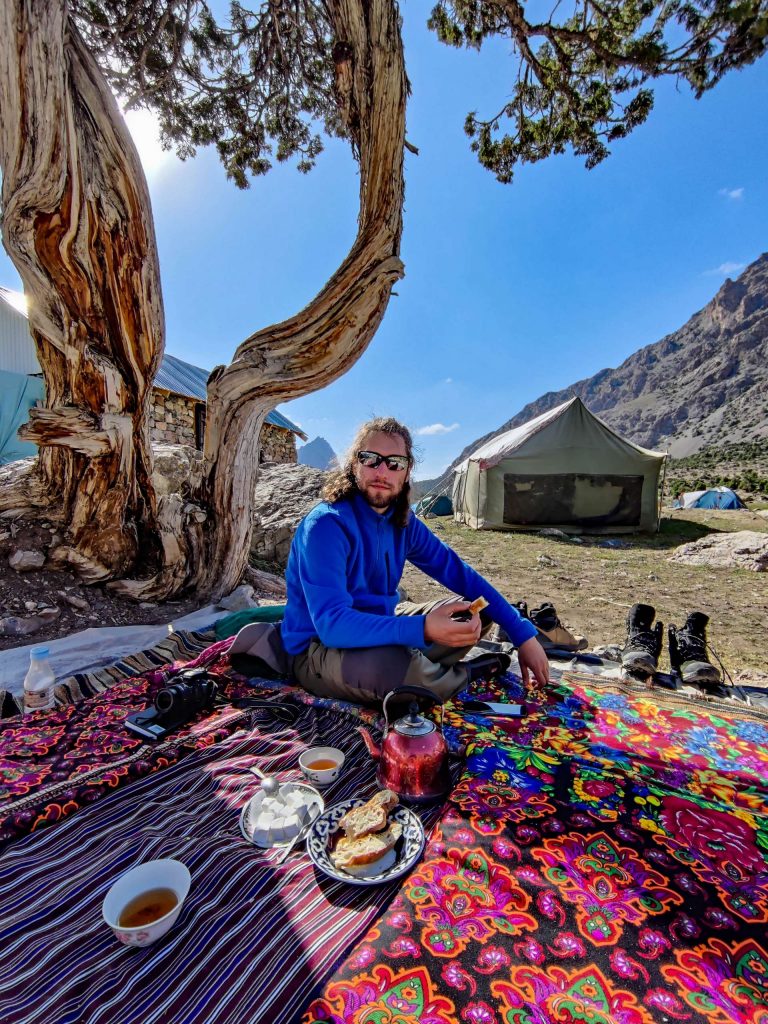
Teahouse “At Siroja’s” About 200 meters before reaching the teahouse, we started coming across girls in urban outfits taking selfies with the lake and mountains. Nearby, guys with tripods and eager eyes were running around, searching for the perfect spot for filming. Around the teahouse, there were many tents pitched by a commercial Russian tour group. At the doorstep, a local man (Siroja, perhaps?) greeted us warmly, inviting us to rest, relax, and pitch our tent on their site. He showed us a spring right on the premises and explained that food is brought up on donkeys from the valley below, an 8 km journey. However, it would take about two hours to prepare. For now, they had tea, watermelon, and alcohol available. We opted for tea, and they guided us to beautiful carpets laid out under a sprawling juniper tree. The place had a unique charm, offering a view of the river and mountains. They poured half a teapot of tea and served it with sliced but slightly stale flatbread, though it was presented in beautiful cups. There was also an unusual, very finely pressed sugar in small chunks that tasted faintly smoky. We rested for half an hour and then asked about the cost. He replied, “As much as you’re comfortable with.” We gave him 30 som (~$1.60 or 180 RUB). Before leaving, we asked about the best spots for camping and conditions on the Chimtarga Pass. He advised us to “take something to keep warm” and suggested we set up our tent on the far side of Lake Bibijonat, almost at the end. Following his recommendation, we set off.
By the way, at Lake Kulikalon, there’s a peninsula, and at its very tip, we spotted the tent of our camp neighbor. We didn’t encounter him again for the rest of the hike.
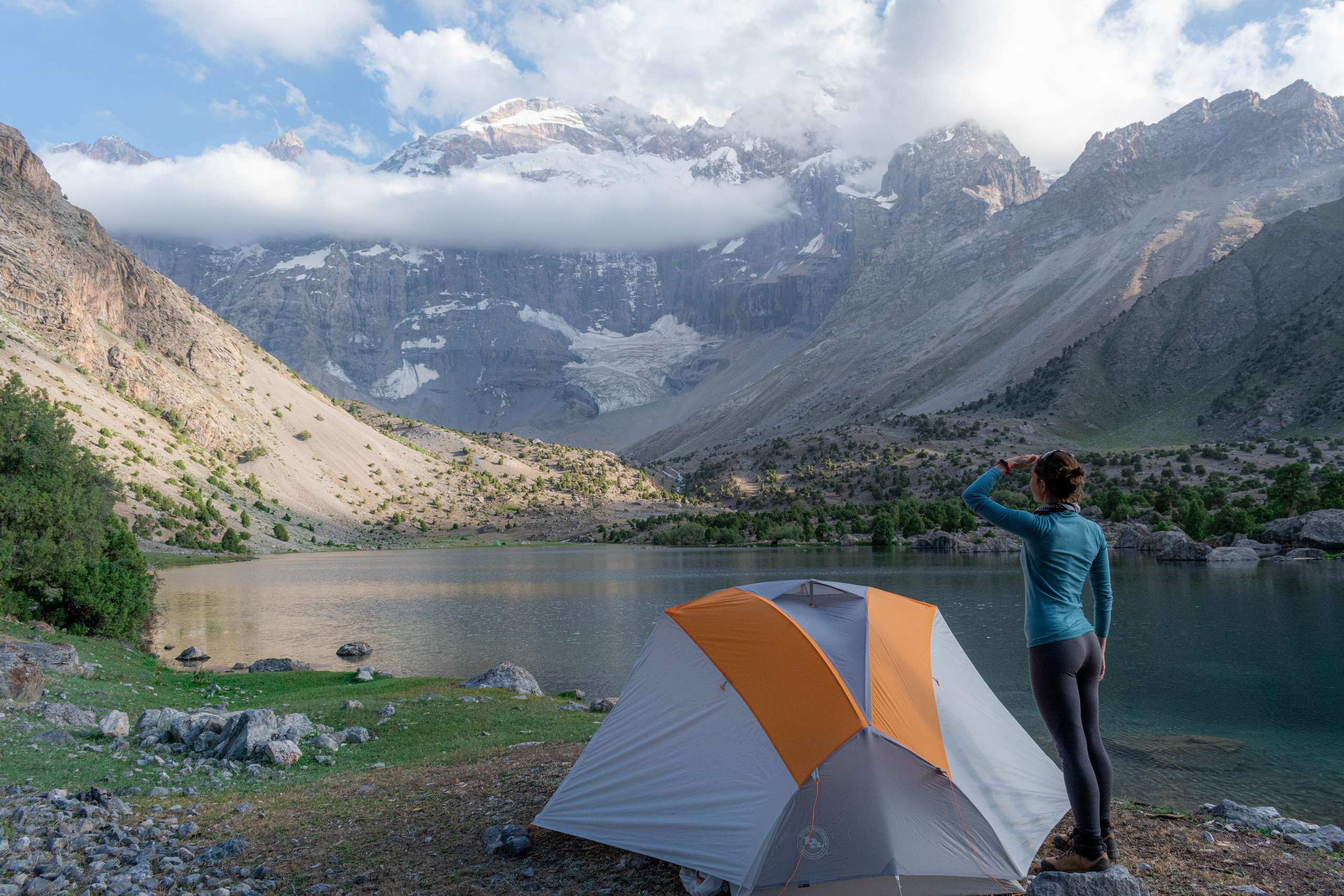
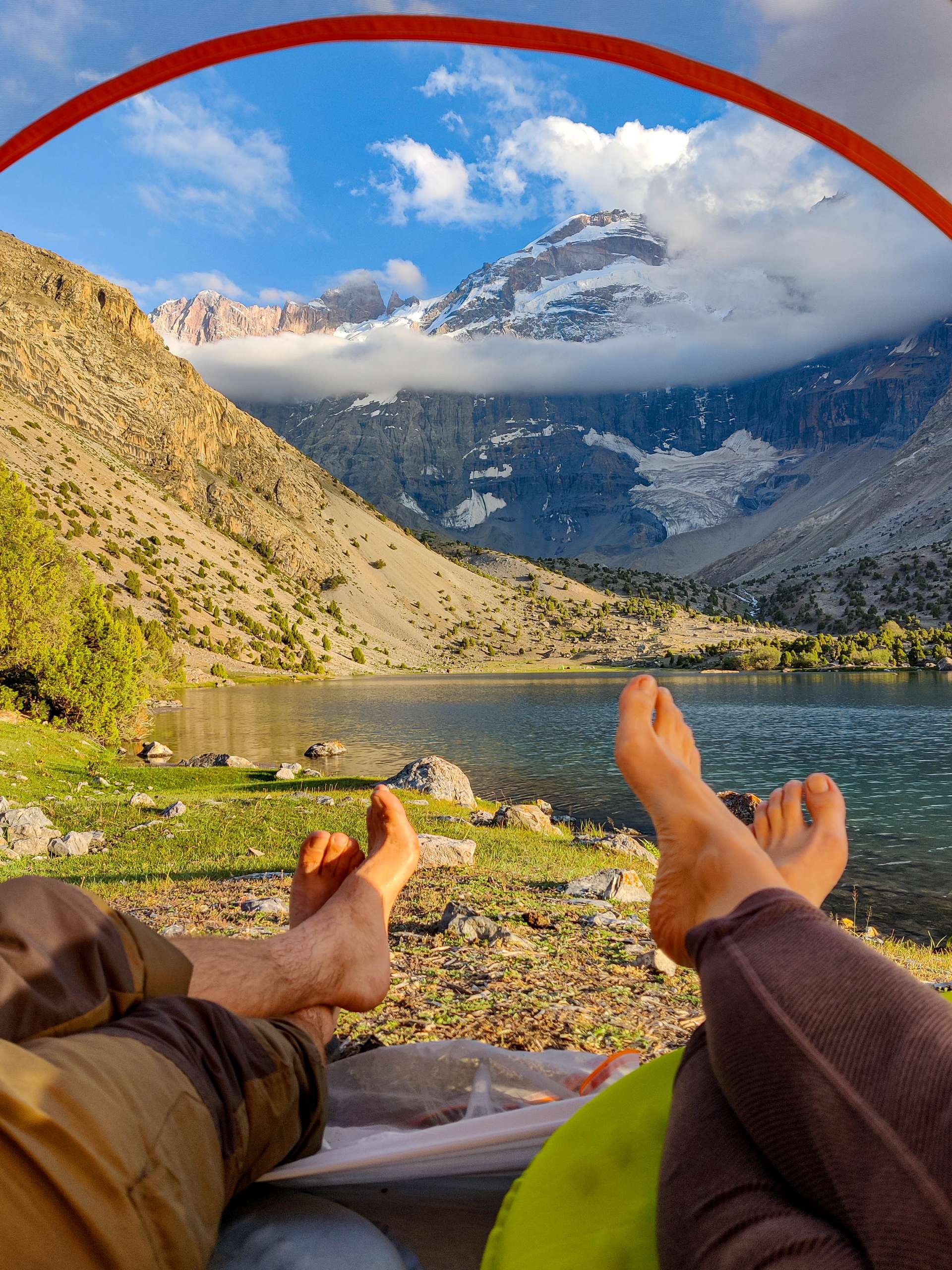
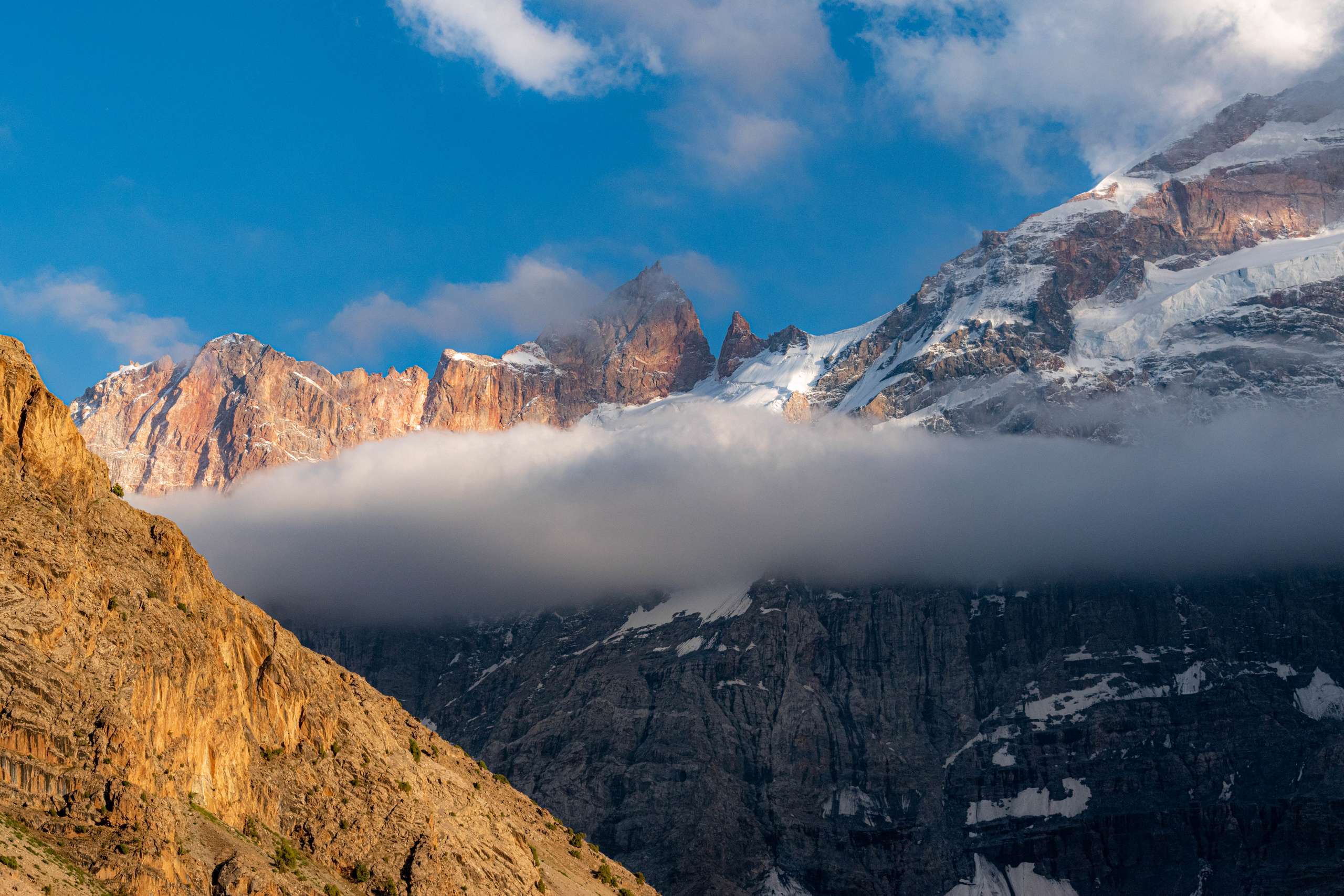
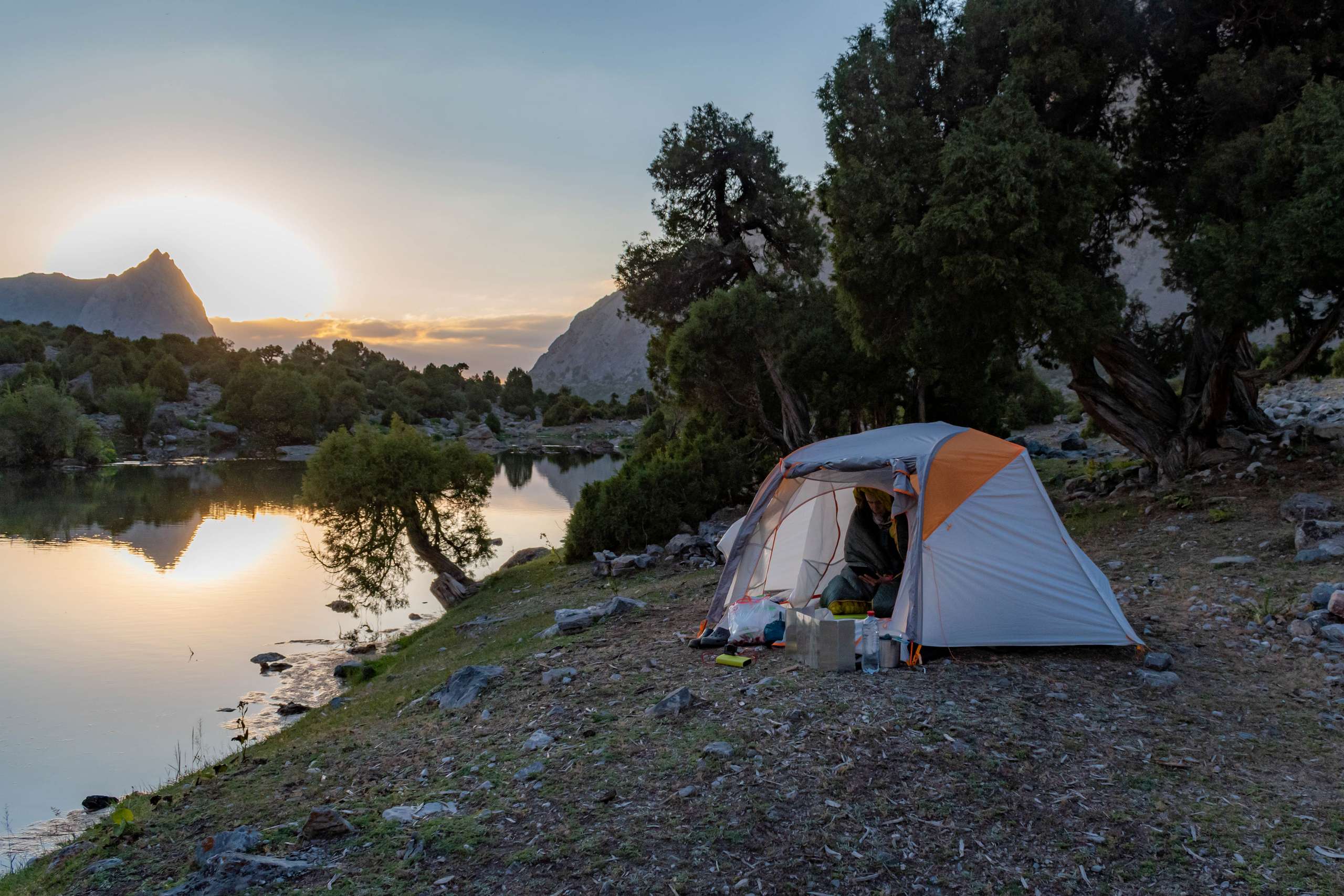
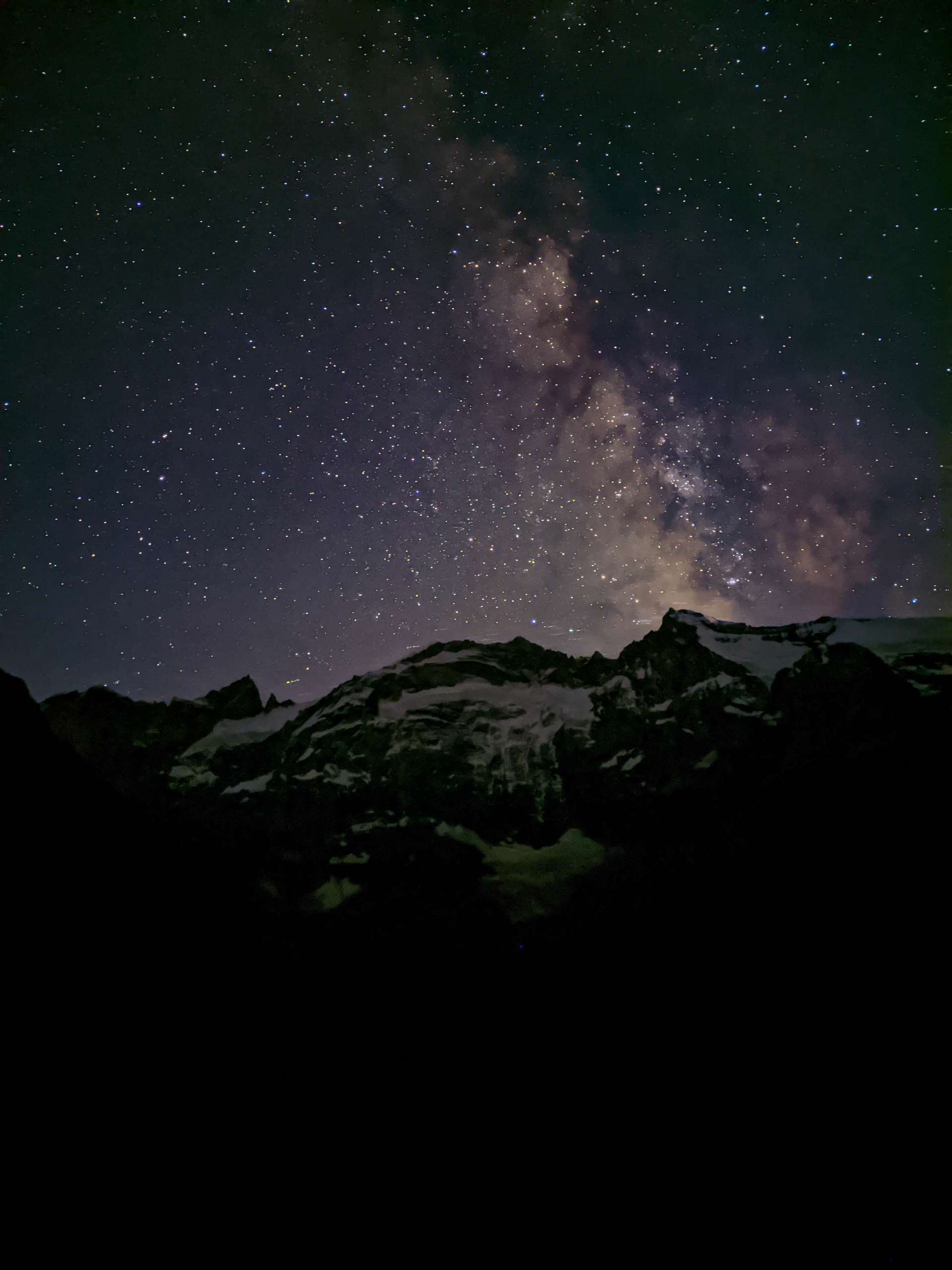
We crossed the river near the teahouse and continued along the mountain wall and Lake Bibijonat, searching for a campsite. Midway along the lake, we found an excellent meadow with a stunning view of the snowy peaks, where clouds gathered beneath the summits, visually splitting the mountains in half. By 18:00, we had set up the tent and started cooking soup with egg noodles, meat, vegetables, and croutons. Katya wasn’t feeling well due to her sore throat and the exhausting day, so she stayed in the tent reading a book. I waited for the stars to come out and at 22:20. captured an astrophoto of the snowy mountains under the night sky.
Day 3. 2022-08-05 Friday
The next day, we decided to take it easy and wake up a bit later, around 7:30–8:00. A challenging day awaited us, with almost a kilometer of elevation gain. First, we had to ascend 900 meters, followed by a descent of 990 meters, covering a total distance of about 8 km for the day. The Alauddin Pass is a non-graded (easy-grade) pass, but for us, it was quite high at 3780 meters.
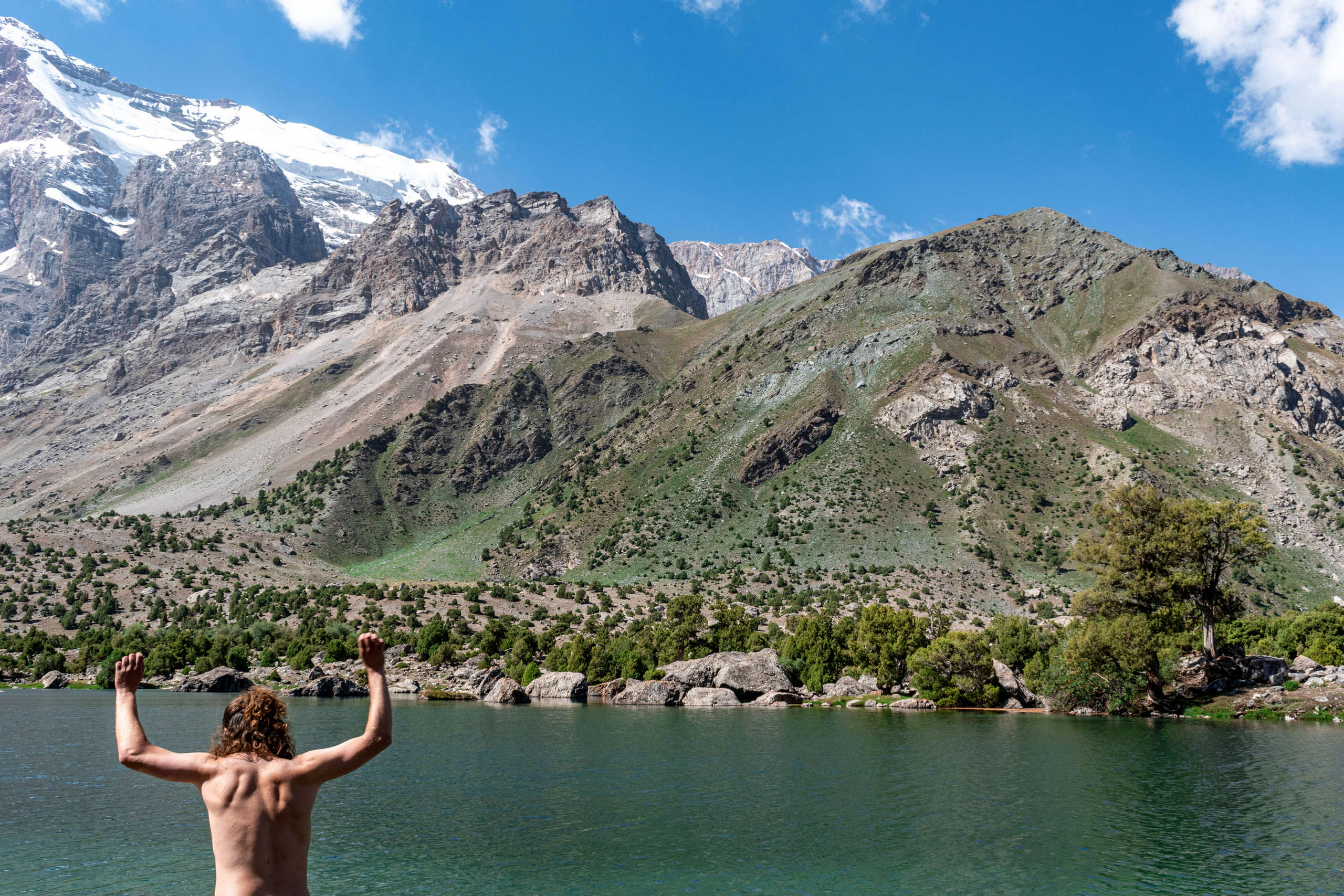
While we were packing up, a commercial tour group passed by on their way to the same pass. They admired the beauty of our campsite. At 10:11, we left the camp. Before heading out, after some intense packing in the sun, I took a dip in the lake — the water was freezing cold!
At the end of Lake Bibijonat, there is a stream flowing from the Dushakha lakes, which seem to form from the melting ice and snow. There, we decided to collect water for the upcoming ascent. Near the stream, there was a camp with a couple of RedFox tents and one giant one, like the Soviet ones. The only inhabitant of the camp, a local man in a traditional robe, greeted us. Apparently, he watches over the camp while the group climbs the mountains. We asked him about the water quality and the best route to take to the pass. We could go through the Dushakha lakes — this route would be longer — or we could go between the mountain wall and the stream directly upwards. Following his advice, we chose the second option, and after collecting filtered water, we began the ascent.
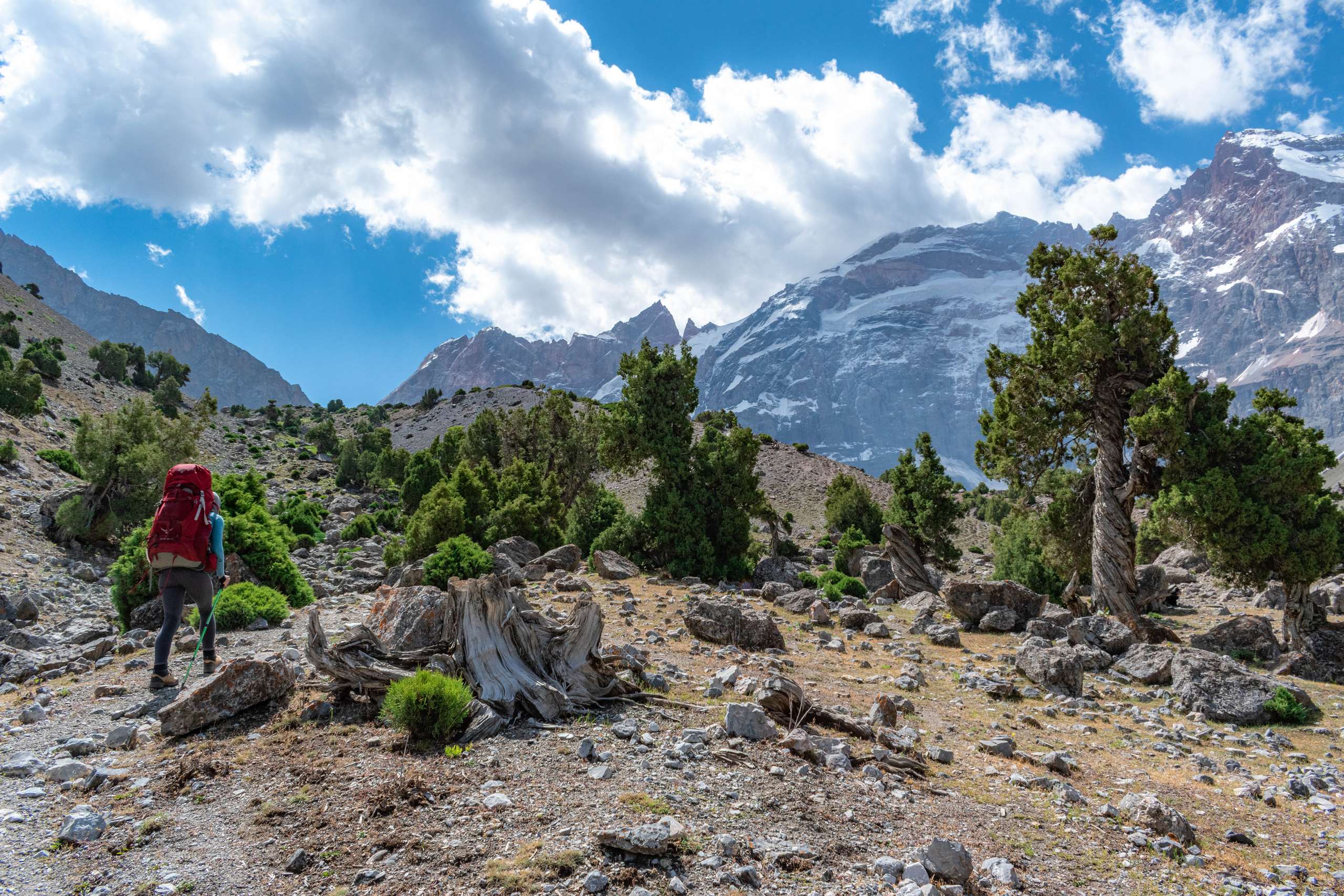
At first, I was walking very briskly, while Katya, on the other hand, was extremely sluggish. However, as we got closer to the saddle of the pass, the situation changed drastically, probably because the altitude was affecting me in a not-so-good way.
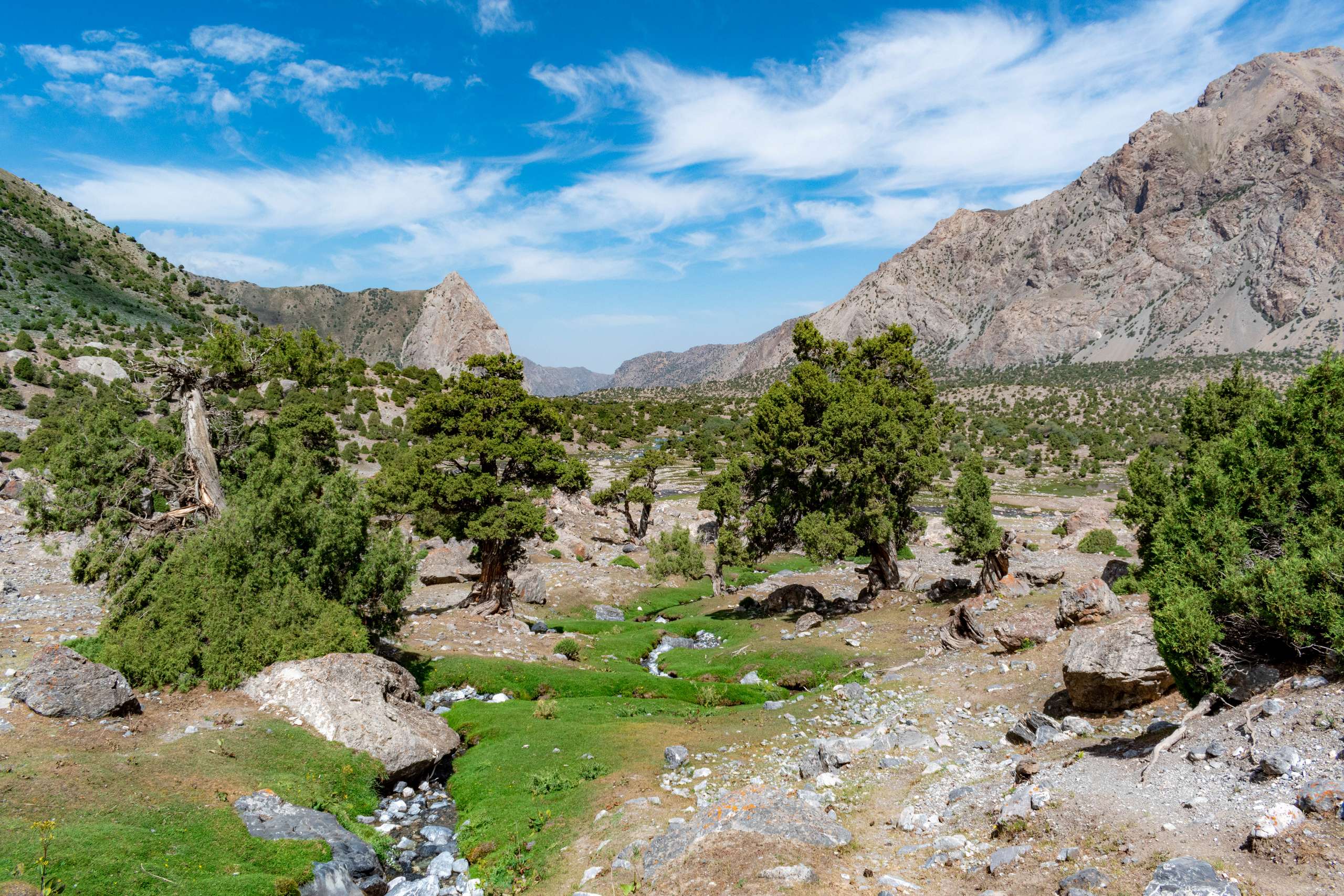
After climbing slightly from the stream, we entered The Shire — lush green hills with a stream running between them. Higher up, the stones and junipers begin, and most importantly, the view opens up to the Dushakha lakes and the entire valley. In the distance, we spotted the Chukurak pass, which we had conquered yesterday. The sight is impressive, a very high, sheer cliff. And what is of most interest is that to the right, it is bordered by a mountain, after which there is a steep drop into the Artuch River valley. So, it would be much easier to come from the Artuch camp along the river, bypassing the passes. But then, you wouldn’t get such breathtaking views.
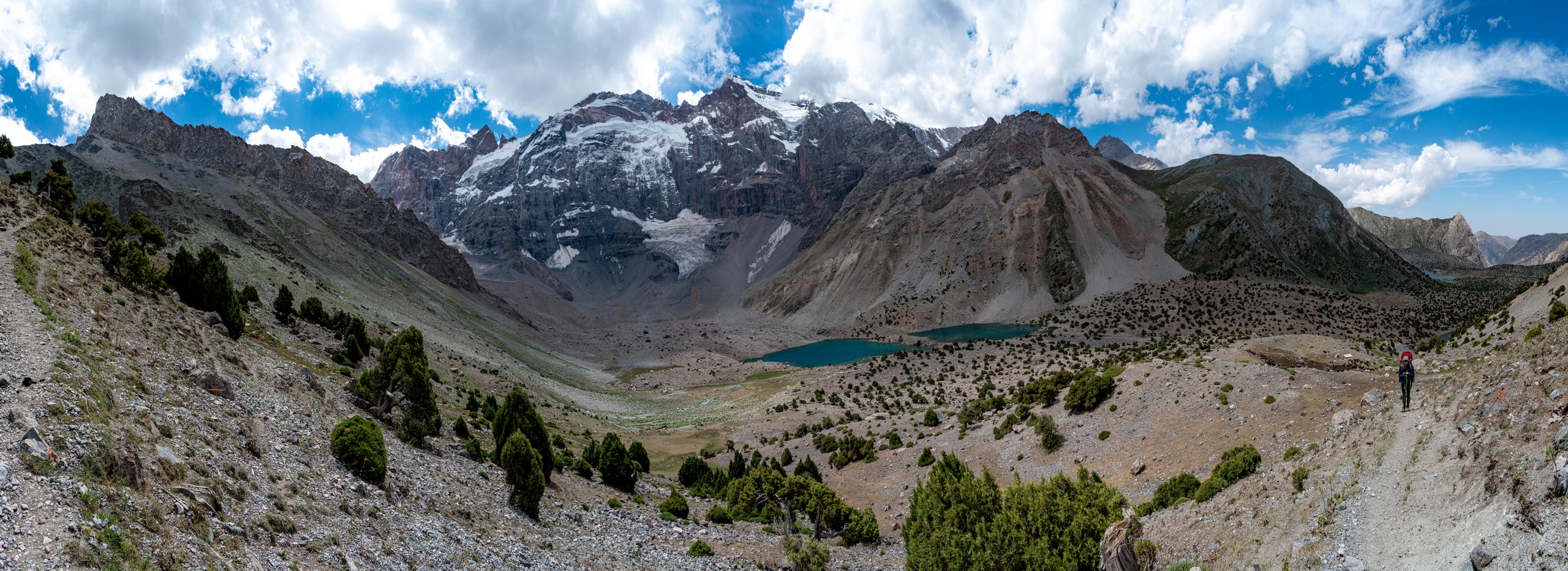
The last photo on my phone before the pass was taken at 11:47 — it is a view of the Dushakha lakes from an altitude of 3140 m. The photo at the pass, 3780 m, was taken at 14:12. In this time frame, there were 2.5 hours of suffering during the climb. Around 13:00, the clouds started to gather, and we really didn’t want to find ourselves on the pass in bad weather again (we had been caught in a thunderstorm in Arkhyz at the Agur pass a few years before).
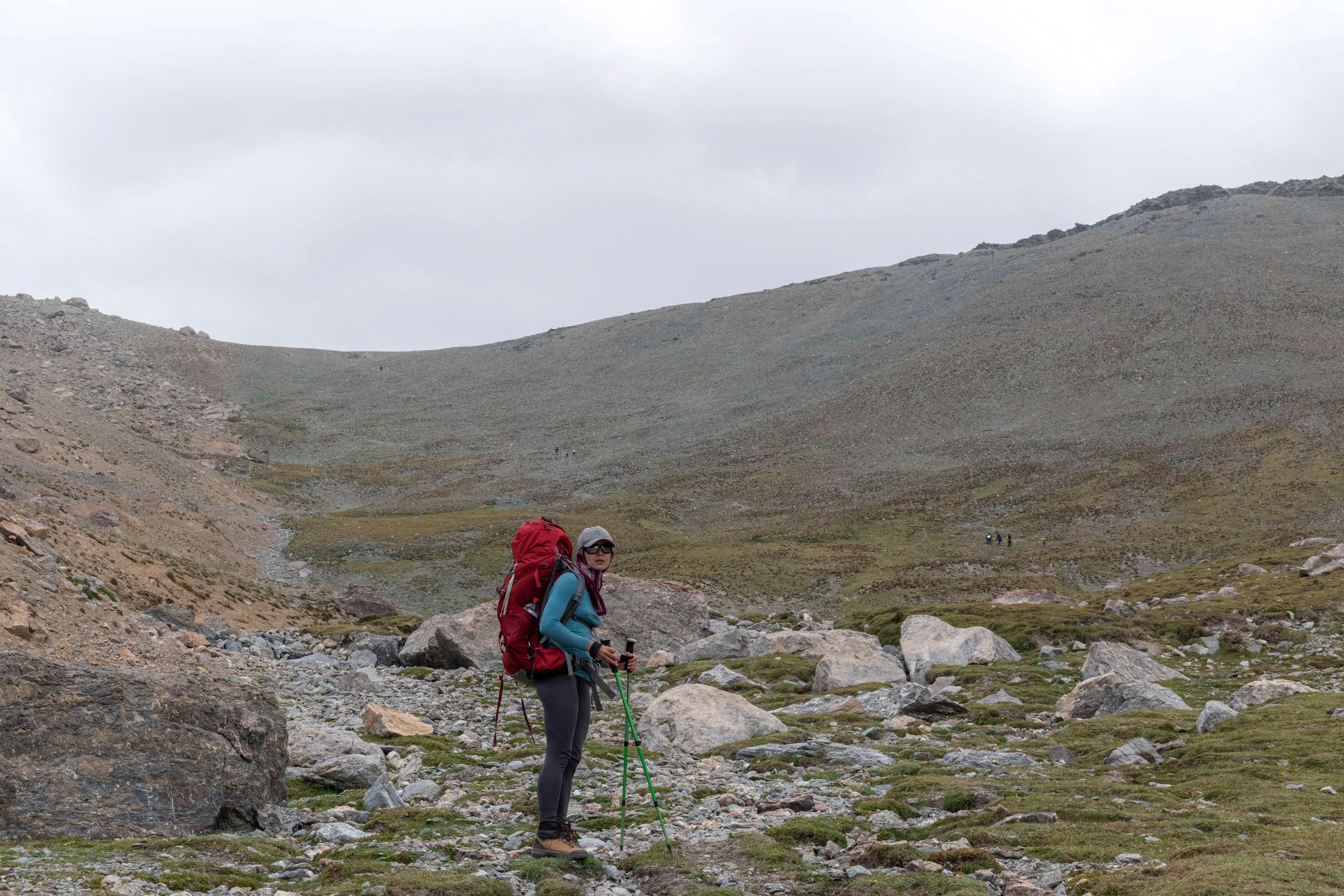
About 300 meters in altitude from the pass, we caught up with a commercial tour group. The guide was waiting for a slow-moving woman from the group. The guide was from Moscow and wearing a buff from Rosa Khutor. We exchanged a few words, told them about our route, and asked if the ascent to Chimtarga would be as difficult as this one. She replied, “Yes, it’s just as tough.”
We quickly ascended to the pass, as the fear of bad weather gave a good boost to our pace. As soon as we stepped onto the pass and saw the next valley with Lake Chapdara (Alaudin Lake), hail began to fall from the sky, and a strong wind picked up. We took a couple of photos and videos at the summit and hurriedly ran down.
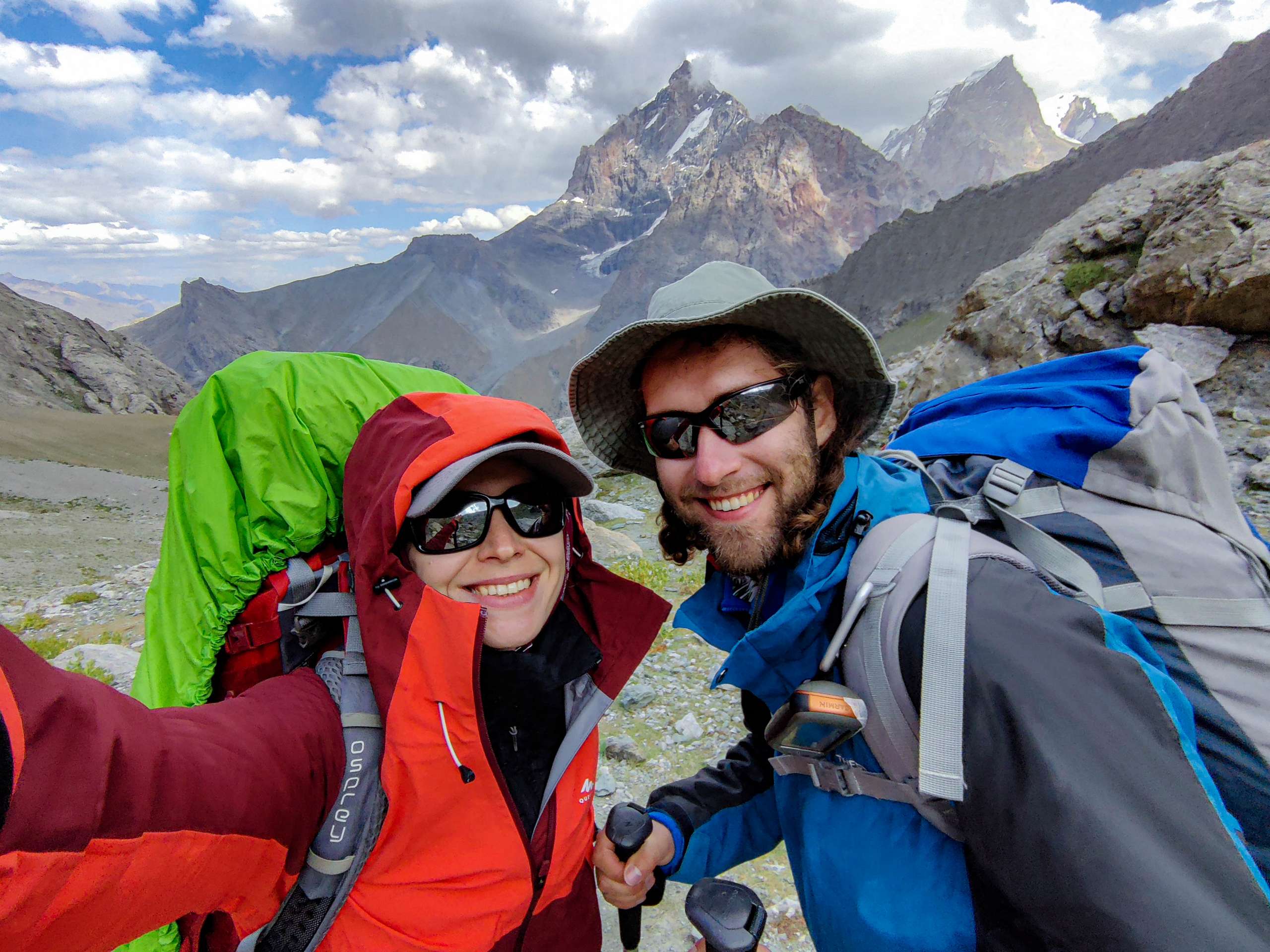
The descent from the Alaudin Pass was also tedious, as the trail went at a steep incline with some loose scree, keeping our legs constantly tense. We still had to descend 1 km in altitude. The wind and drizzle didn’t let up, and it was chilly and cold, plus we were hungry since it was already past lunchtime. Somewhere in the middle of the descent, around 15:00, we found shelter from the wind behind some rocks and prepared lunch. Couscous with extremly spicy chili con carne from Kronidov, and of course, we didn’t forget about tea — fortunately, we had collected plenty of water before the ascent and managed to bring it here since there was no water available. Despite the hot meal, we were frozen to the bone from the wind and only warmed up by the end of the descent. While we were having lunch, the guide caught up with us, asked more about our hike — how many days, what our plans were. We asked again about the Chimtarga Pass, wondering if the altitude would make it more difficult for us. She replied, “Well, if you’ve never been at that height before, then yes. You’re carrying backpacks too… maybe take a donkey to carry your things up there.” The idea of hiking through the Chimtarga Pass was becoming more and more challenging for us. Moreover, according to some reports, helmets were required, which we had decided not to bring.
The rest of the descent, the chilli con carne we ate was a strong reminder of itself, not in a good way. At an altitude of 3180 m, there is a fork in the trail. To the left, the trail leads to the left side of the lake and to another teahouse. To the right, the trail goes to the right (southern) side of the lake, where the campsites are located. We had already visited one such teahouse, so we decided to head straight to the campsite. This was probably a mistake, as the trail in the second half was very steep and loose, and after an entire day of hiking, our strength was running low.
We had spotted potential camping spots earlier from above, during the descent. The closest one was a large, nice meadow, already occupied by a group with about seven tents, plus a large white tent, likely belonging to the locals. On this meadow, there was a big barbecue grill, and donkeys were standing nearby. The next morning, we watched as all the tourists from the camp left with just light packs, leaving their tents behind. About 5-6 locals came and packed everything up for them, loading it onto 8 donkeys, and set off to the Alaudin Pass via our trail, where we had descended. Now that’s service!
Through a small strip of junipers, there was a second meadow for tents with a large fire pit in the center, and we headed there, deciding not to greet the neighbors since we were completely out of energy. The meadow was heavily littered but overall suited us, especially given how exhausted we were. We arrived around 18:00. We dropped our backpacks and Katya went to scout a bit further along the shore. There she found the perfect spot for our tent. It was a small land curve into the lake, just big enough for one tent, and, most importantly, there were springs flowing from the ground into the lake! The water in the lake was smooth, but near the shore, there was a fairly strong current from the underground springs — hard to miss.
We had dinner and took a walk around the lake at sunset to warm up. Along the way, we met local girls playing by throwing rocks off a cliff into the lake for fun. After returning, we settled into the tent. I had a headache from the climb to the pass, especially when I have to bend over, but after taking ibuprofen, the pain went away. Katya had a sore throat and was completely exhausted from the day. Our morale had dropped to almost zero.
We started discussing what to do next. We wanted to enjoy the beauty around us, not exhaust ourselves with grueling pass crossings all day, only to end up lying in a tent at a stunning mountain lake, completely drained. One option was to stay at this lake until the end of the trek. Nearby, there’s the tourist base called “Vertical”, where we could likely rent a room, enjoy a shower, and get phone signal for the internet. We could also go on day hikes and reschedule our transfer to pick us up from “Vertical”. However, five days seemed too long for this plan.
According to our original itinerary, the next day was supposed to be a relatively easy — 5.2 km with a gradual 720 m elevation gain to 3500 m, where we would camp at the Mutnyi Lakes. Since we hadn’t yet camped at such an altitude, we decided to stick to the plan and head to the Mutnyi Lakes to gain this experience. If things got worse there, we could always easily return to the “Vertical”.
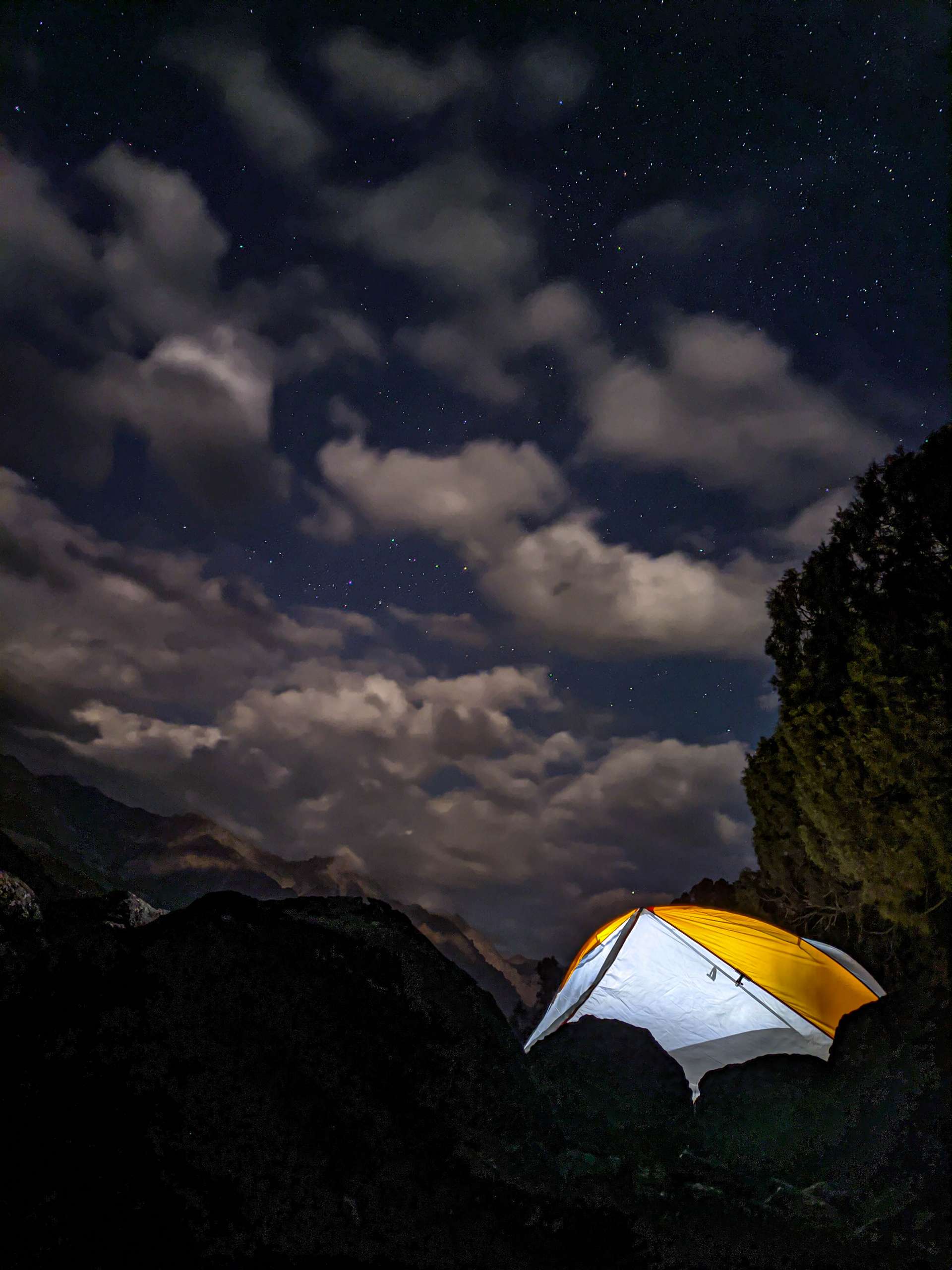
Before going to sleep, I waited for the stars to come out and took a couple of astrophotos, including some with our tent. Lights out was at 22:00. We fell asleep to the deafening cries of donkeys. It was a revelation for us just how devilish their screams sounded in the mountains. Incredibly loud, piercing, and almost otherworldly, likely amplified by the echoes bouncing off the surrounding peaks.
Day 4. 2022-08-06 Saturday
We woke up at 7:30 and step out of the tent. We were left speechless by the beauty — the lake is perfectly still, an ideal mirror, especially mesmerizing in the light of the rising sun. Every mountain, every tree is reflected in the glassy surface of the water.
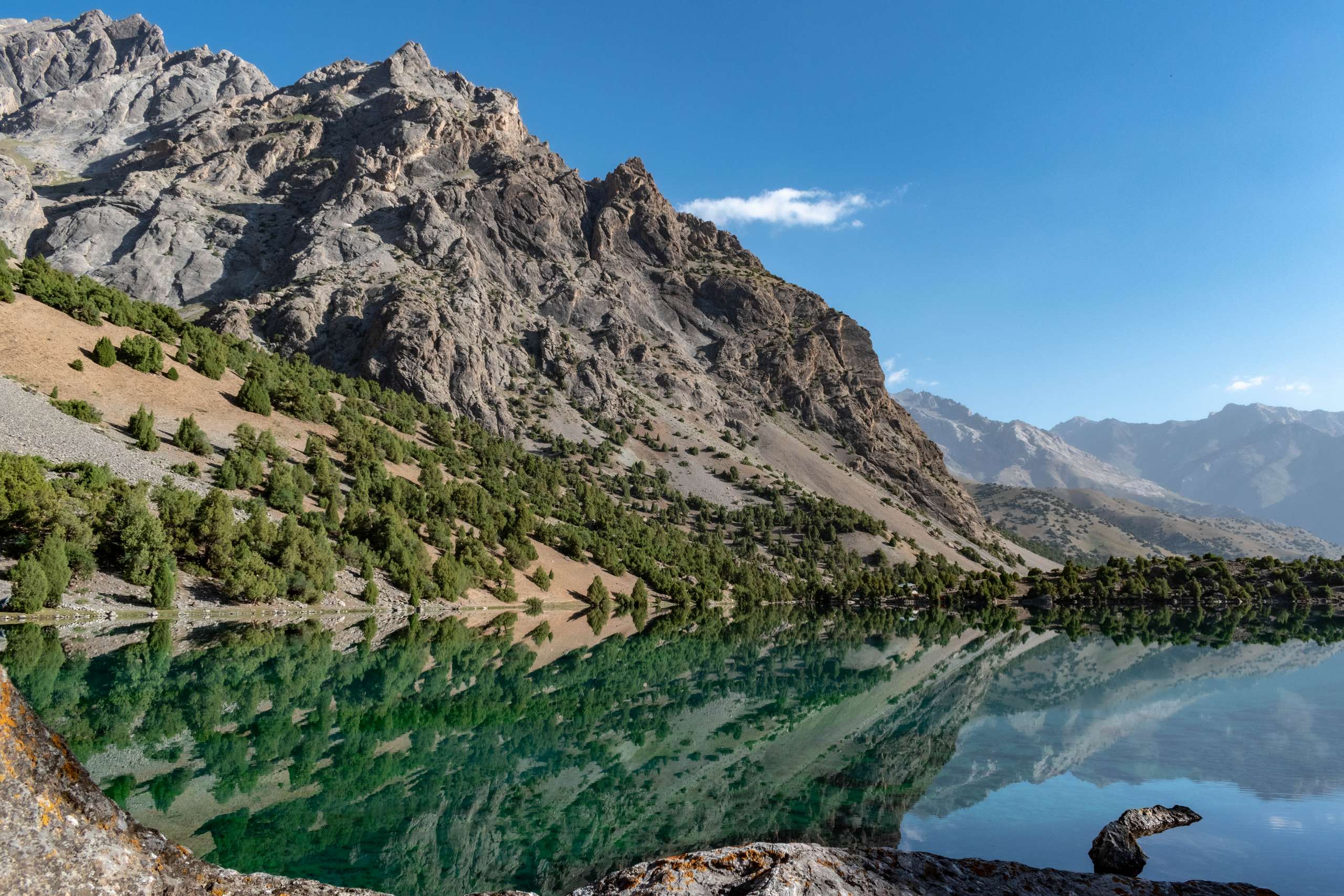
We took our time this morning — washing and drying socks, having a leisurely breakfast. Katya decided to dilute Octenisept in a bottle and gargle as often as possible throughout the day since her sore throat wasn’t getting any better.
While we were packing up, a curious little animal, most likely a stoat, ran up to us. It darted energetically over the rocks, approaching us from all sides, cutely tilting its tiny, delicate head. We tried tossing it bits of bread and getting closer, but it would immediately hide in the crevices.
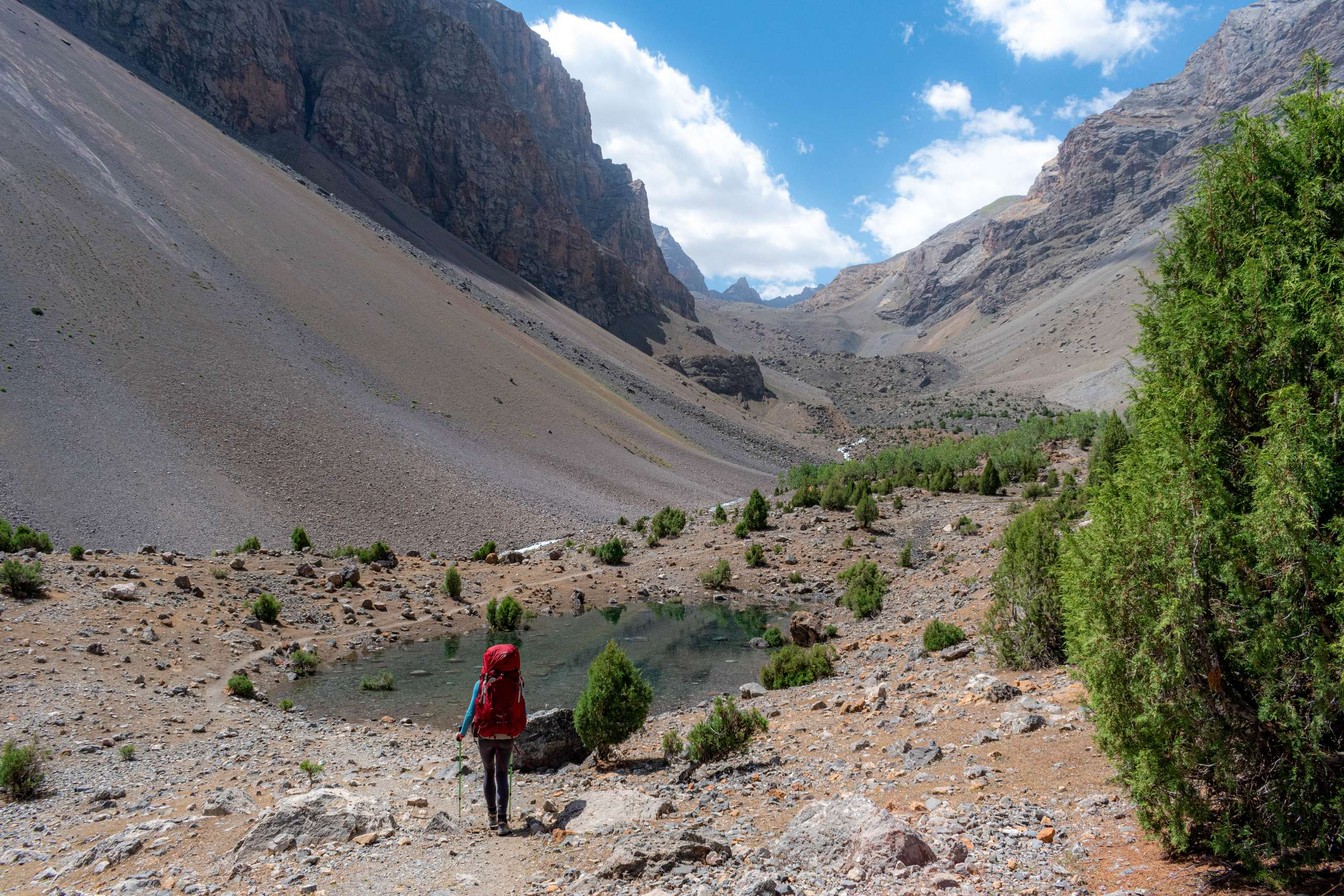
Around 10:00, we set off for the Mutnyi Lakes. The trail to them is well-defined and easy to follow. We climbed about 50 meters above Lake Chapdara (Alauddin Lake), situated at 2800 m, and emerged onto a picturesque plateau with trees, numerous streams, and small lakes. We even considered taking a quick dip in one of the lakes but decided against it when we noticed a large group catching up to us. The trees were mostly junipers, but there were also some leafy trees that we couldn’t identify.
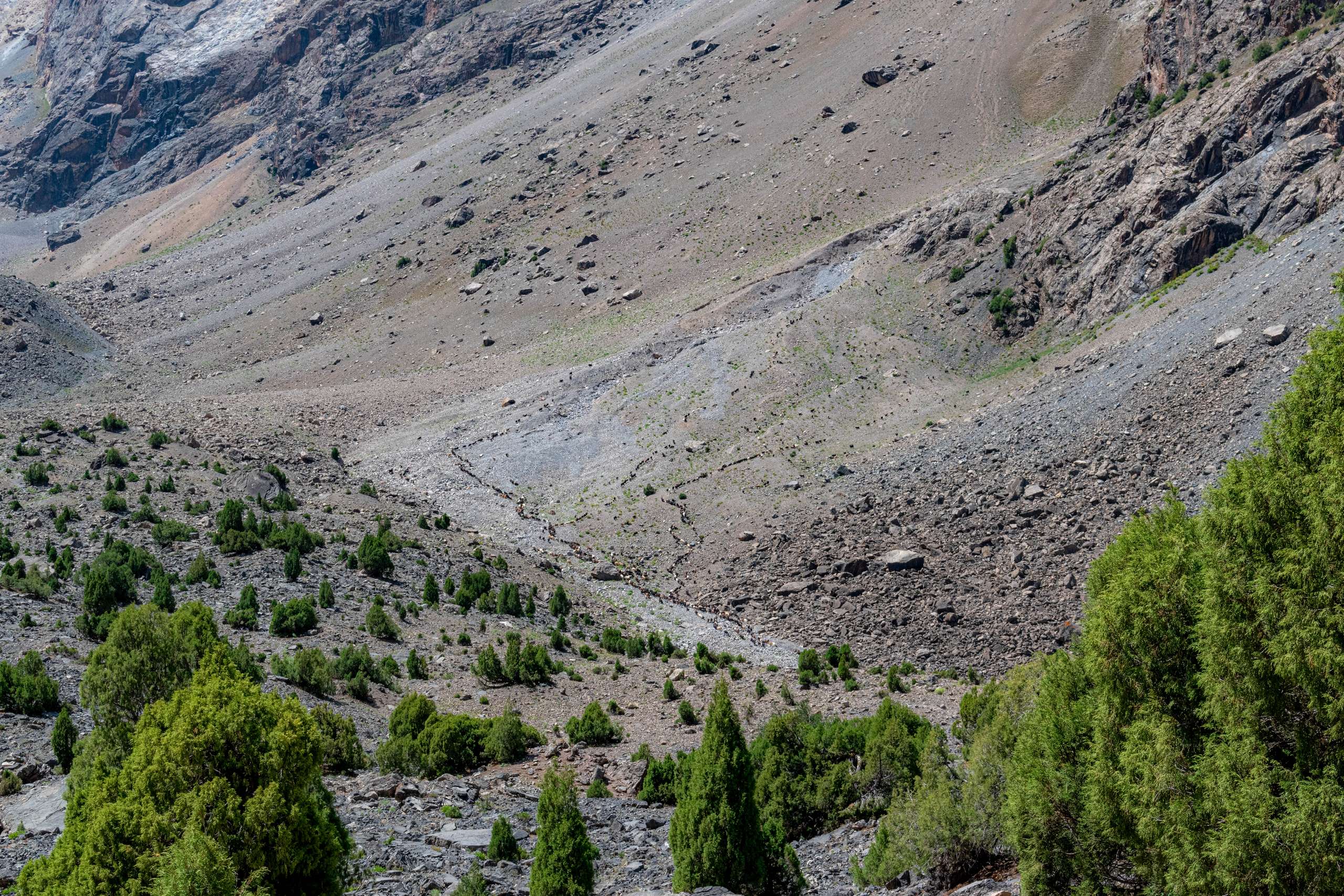
At 11:10, two local men (a father and son, perhaps?) with three donkeys loaded with many things caught up to us. The young man walked ahead, while the elder stopped to ask how we were doing. I asked him about the unusual leafy trees, and he replied “That’s a long story” and he sat down next to a rock, spreading his legs wide.
He told us that when the Arabs were still in these lands, there was a general named Alauddin. He was buried under a mountain, and the mountain was named after him (though he pointed, oddly, not at Mount Alauddin). Near this place, trees (or orchards?) were planted, and they have been growing here ever since. In short, we never figured out what kind of trees they were.
He admired our sunglasses, complimented Katya’s scarf, and wished us a son. As is typical in these kinds of places, he asked about Katya, but not directly to her — he asked me, “What do you do? And what does she do?”
Regarding the Chimtarga pass, he asked if we needed any help, probably thinking of donkeys to carry our things. We said we wanted to ascend on our own, to which he replied “Well, you’ll think it over” and he run off after his donkeys up the mountain.
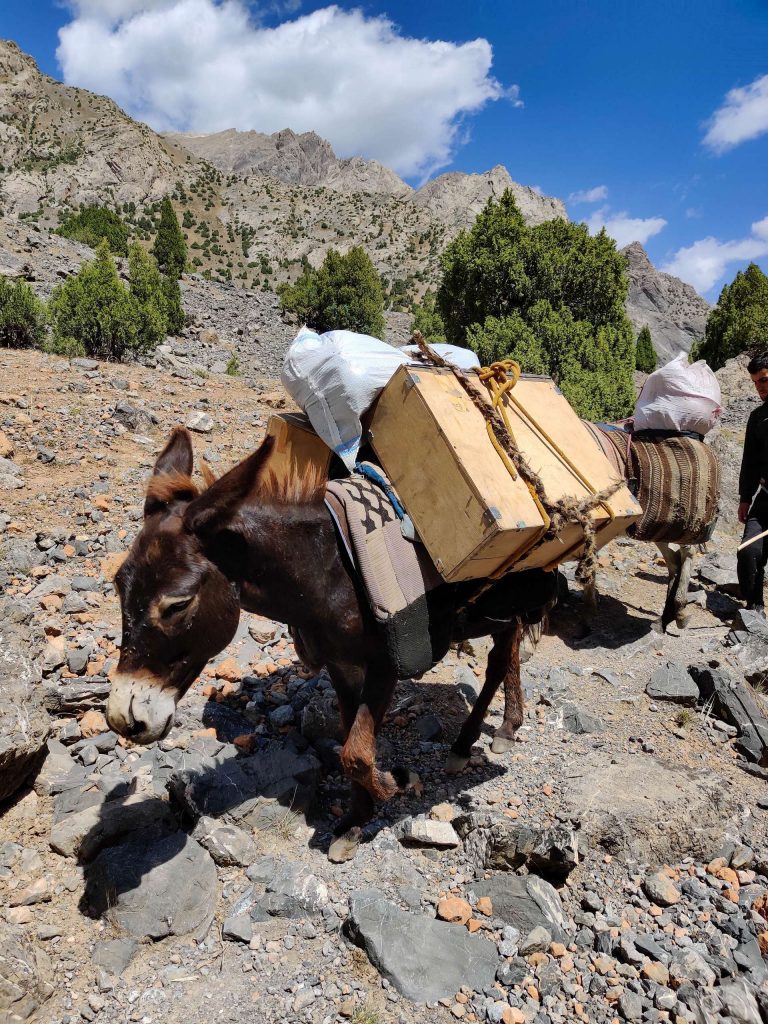
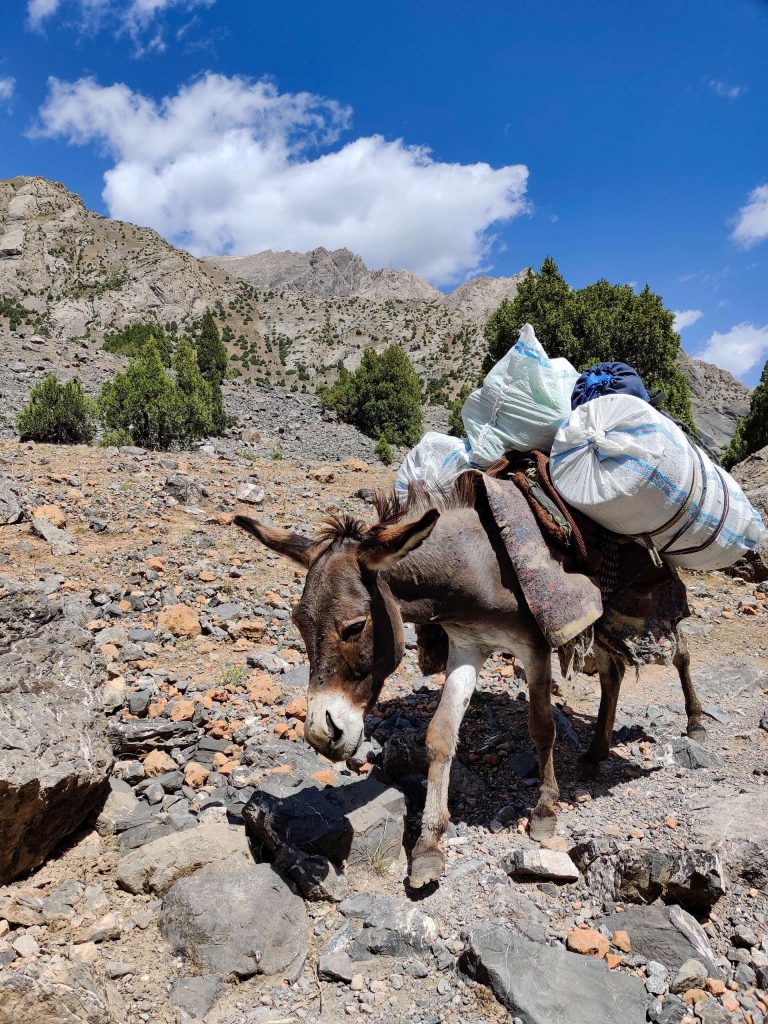
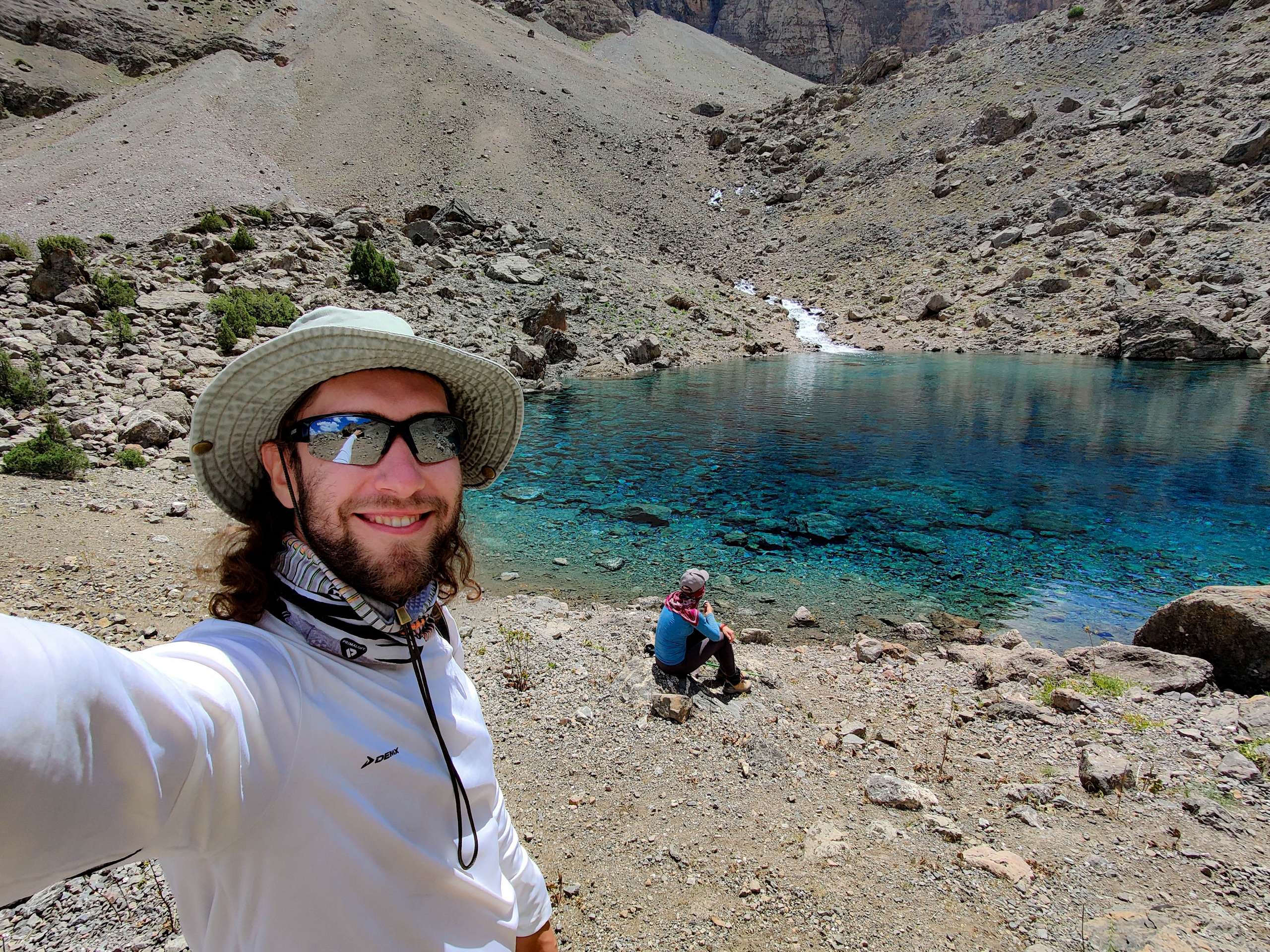
Oh, and he also asked if we were planning to swim in Lake Piala, which is on the way and very close by. He said it was the most beautiful lake. We reached Lake Piala at 11:45, located at 2930 m. We had a quick snack with some bars and took some photos of the lake. We didn’t swim — it was too cold, and the weather wasn’t particularly warm either. But the lake itself was truly beautiful, with crystal-clear, azure-turquoise water.
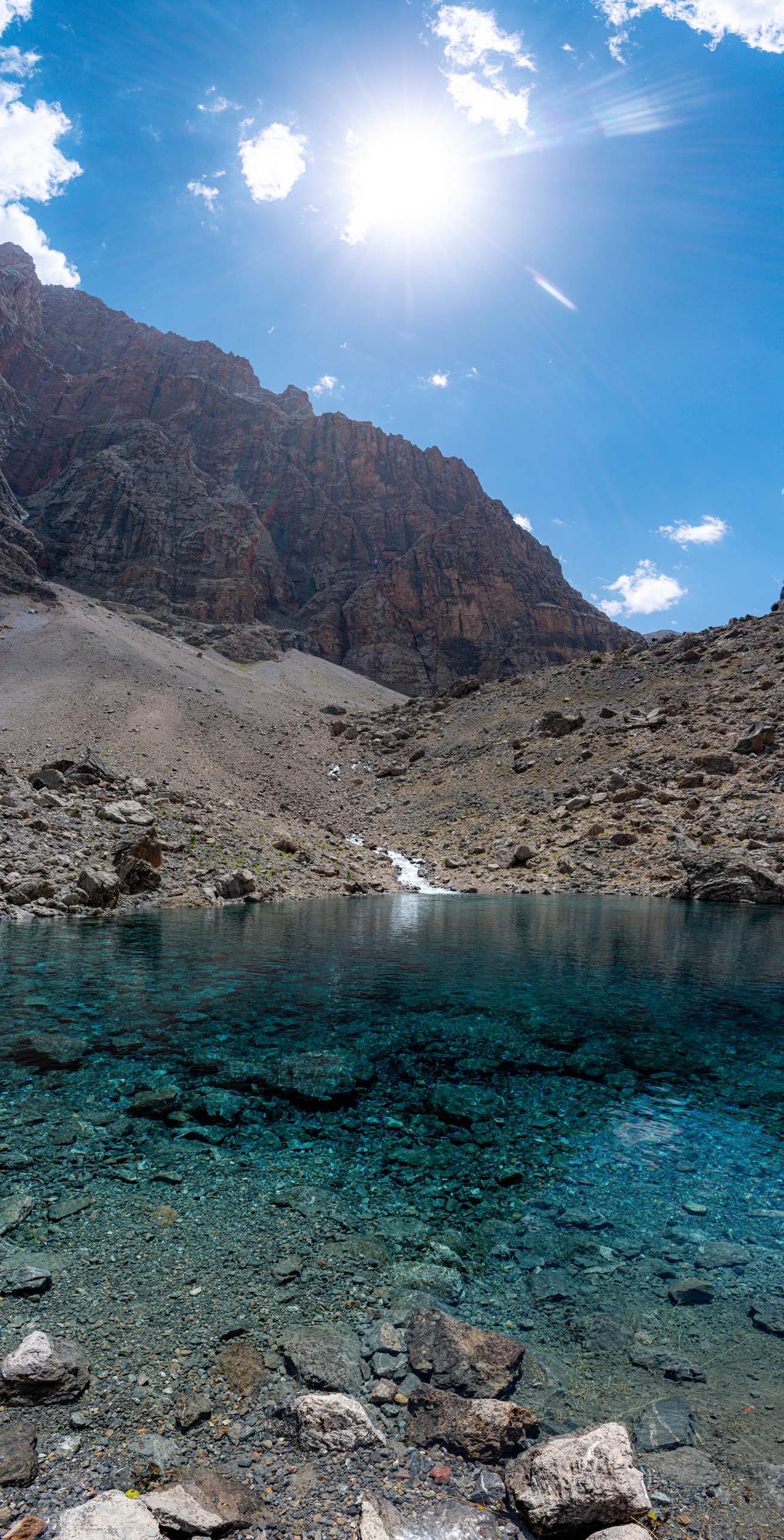
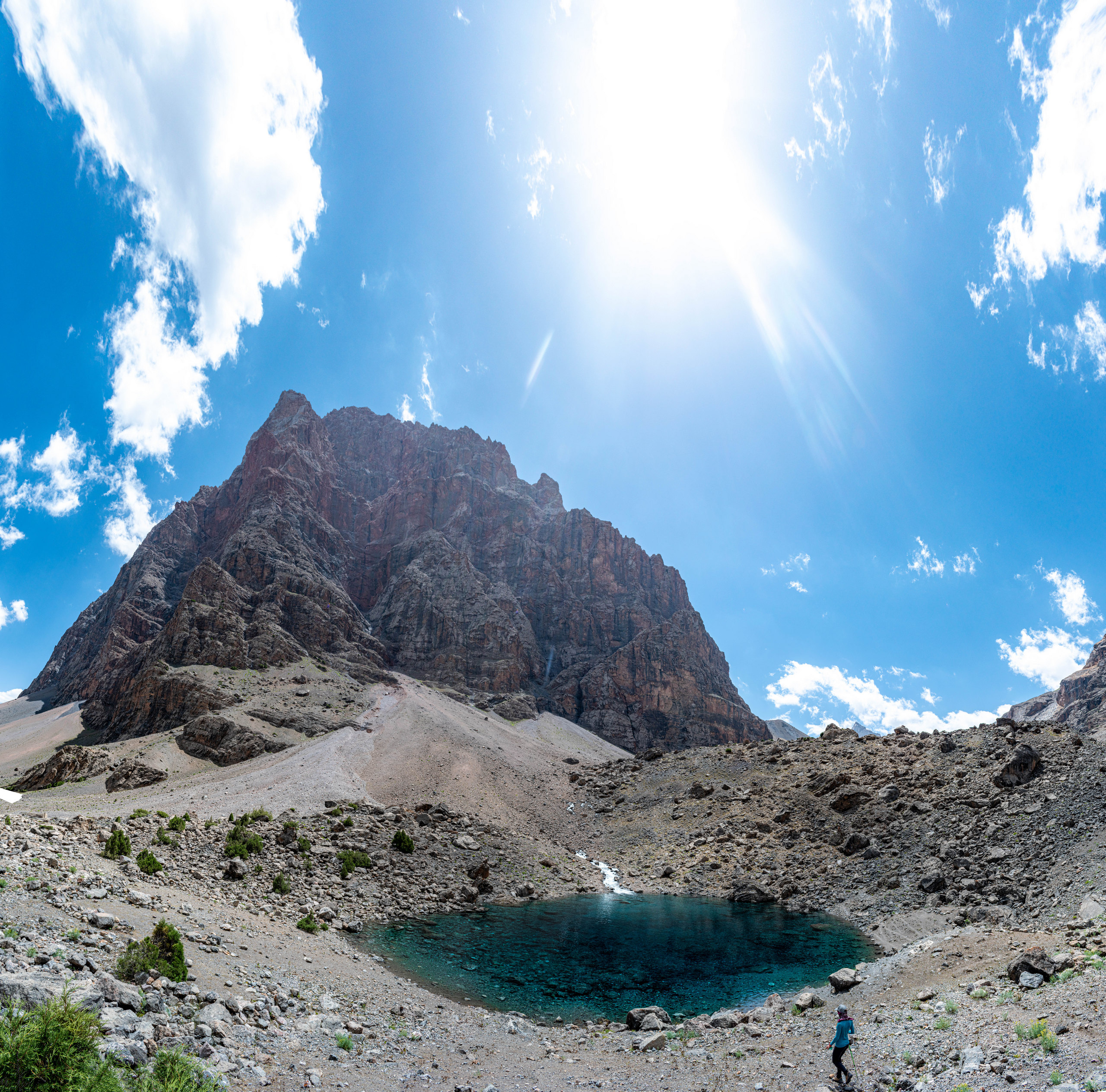
At the lake, a group caught up with us, coming from below. They were Russian guys, about eight men. They were heading to climb Mount Energia, and their plan for the day was also to reach the Mutnyi Lakes.
We let the guys pass and resumed our ascent at 12:10. We didn’t collect water at Lake Piala, as according to the map, there should be a waterfall just 1 km ahead, where we planned to have lunch.
By 13:00, we reached the waterfall — a disappointing sight. Only a few tiny streams of water fell from a height of about a hundred meters, and the wind blew these droplets left and right along the sheer cliff.
We were really thirsty and hungry. There was nothing else to do, so we scrambled up the pile of rocks to the spot where most of the drops were flowing. First, we collected water, then we planned to filter it. Since we had already started filtering water on the hike, we filtered everything — even if it came from melted snow or ice.
It took us about 30 minutes to gather 2 liters of water. We held the bottles under the streams of water running down the rock walls. What made this task even more challenging was the occasional rain of droplets from the waterfall, which the wind blew right onto us. The place was in the shade, so we had to endure the cold. The descent from there over the wet, loose rocks was quite the adventure too.
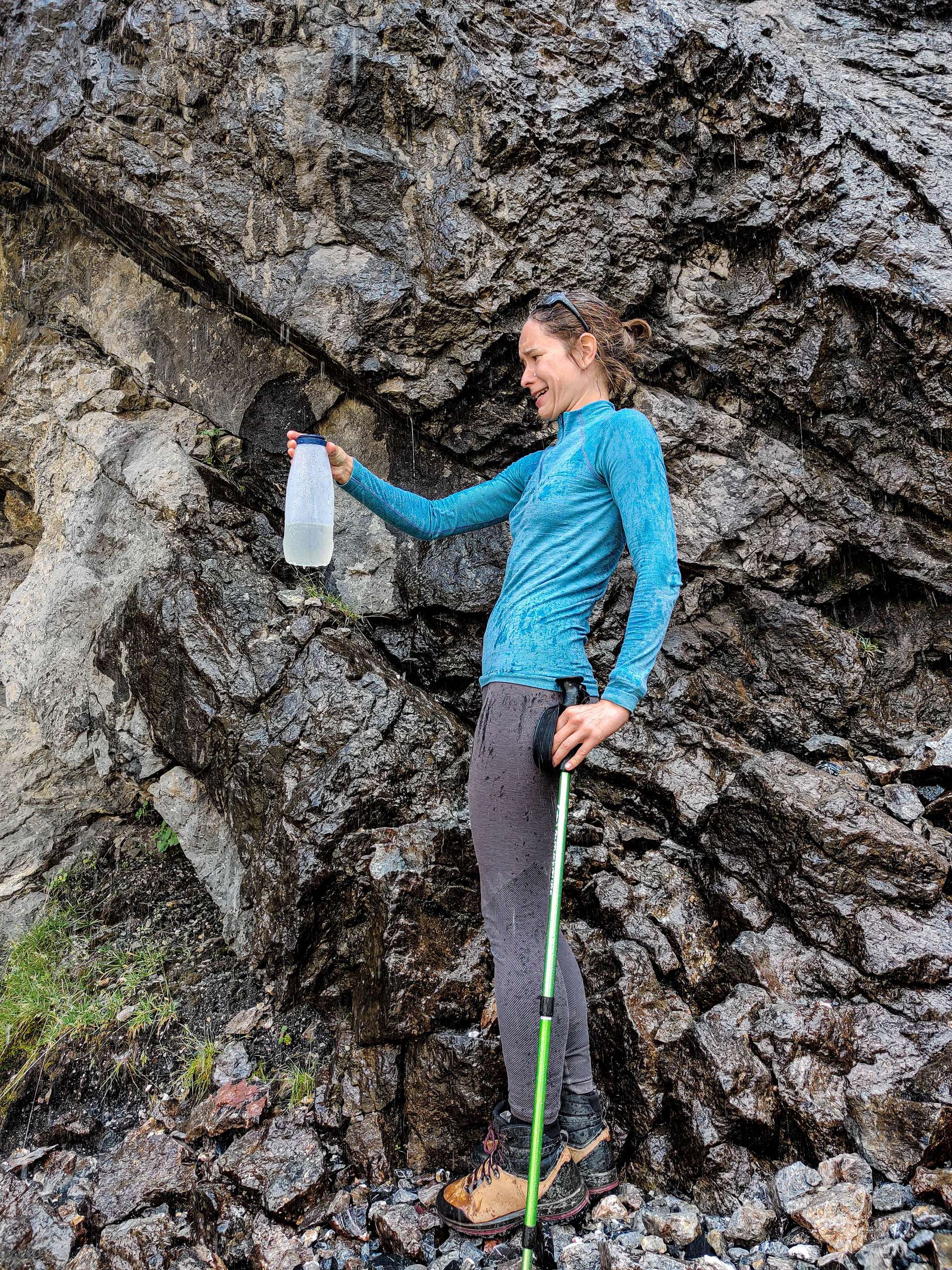
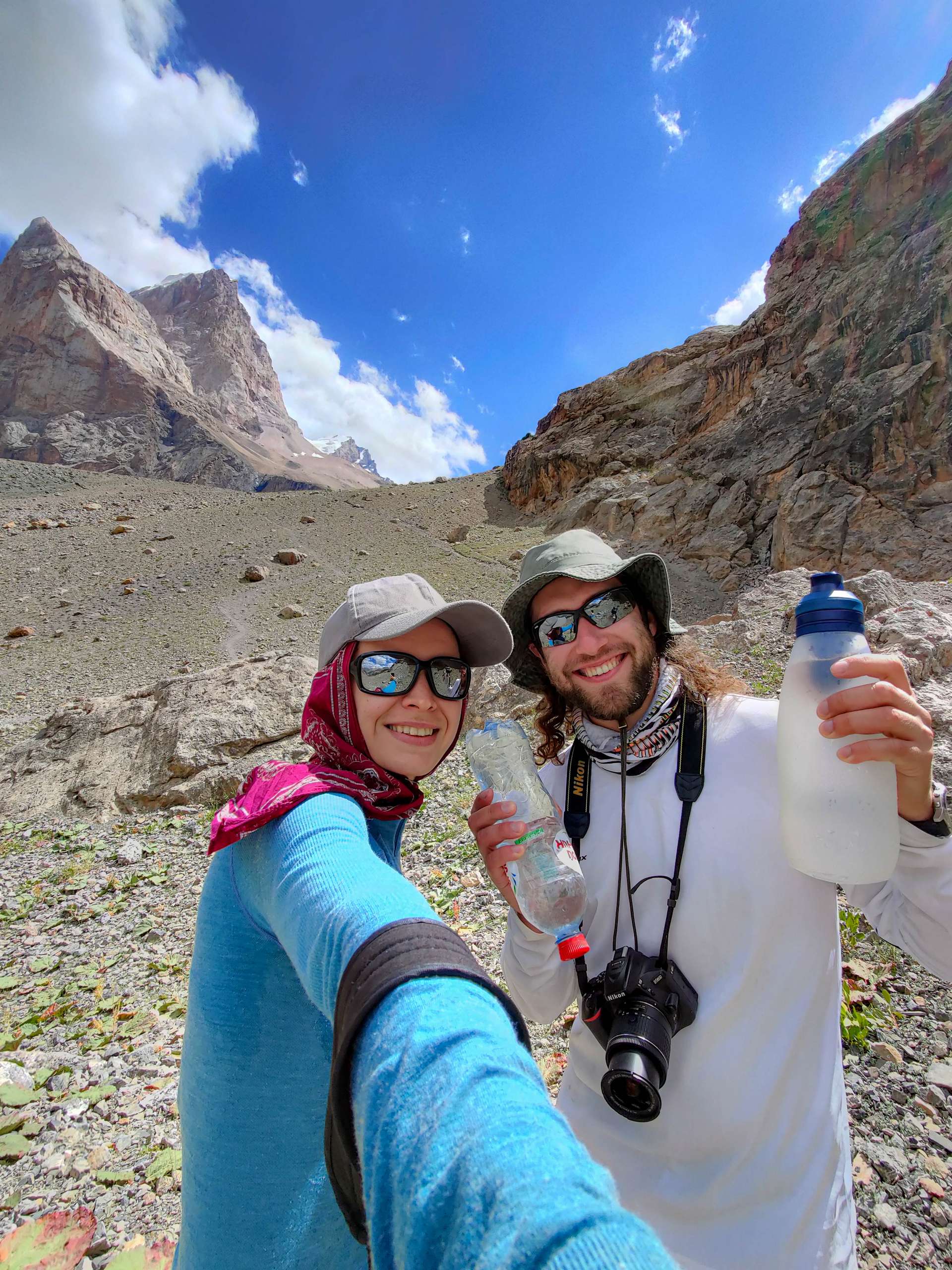
By 13:45, we had gathered the water. By 14:05, the delicious Bolognese pasta was ready! We sat in the sun, warming up, eating, and enjoying the mountain views. While we were sitting, we noticed that the droplets stopped falling from the waterfall. Apparently, the water supply there had run out for the day — lucky we had managed to collect some. As we sat there, another group of about six Tajik men passed by on the trail to the Mutnyi Lakes, carrying a large bag of green grapes. They also asked about our route. Like everyone else, they were heading to Chimtarga via the Mutnyi Lakes. They said, “We’ll see you again” but we didn’t cross paths again.
The remaining route passes through what feels like long steps — you climb, thinking that the lakes will be just beyond this rise, but then there’s another ascent. The surrounding mountains are majestic, and the vegetation is gradually disappearing. The climb along the trail is predictably not too steep, making the hike relatively comfortable.
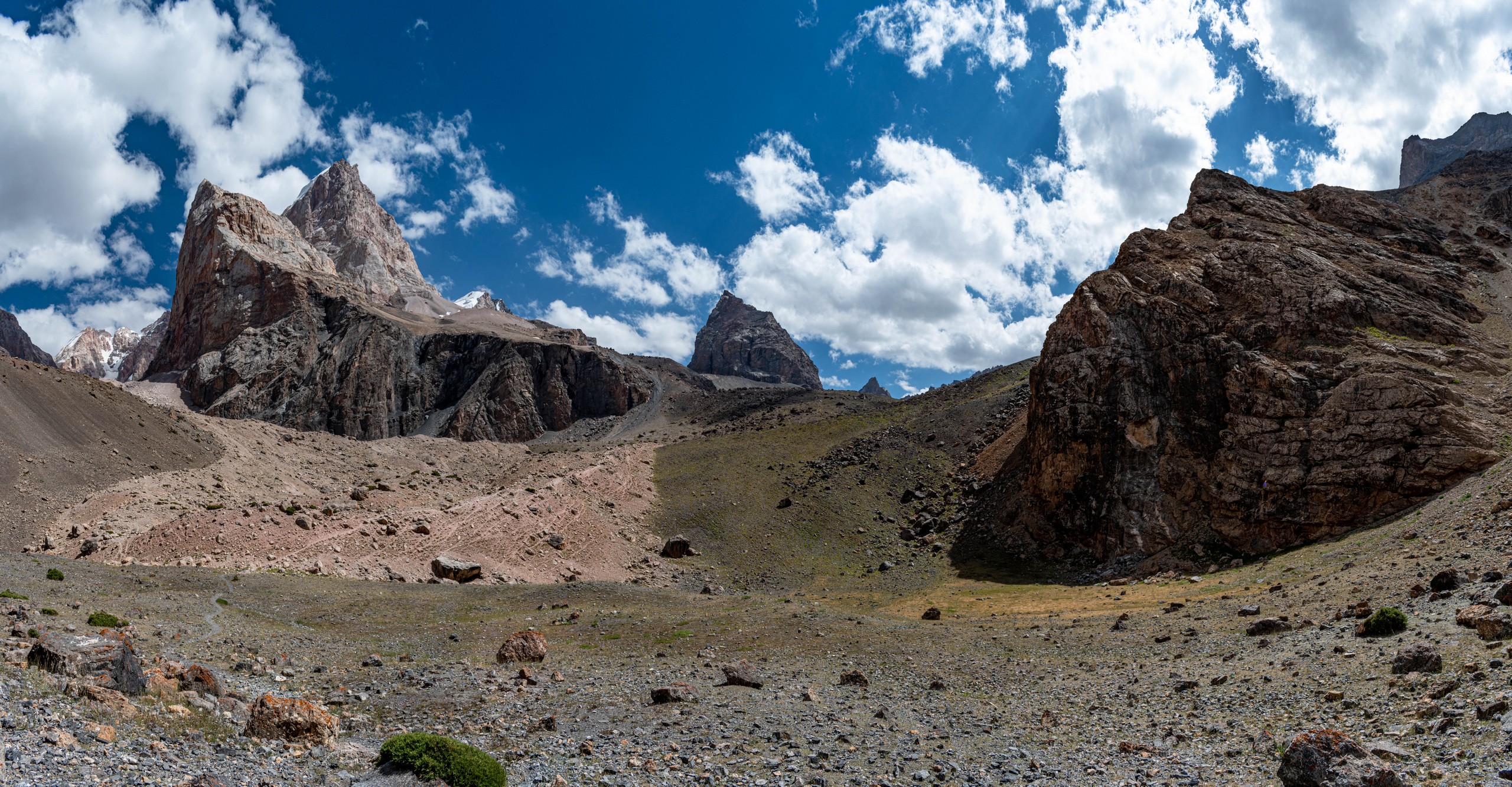
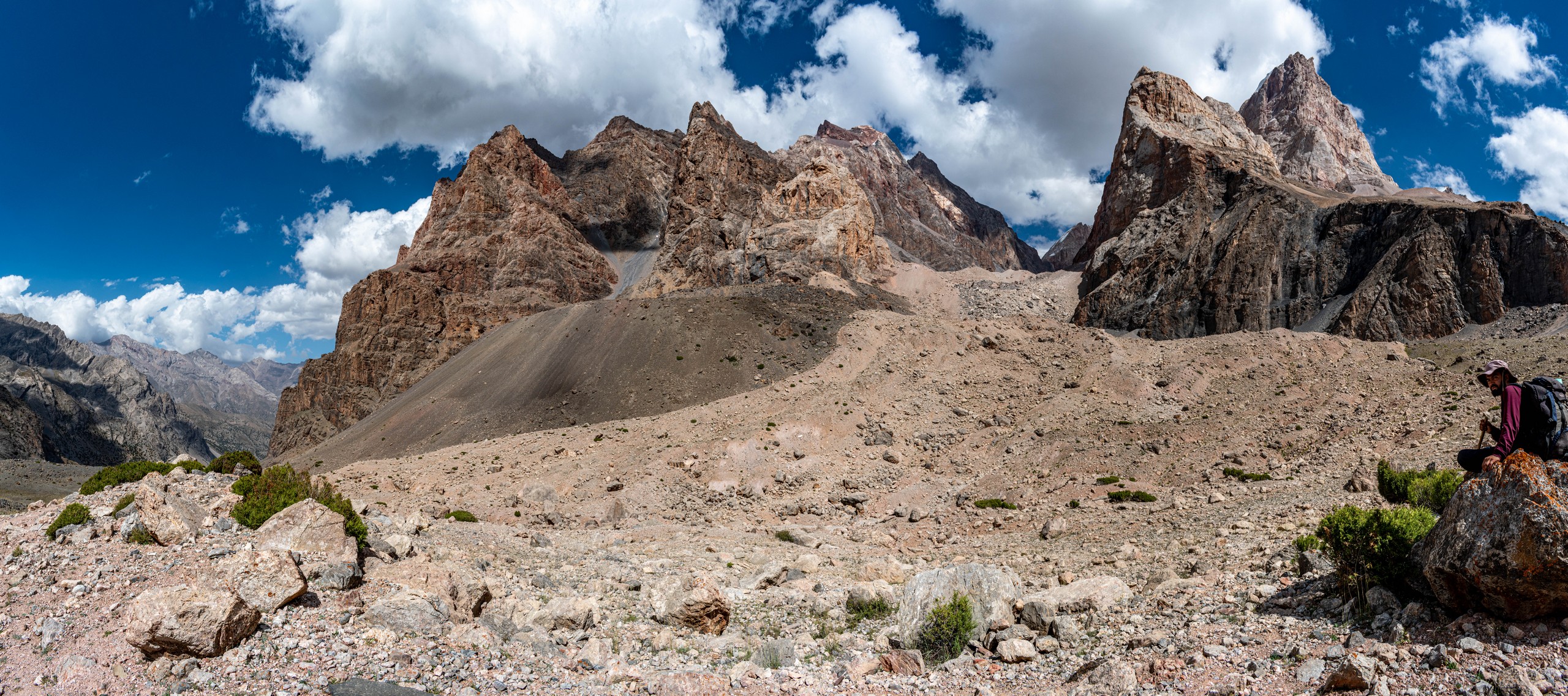
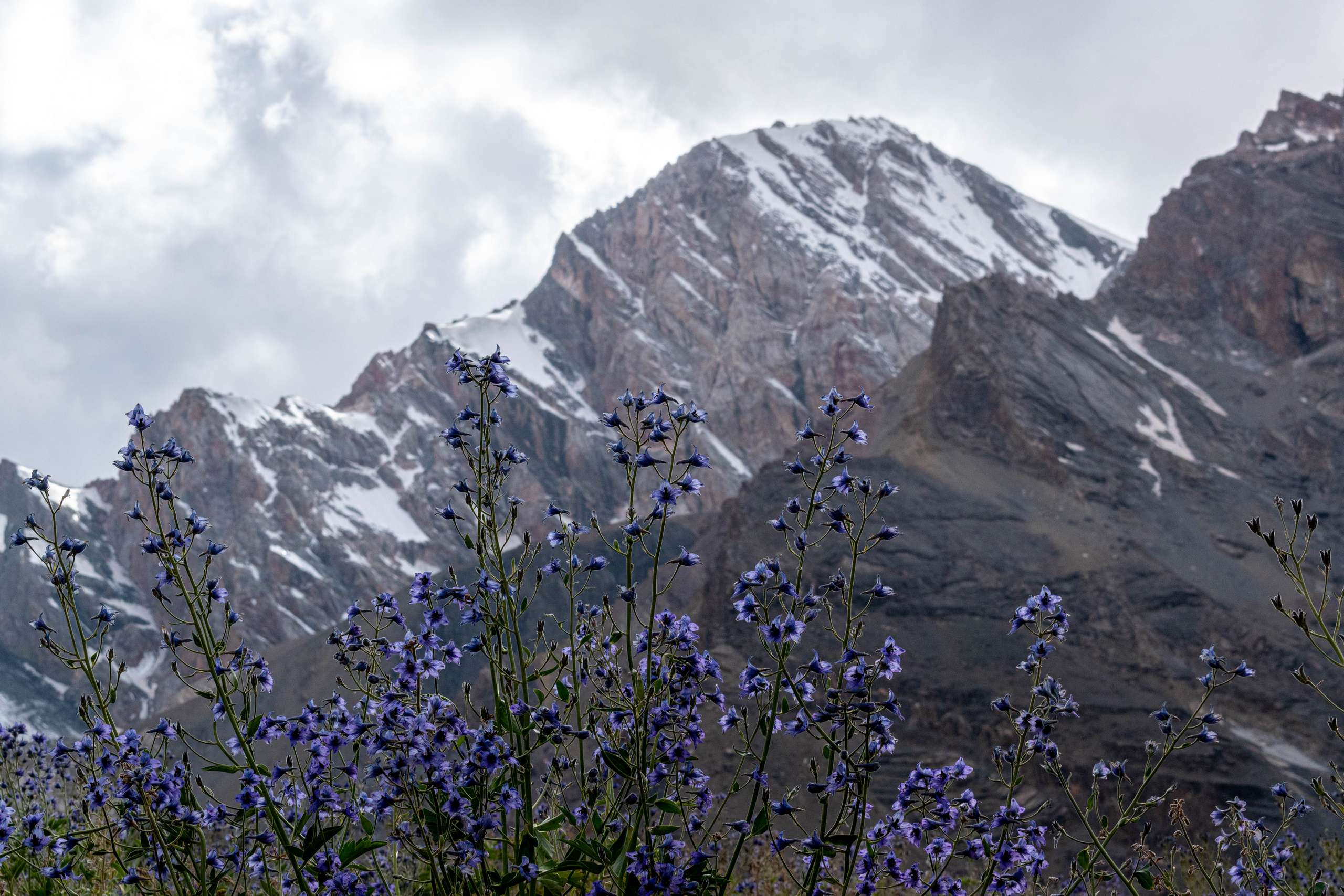
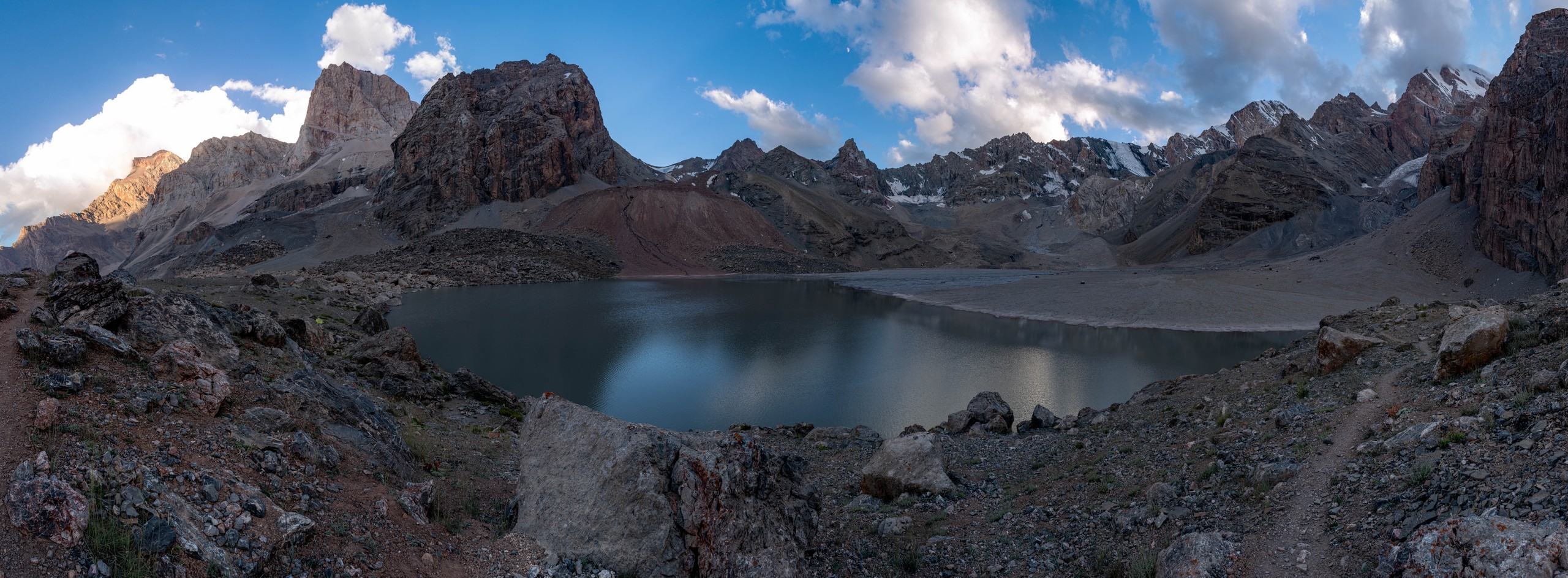
By 16:00, we reached the Mutnyi Lakes. Now these are The Mountains! Before the lake, there are large, gray, bleak stone blocks scattered around, with no vegetation in sight. Between the rocks, there are some flat areas for tents. The wind is very strong. The lakes themselves are indeed murky, with a grayish sediment that resembles very fine gray sand. A fine addition to this scene is a snow-covered wall of tall mountains on the opposite side of the lake. On the right side of this wall, you can see the Summit of Energia (5120 m), and a bit closer to us, the highest peak in the area — Chimtarga (5489 m). Between these giants is the Chimtarga Pass (1B, 4740 m), which we plan to ascend.
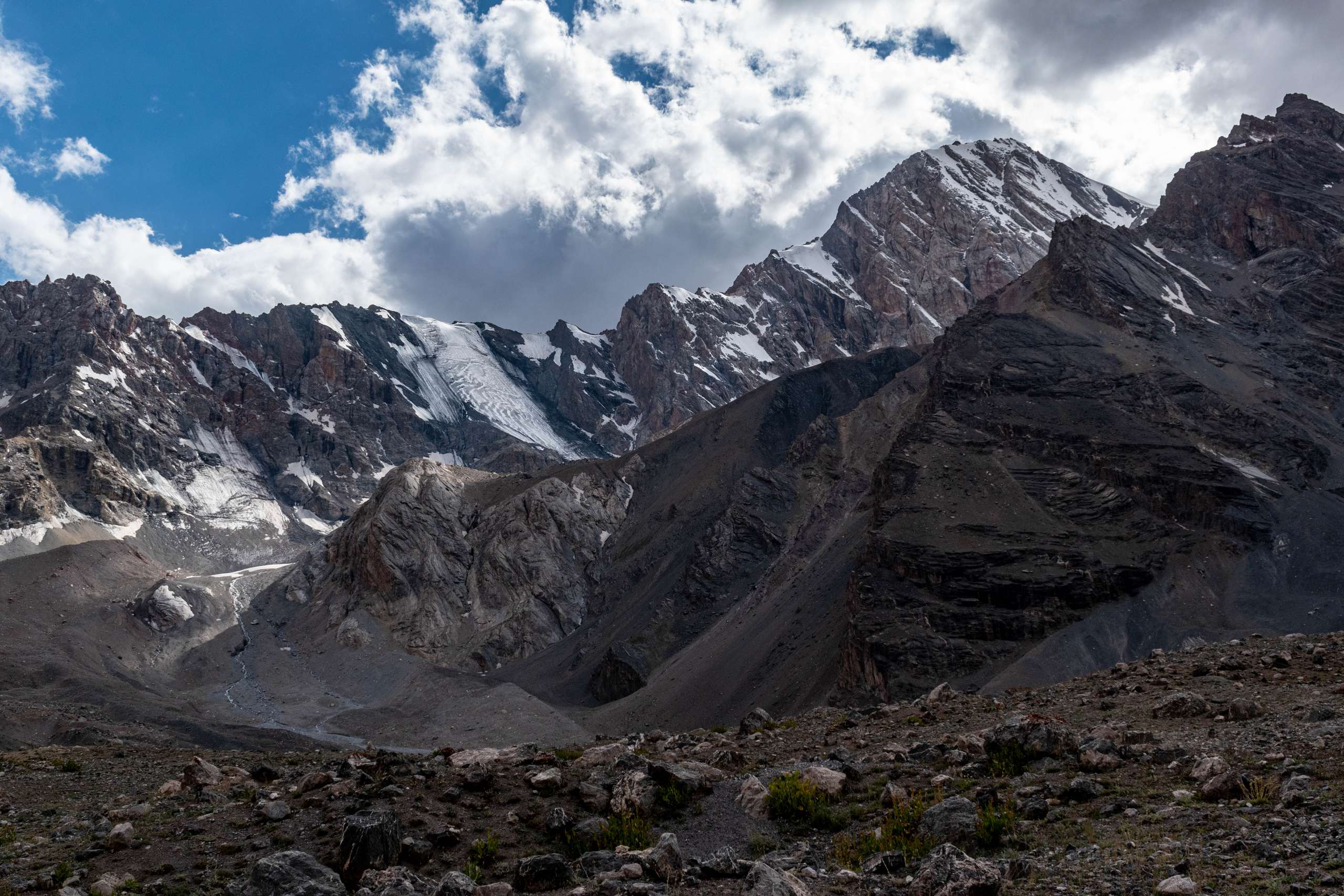
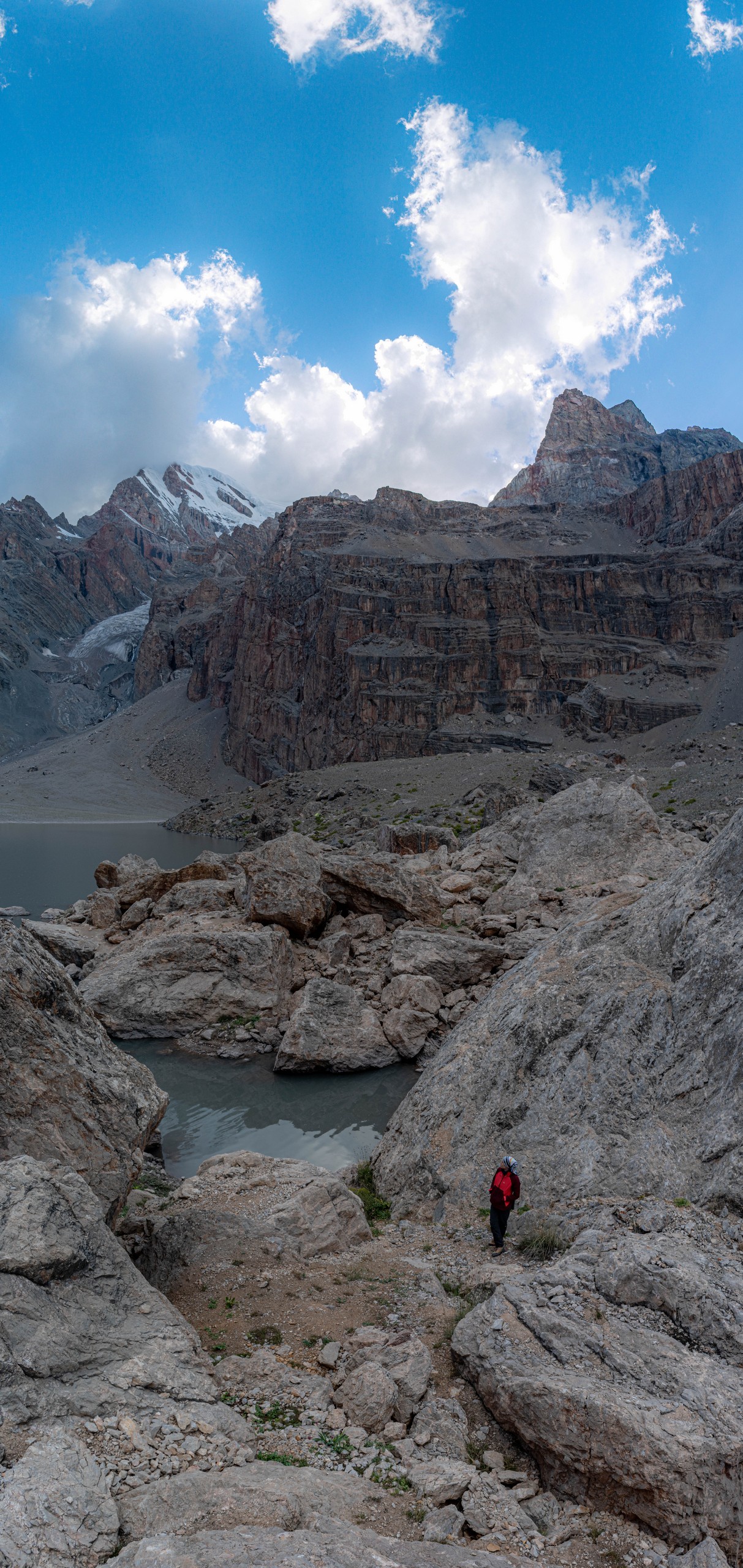
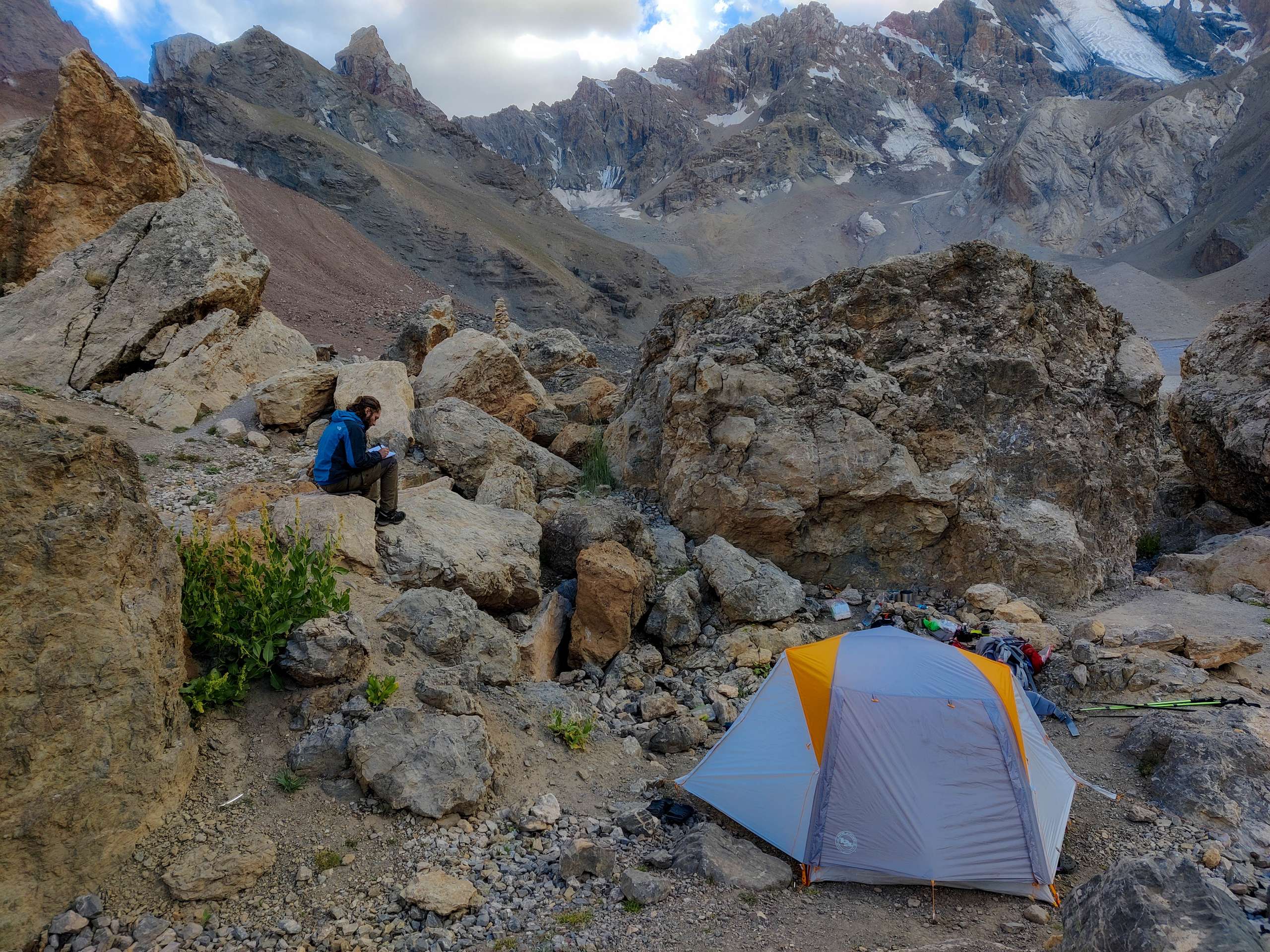
In the evening, to warm up, we took a walk around the area. We saw a few more tents on our side of the lake and on the opposite side, closer to the ascent to the Chimtarga pass.
Katya’s throat seems to have dried out from the constant gargling with Octenisept, still she gargled once again before bed. We discussed what to do next. From here, at an altitude of 3500 m, it’s a 1 km climb to the base camp below the pass at 4500 m. That was our original plan, to try a night at 4500 m. But now, even at 3500 m, we realized how cold and uncomfortable it is. My sleeping bag is not ready for this (comfort zone +10). So, we had two options. Either go straight over the pass and try to reach the campsite by Lake Bolshoi Alo, meaning we’d combine two of the most difficult days of our route into one hiking day. Or, return down to “Vertical”. Of course, I wanted to keep going. We decided to try the first option, as long as neither of us feels too bad by the morning. If we feel unwell during the climb to the pass or realize we’re running out of time, we’ll turn back and go down.
The alarm was set for 05:00. Katya had already prepared everything for breakfast and sandwiches for a snack/lunch, so we wouldn’t waste time tomorrow.
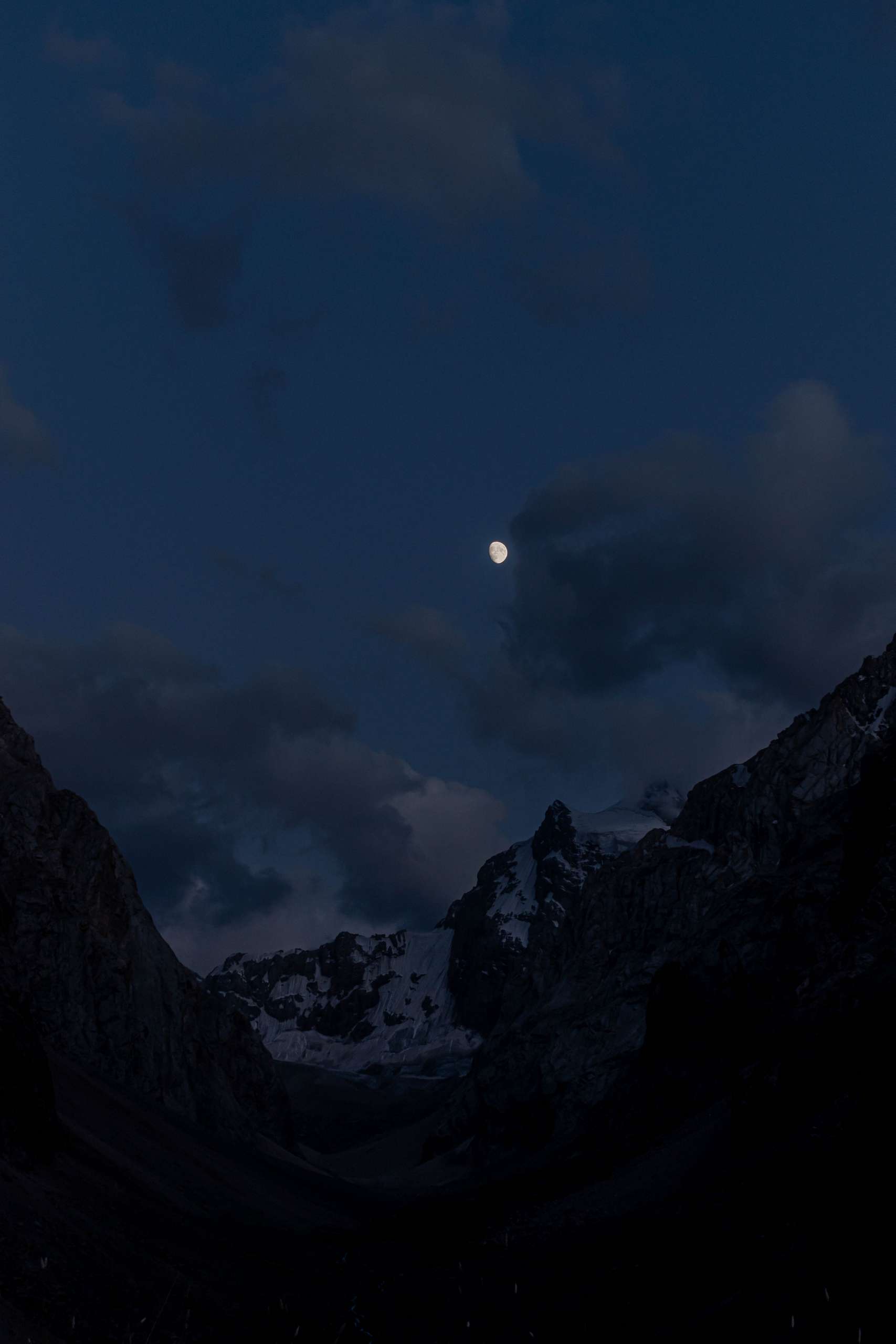
I waited for the stars and around 21:00 took some amazing astrophotos, as the stars at this altitude were stunning. While I was shooting, I caught a bright flash out of the corner of my eye – I turned around and saw a bright point flying horizontally across the sky (about 10 times brighter than the stars), leaving a fading trail behind it. Just one second and it vanished. I imagined an alien spaceship, although, of course, it was a shooting star. For some reason, the moon here is very bright, almost like a lantern in the sky. The moon is waxing, but even at this stage it is enough to walk at night without a flashlight, everything is clearly visible. Lights out at 21:30.


Day 5. 2022-08-07 Sunday
The night was terrible – it was cold, the wind was slapping against the tent, and it was extremely uncomfortable. We woke up on our own, without the alarm, at 04:56 sharp and quickly started getting dressed. Neither of us experienced any health issues, and Katya’s throat miraculously healed! So, we decided to stick to the plan – head for the pass and then to Lake Bolshoi Alo.
Worth noting that our plan was not easy at all. First, a 1240-meter ascent to the Chimtarga Pass (1B, 4740 m), followed by a 1573-meter descent. The total distance is around 13 km, which, at these altitudes and with backpacks, is quite a lot. On the descent from the pass on the way to Lake Bolshoi Alo, there are two campsites at equal distances. If needed, we can stay overnight at one of them.
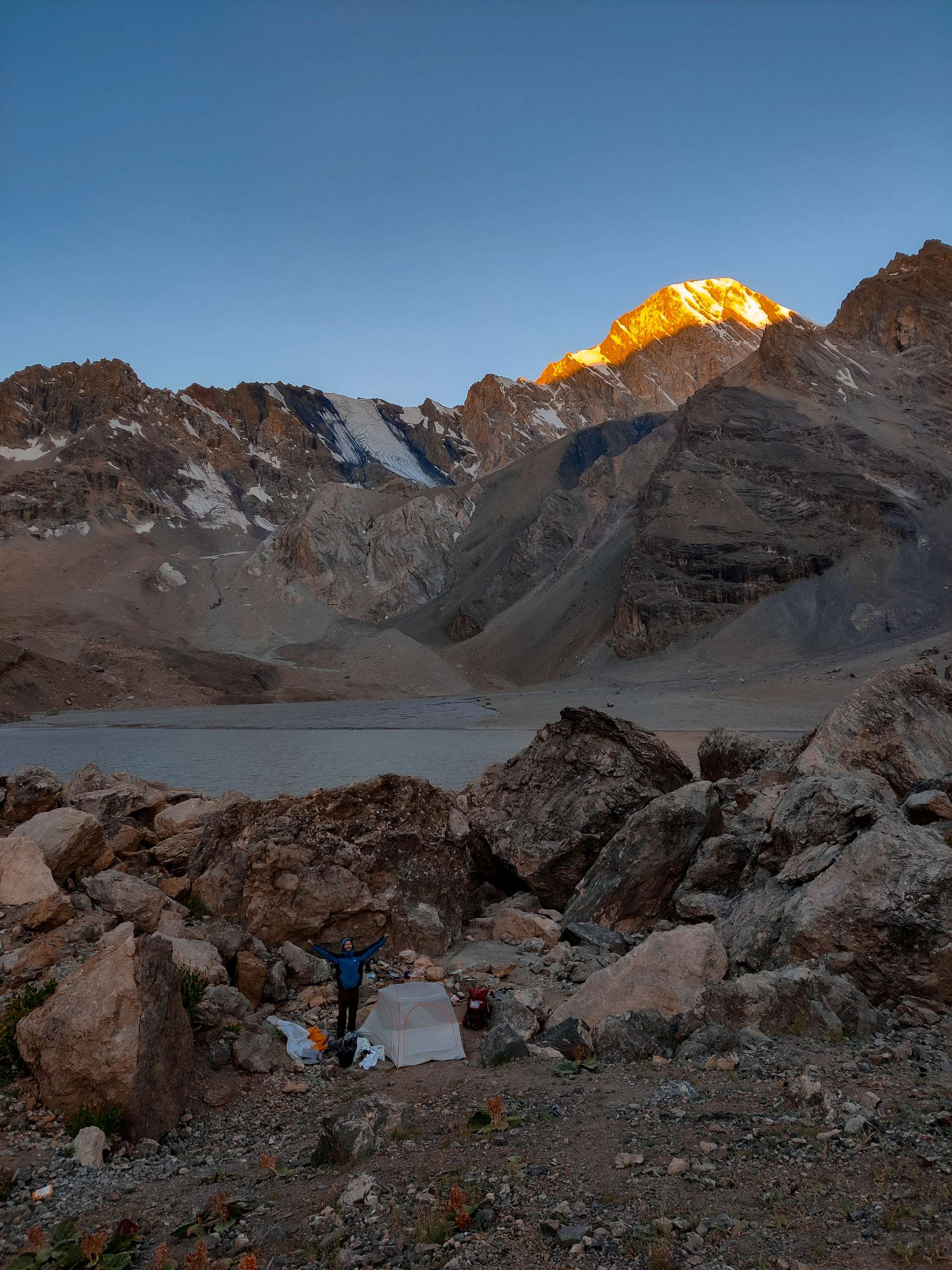
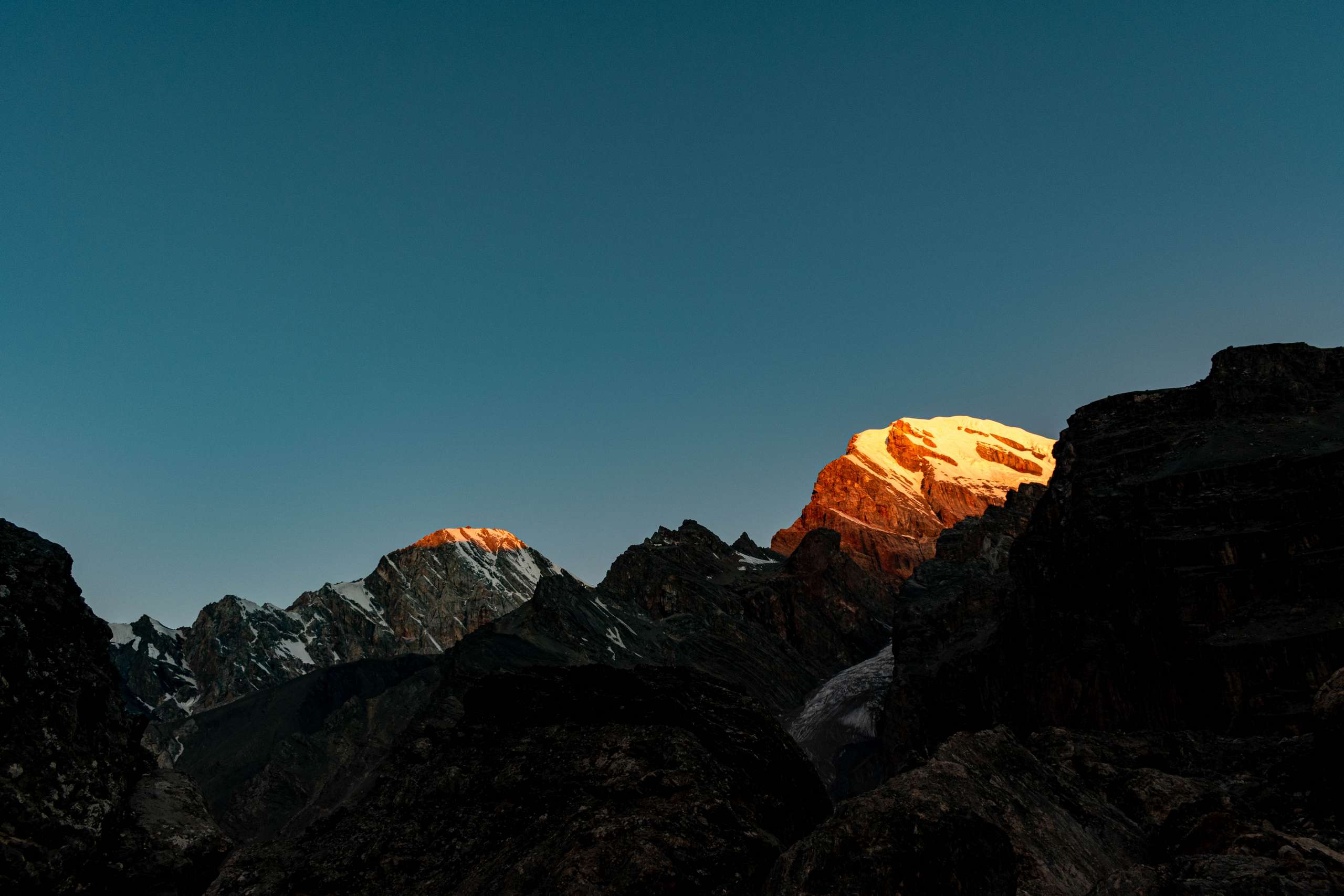
Waking up at 05:00 in the cold at this altitude is an extremely unpleasant experience. Both of us agreed it’s comparable to those early winter mornings when you had to wake up for school. However, the views were absolutely breathtaking — the first golden rays of the sun from the east lit up the peaks of Mounts Chimtarga and Energia. The sky was completely clear, which was crucial since good weather at the pass is already half the battle. This was also why we got up so early — our goal was to reach the Chimtarga Pass before noon, as the weather can change drastically after that.
At 6:20, we left the campsite. We decided to skirt the Mutnyi Lakes on the western side, where a clear trail was visible. There are essentially two lakes here — one large and another smaller one tucked at the base of the mountains to the west. Between the lakes, there’s a stone bridge that the trail crosses. Beyond this, the path winds through gray rocks, with streams flowing down from the mountains into the Mutnyi Lakes. The whole scene resembles some sort of alien, lunar landscape.
Around the same time, two guys — Andrey from Serpukhov and Arseny from Minsk — also started their climb toward the pass. We ascended almost parallel to them for most of the way. The guys are experienced climbers who have been to many places and are currently scouting the route to summit Energy tomorrow. We shared our plans with them and discussed the best way to approach the climb.
At the far end of the lake, the ascent began along a stream, which was quite steep. The trail on the GPS-navigator followed this route, so we headed straight up the slope. Meanwhile, the guys took a zigzag path slightly to the left. In the end, we all reached the top of the stream (a 300-meter climb) at the same time.
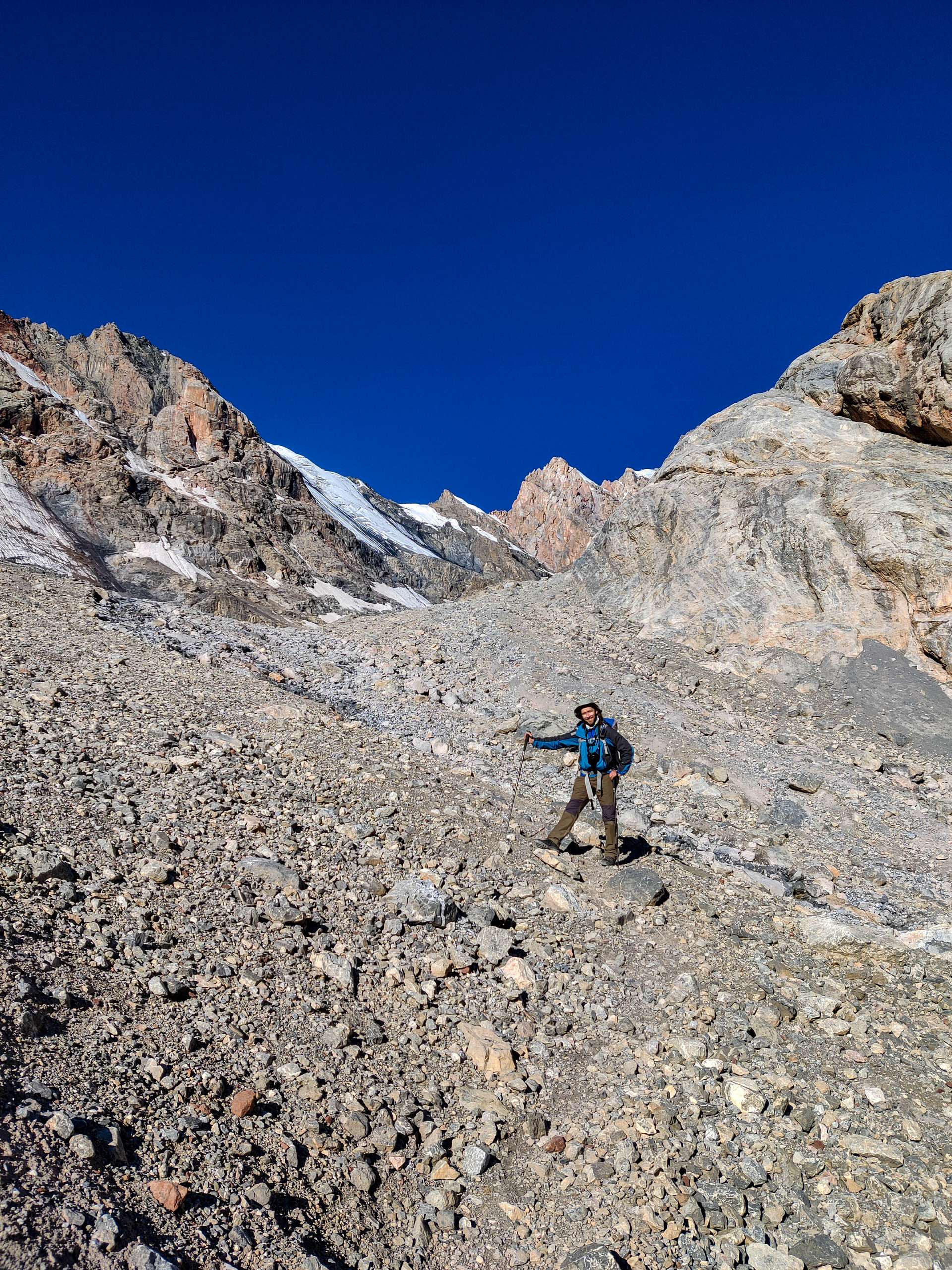
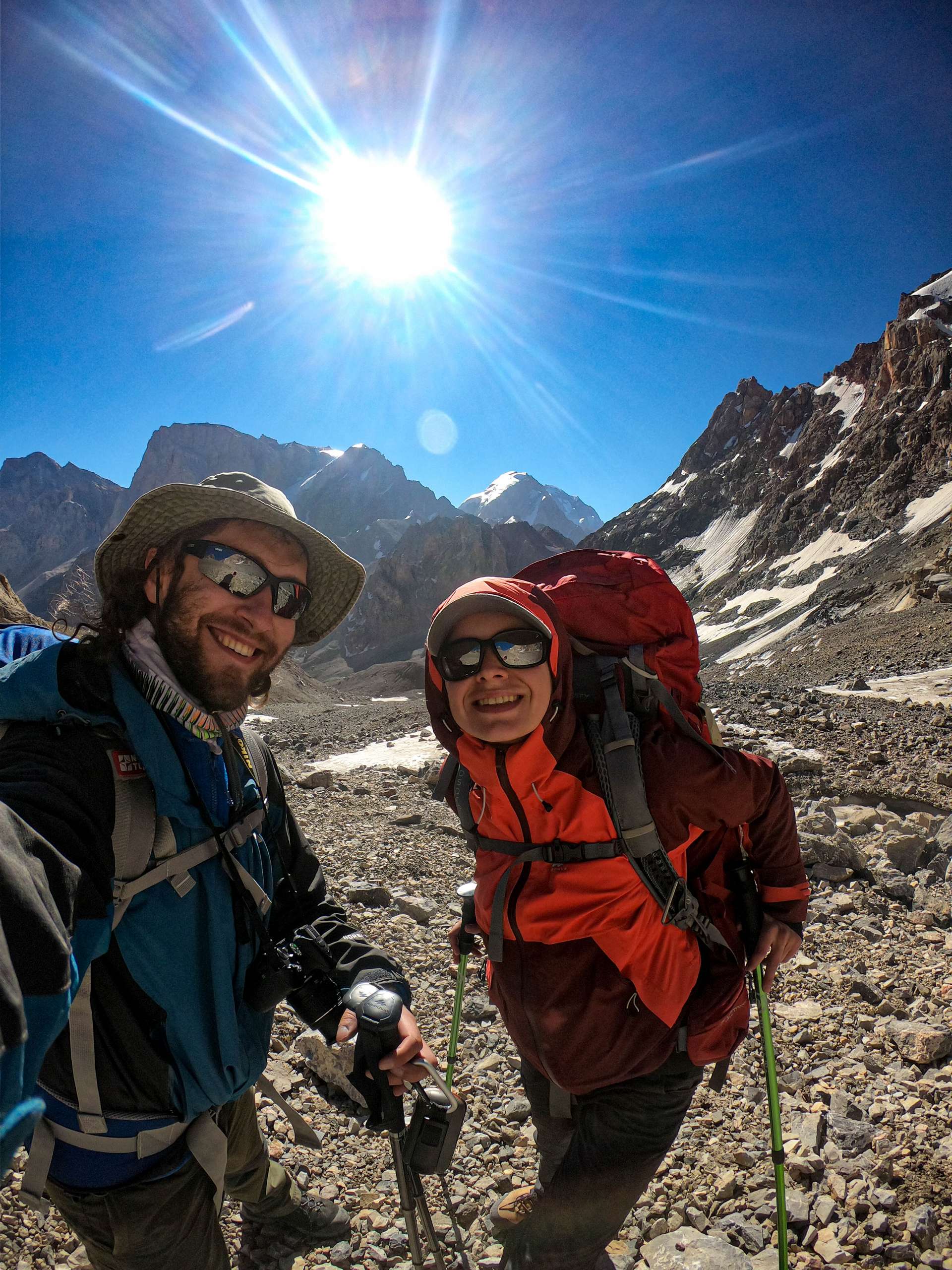
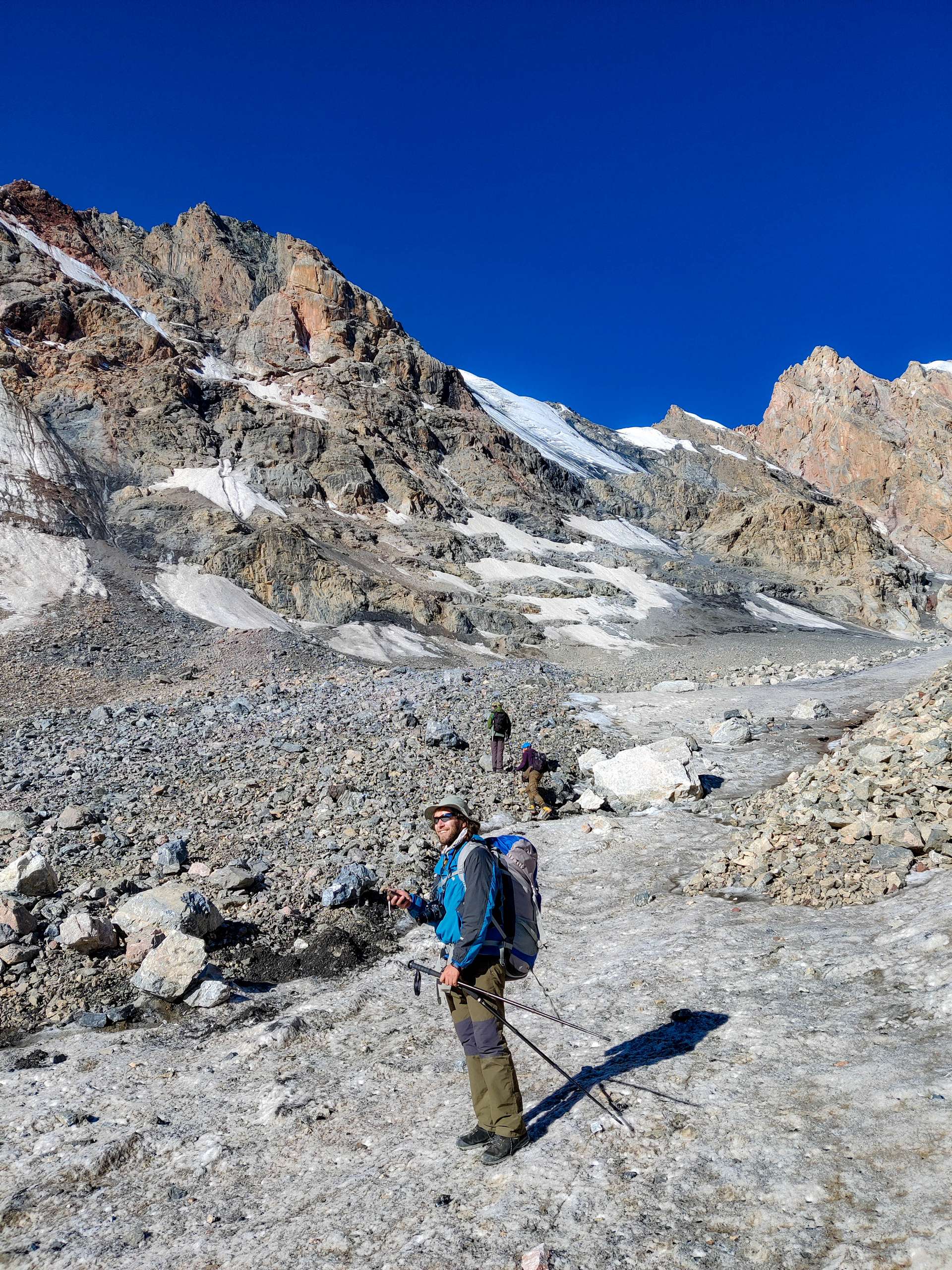
Now about our trail. There were no cairns on the flat section at all, so we navigated by GPS. It seems that during heavy flows, the trail gets washed away. Then came a very steep ascent over rocks, but here we found cairns, and judging by the characteristic “tracks” left on the ground, it looked like donkeys often pass through this route too.
In the upper section, the stream was filled with beautiful snow-ice clusters, and in shaded areas, there were even icy waterfalls, despite it being 07:30 with the sun already starting to warm things up. Here, Katya noticed an interesting plant — a cluster of inflated pods on a stem, very light and ranging in color from bright green to deep burgundy.
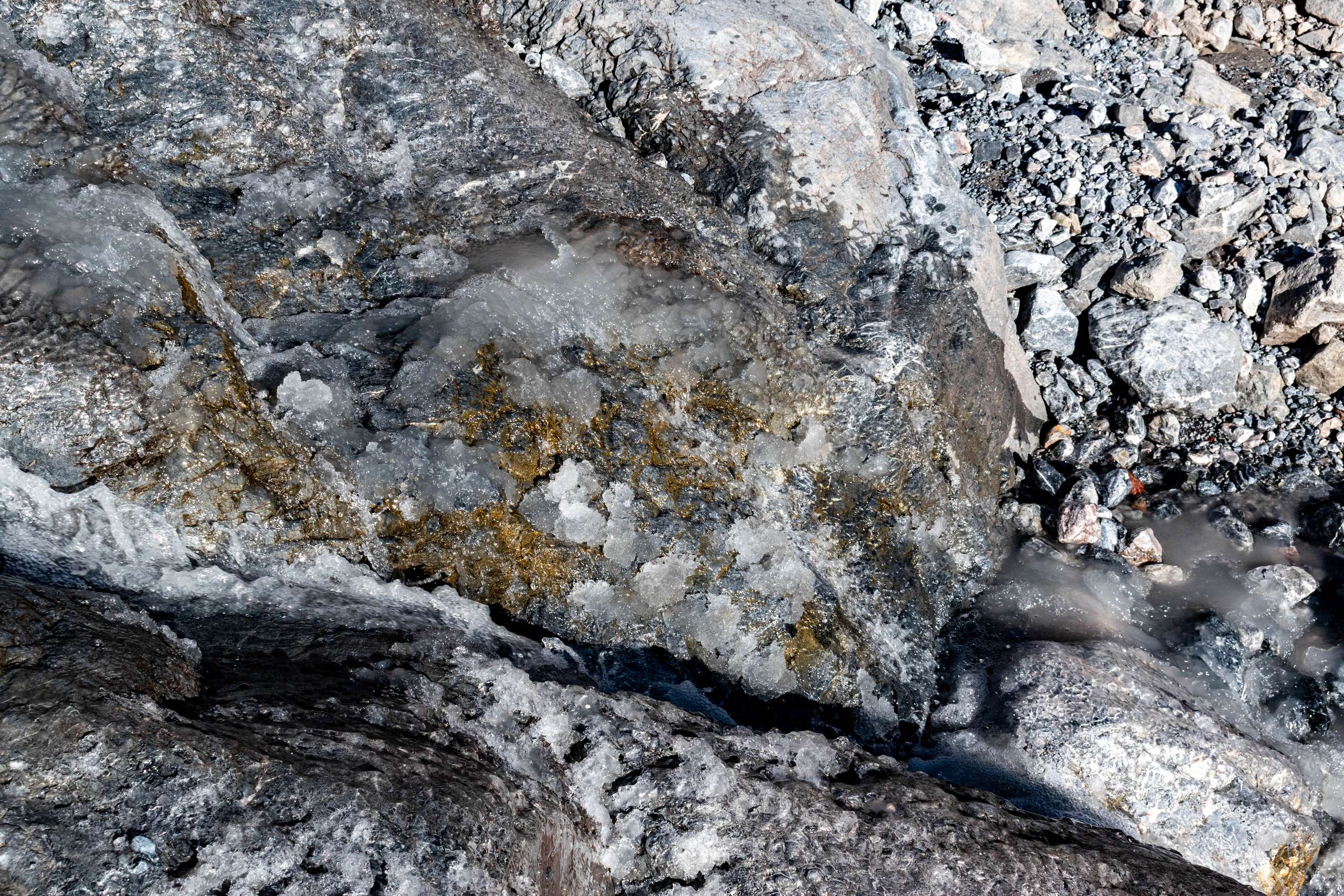
At the top of the stream, we took a short break, applied sunscreen, and chatted with the guys. Afterward, we continued our journey together. They were looking for cairns and a well-defined trail, but none could be found here since the ascent was gentle and scattered with piles of rocks. I decided to follow the navigator directly, and we moved ahead.
The climb to the 4100 m camp was tedious — steep and full of loose rocks — but overall, we were moving steadily. By 09:00, we reached 4100 m, we ate snack bars, and exchanged phone numbers with the guys (I promised to send them the photos). So far, so good: we had climbed 600 meters in 2.5 hours, felt fine, and were on track to reach the pass before noon.
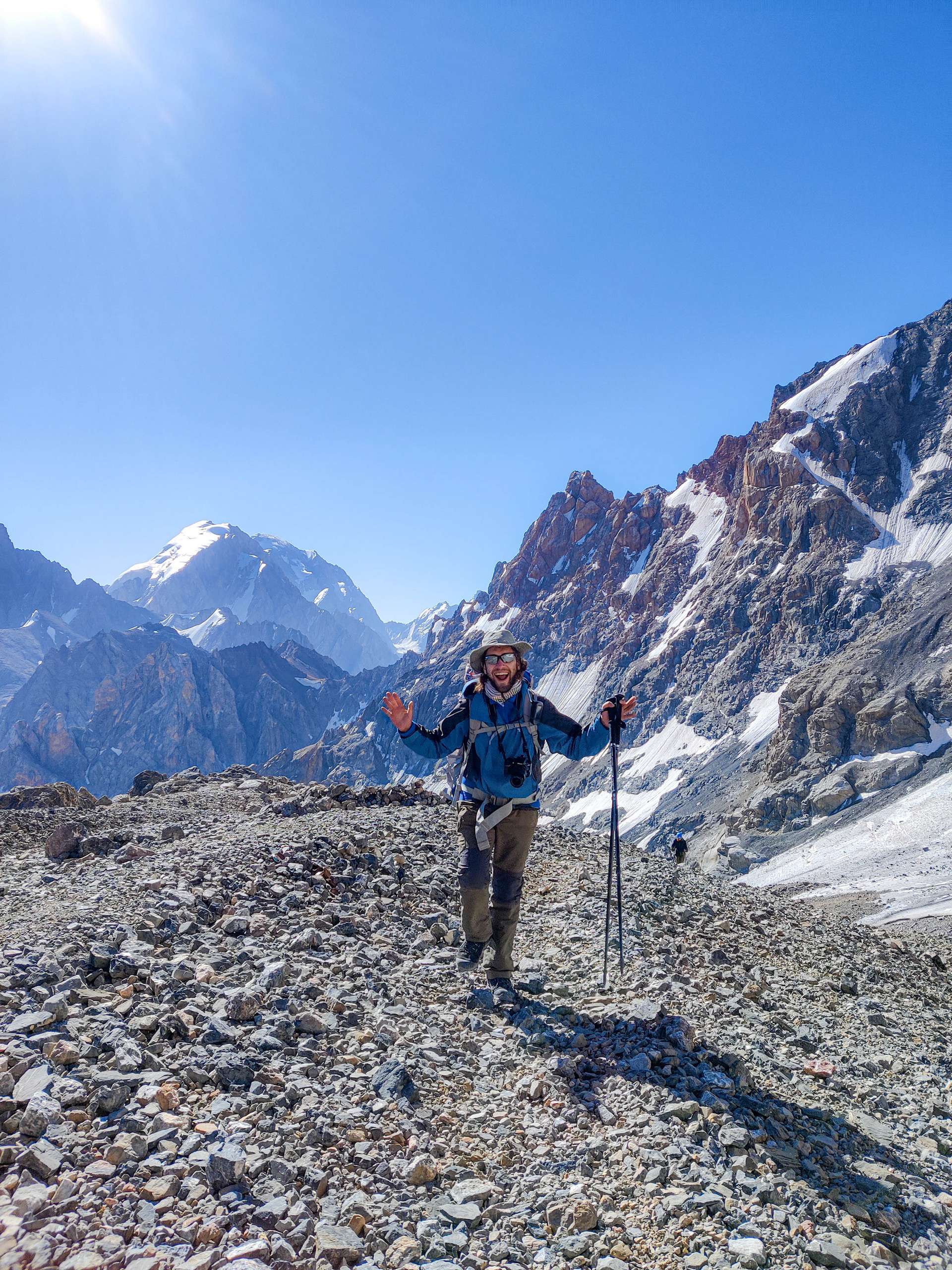
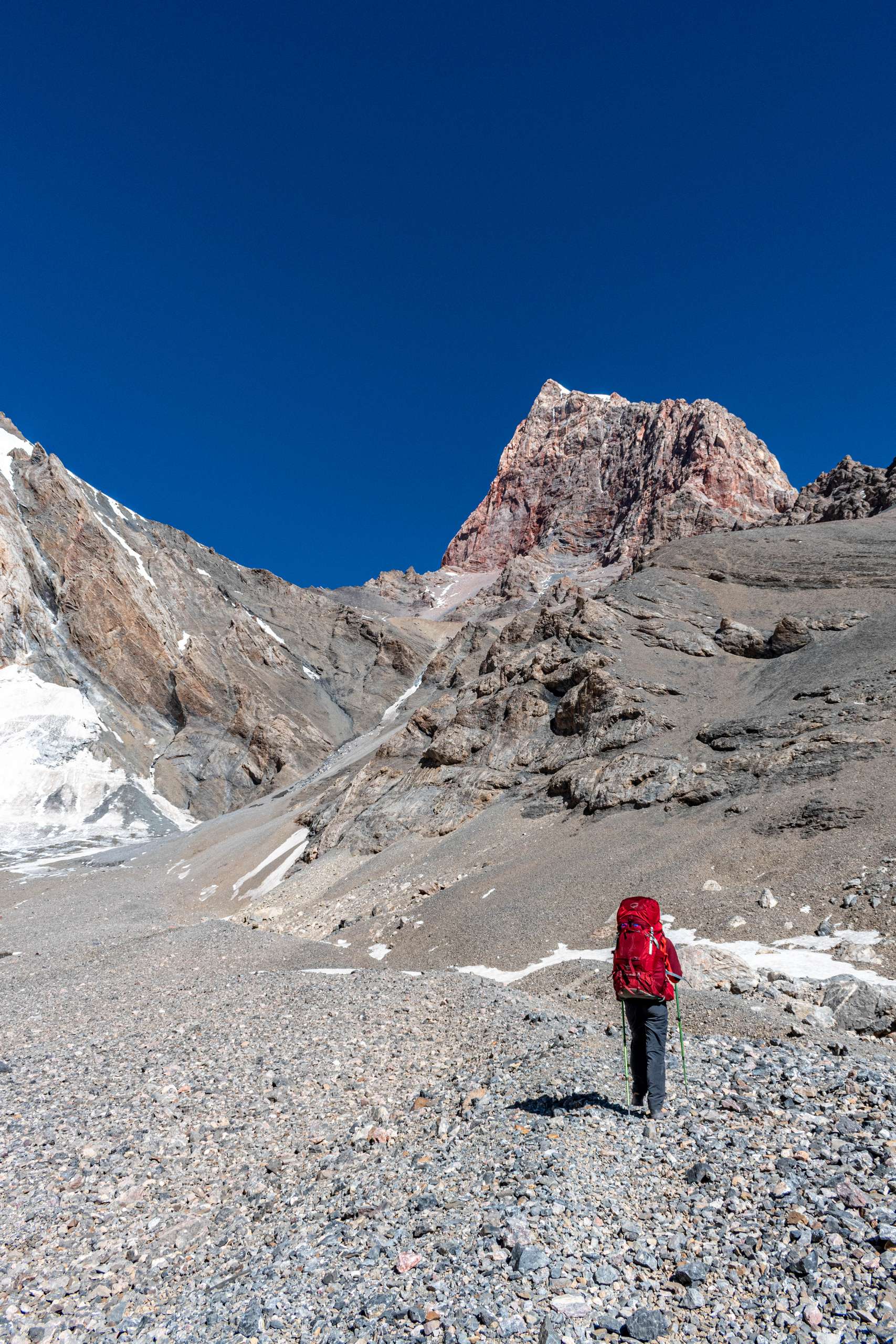
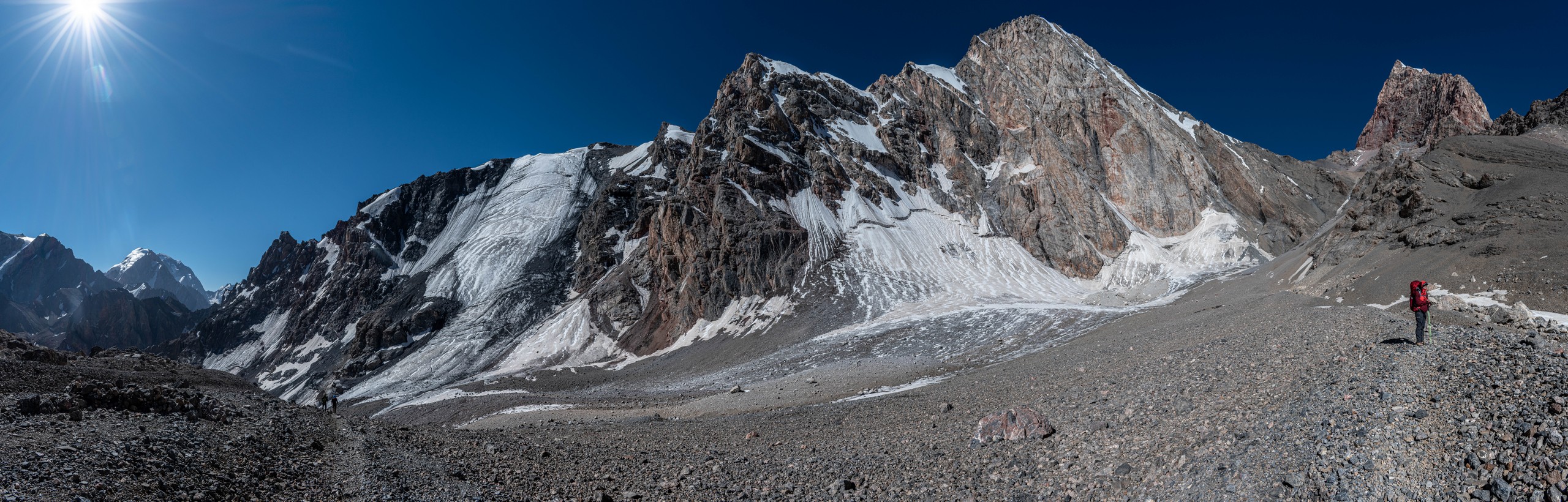
Another hour later, we climbed to 4400 meters, where there were also spots for tents. We were leading the way along a narrow, loose trail with a steep incline, and the guys followed behind us. At this point, I started feeling worse — my head began to ache, and with every effort (each step), a throbbing pain pulsed in the upper part of my head. We asked the guys to take a picture of us with our DSLR (the only non-selfie photo of us from the trip) and let them go ahead. I took Spasgan (antispasmodic) for my headache.
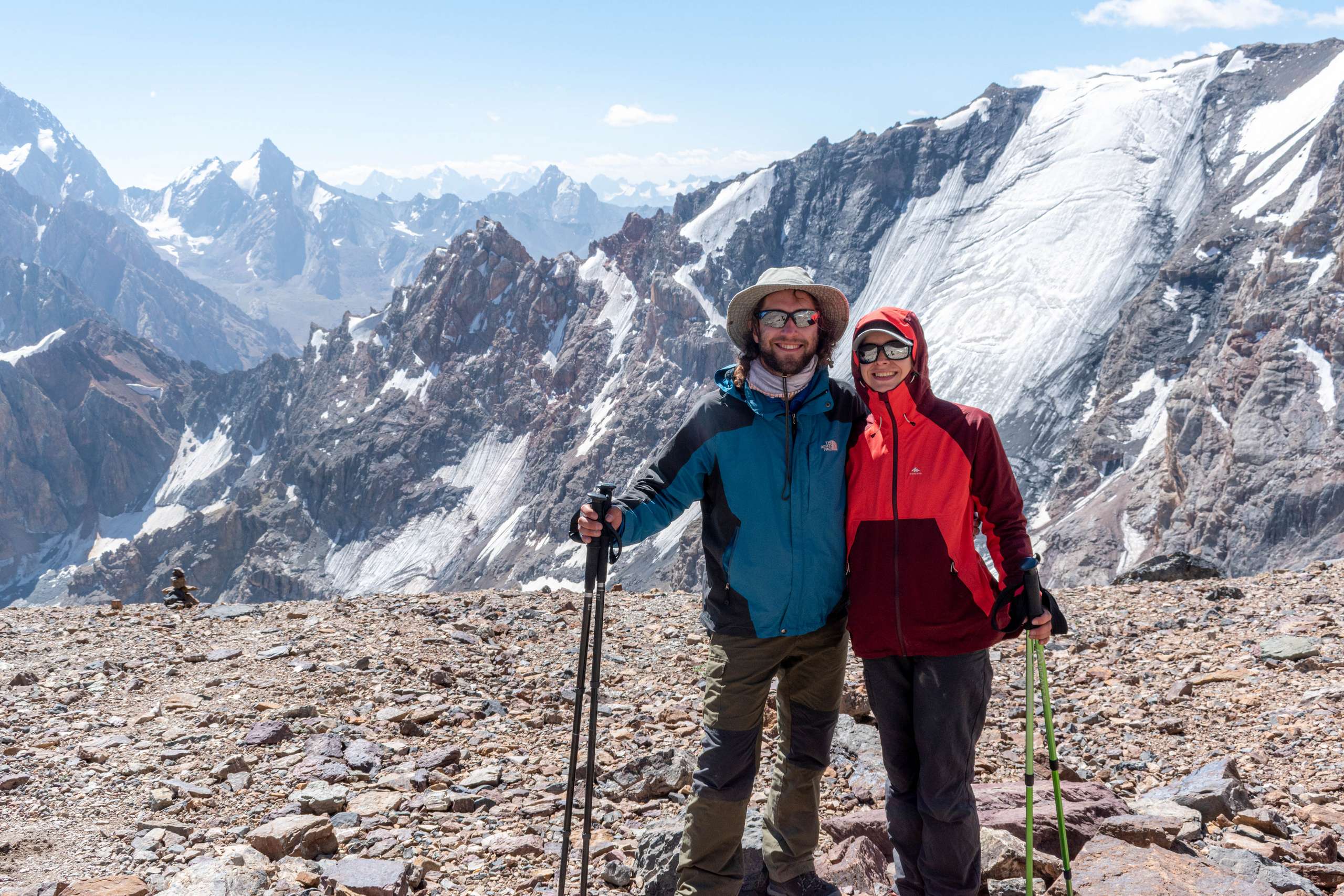
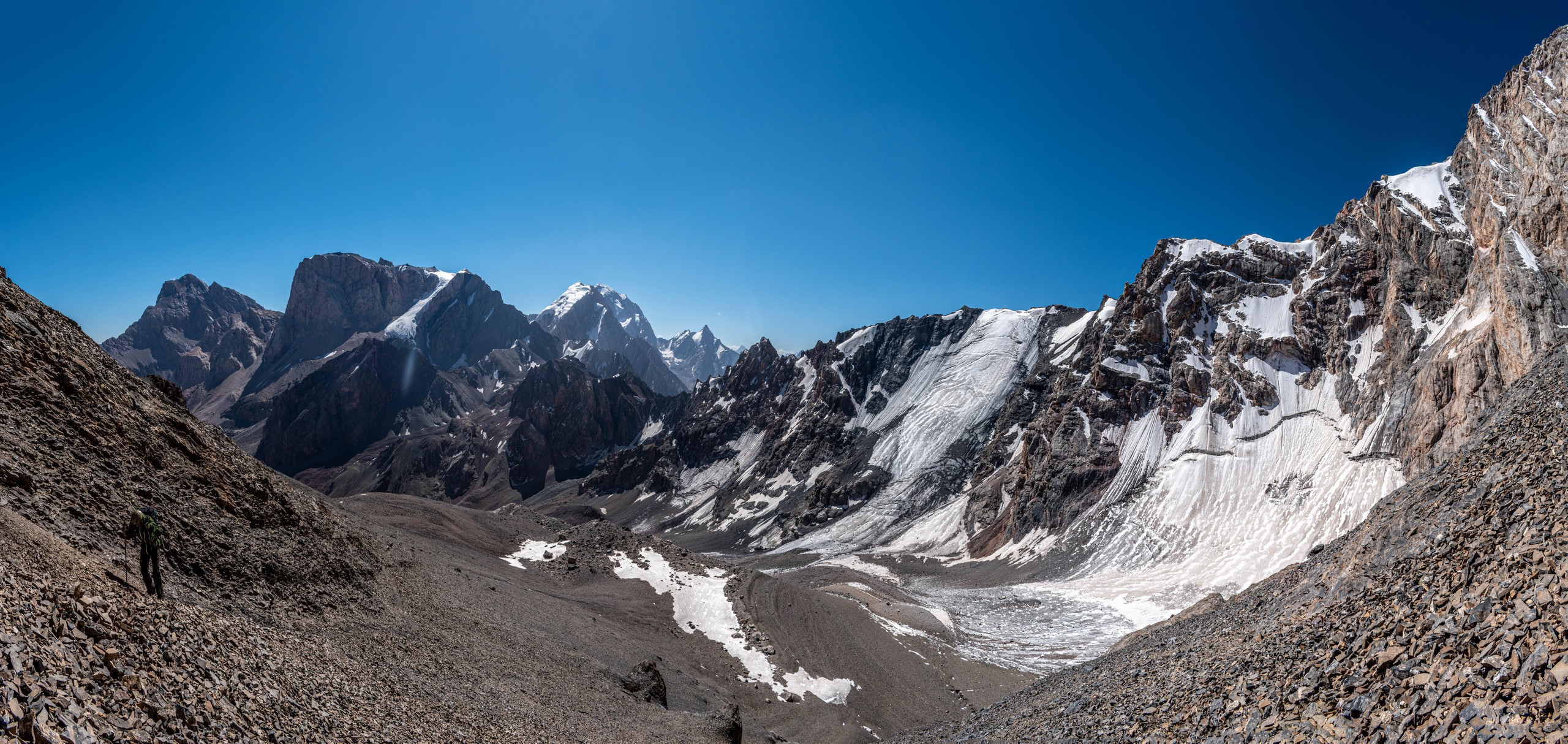
We were dressed warmly from the early morning: thermal pants with regular pants over them, a thermal shirt, fleece, windproof jacket, and a buff. Even with all that, it was cold during stops. I was sure that once the sun came out, it would get hot and we would start shedding layers, but no — it was the opposite. I even wanted to put on gloves as the wind grew wilder.
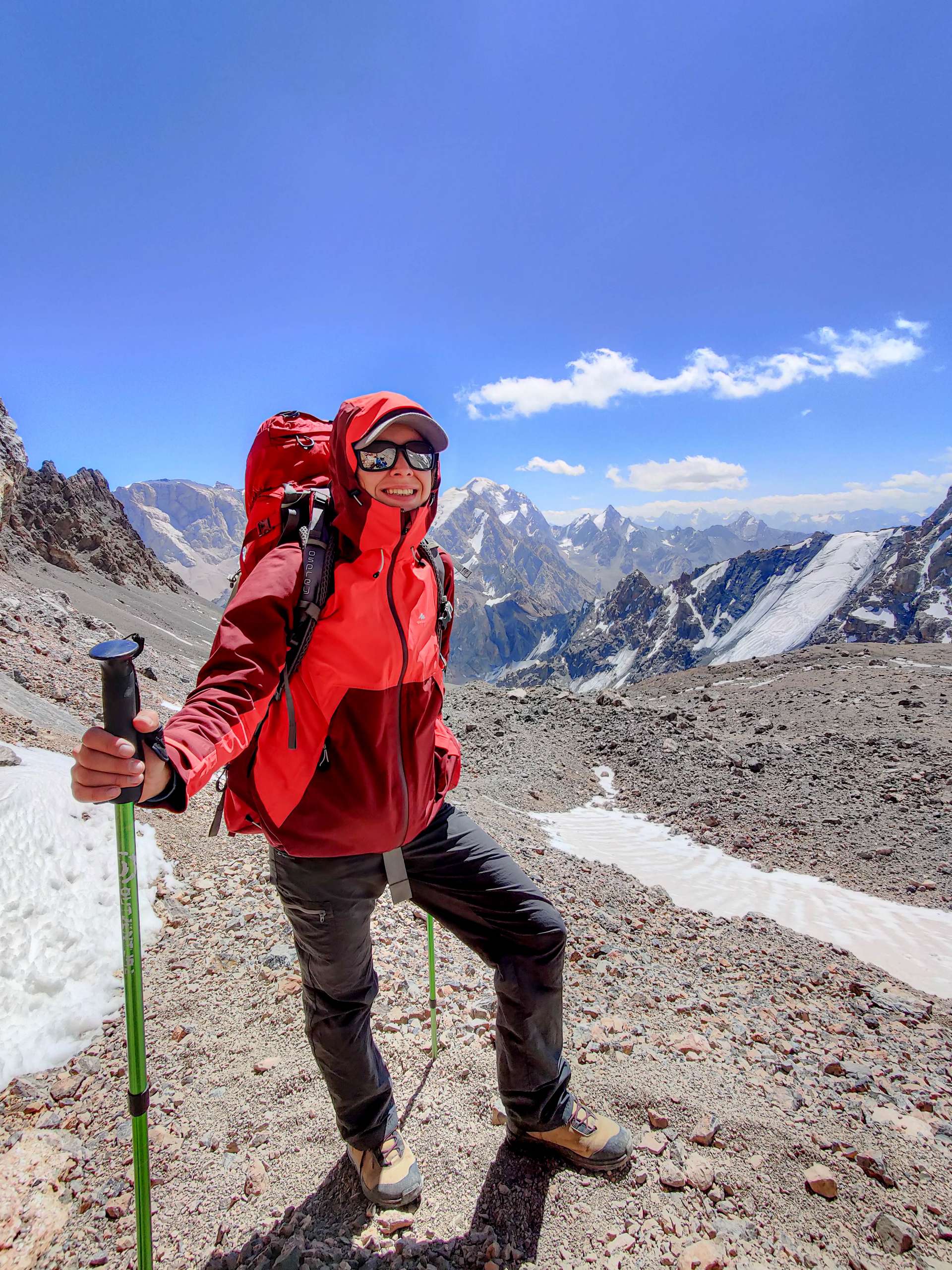
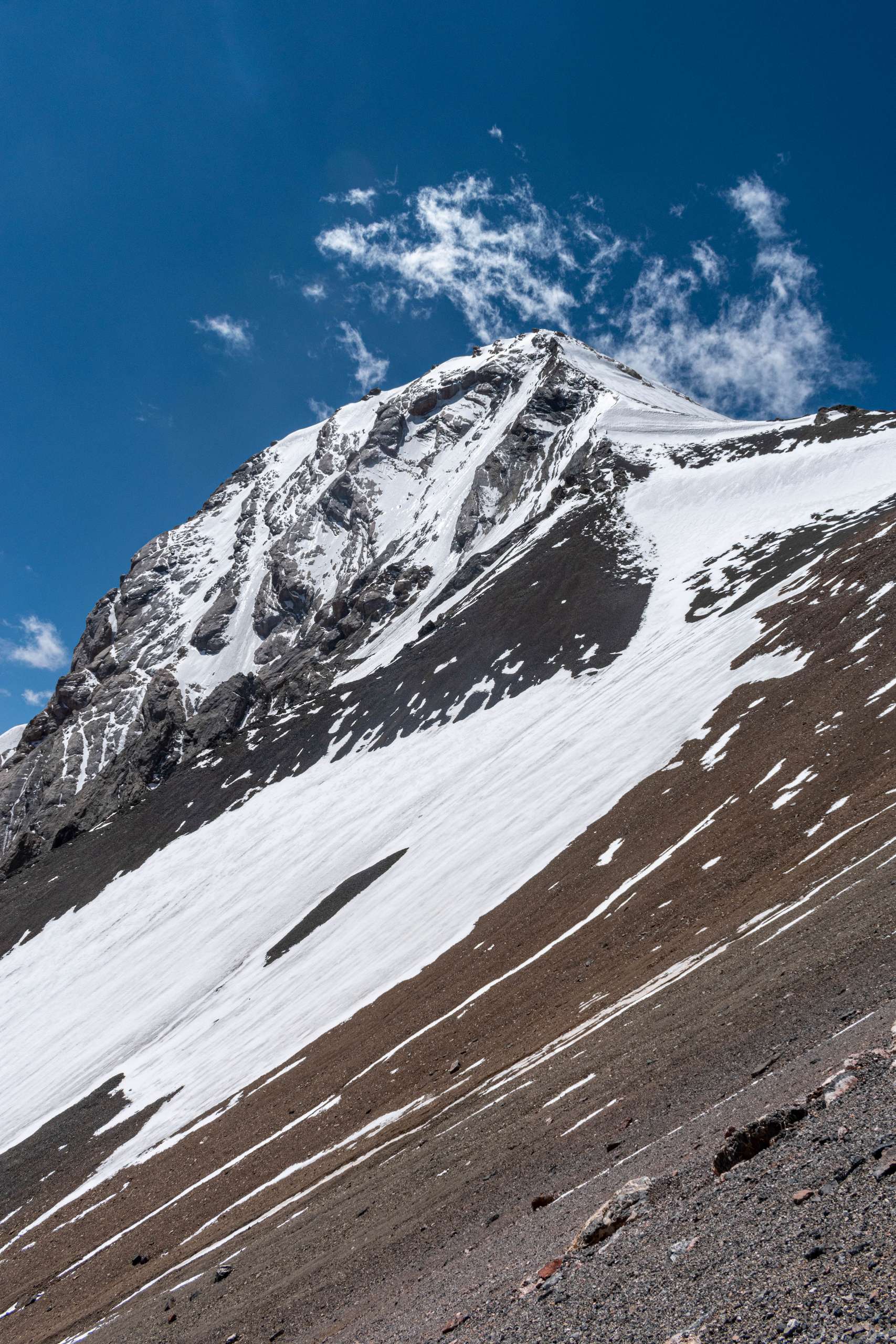
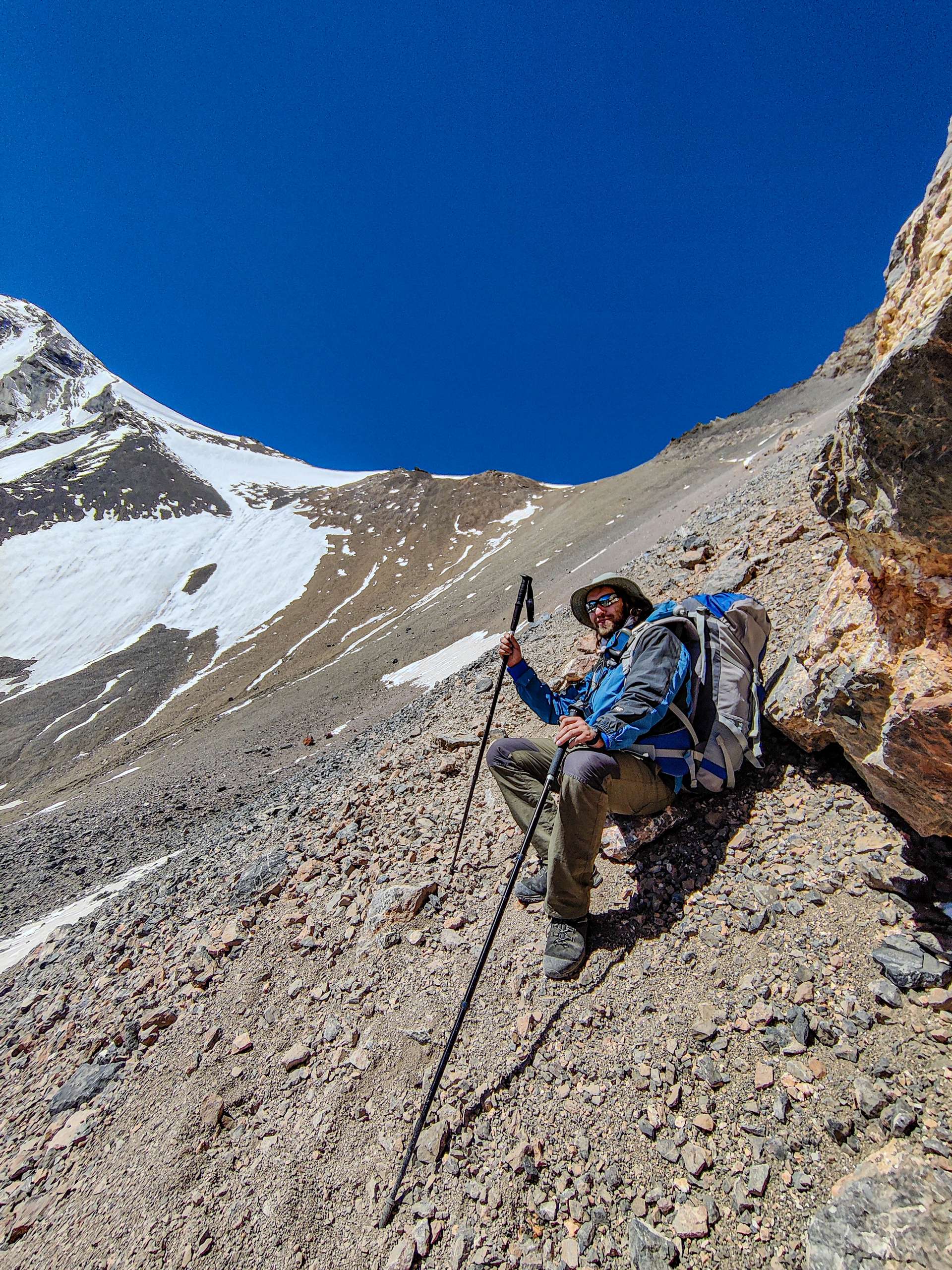
By 10:40, we reached the 4500m camp, where the guys were already putting on climbing gear, pulling out ice axes, and getting ready for the ascent. They reassured us that we had a good pace and plenty of time to reach Lake Bolshoi Alo.
Meanwhile, my headache was getting worse — maybe from dehydration, exertion, or the altitude. According to our plan, we were supposed to have sandwiches and tea here. There was no visible water, only snow. But we were eager to get over the pass while the weather was good and start descending. We were thinking that we would soon reach the river (How wrong we were!).
The trail to the pass looked clear from a distance and seemed quite gentle. However, in reality, it was a hellish scree slope with a steep incline. Every small step forward was followed by sliding half a step back with the rocks. All of this accompanied by the pounding pain in my head. Katya was doing great by the way.
These 240 meters by altitude to the pass took us 2 hours to cover. We finally reached the pass at 12:50. On the way up, I took another Nurofen tablet (pain relief) for my headache, but it didn’t help, the pain persisted until the evening. The worst part was that the pain intensified with sudden movements, and on steep descents and ascents, such movements were often crucial for maintaining balance.
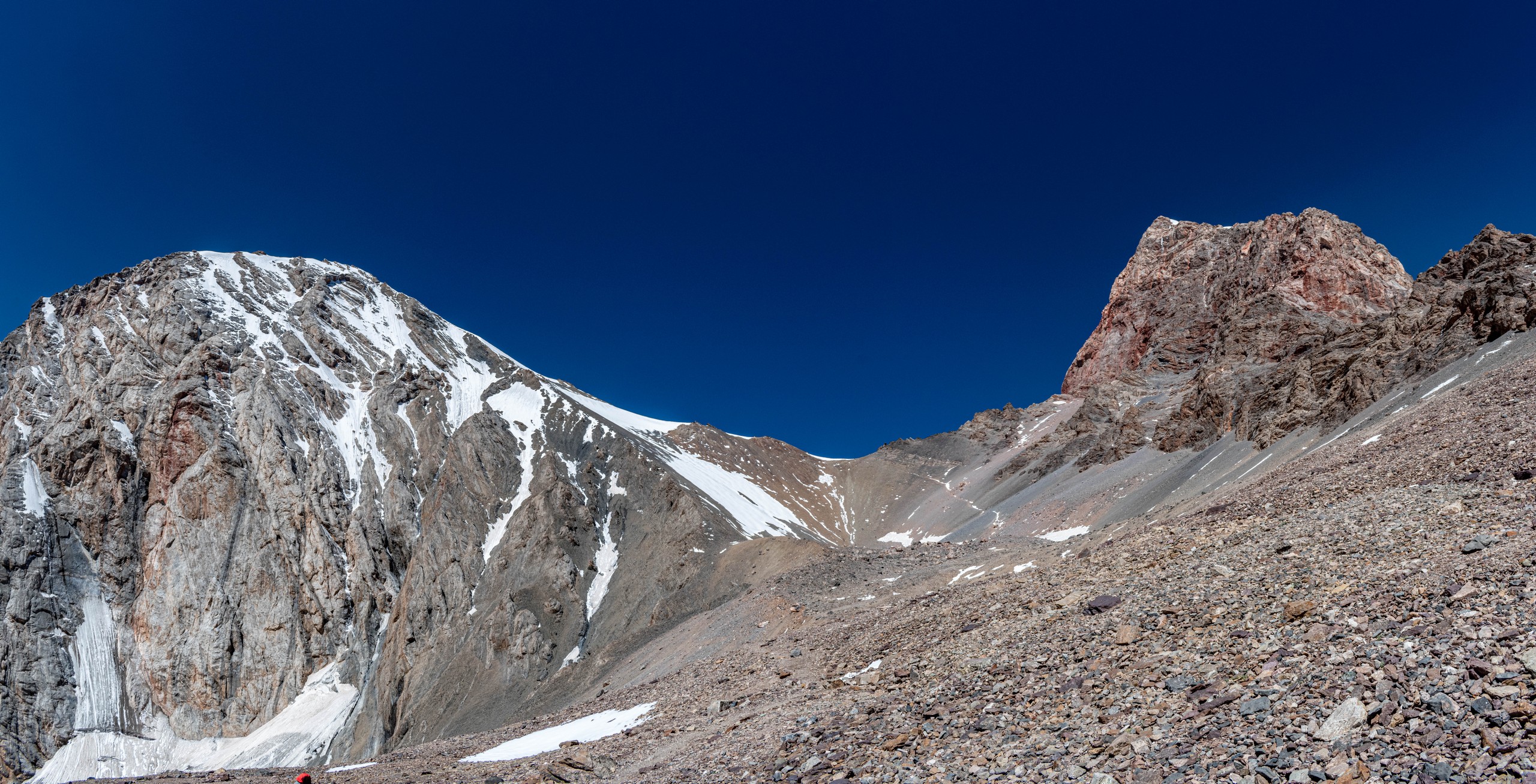
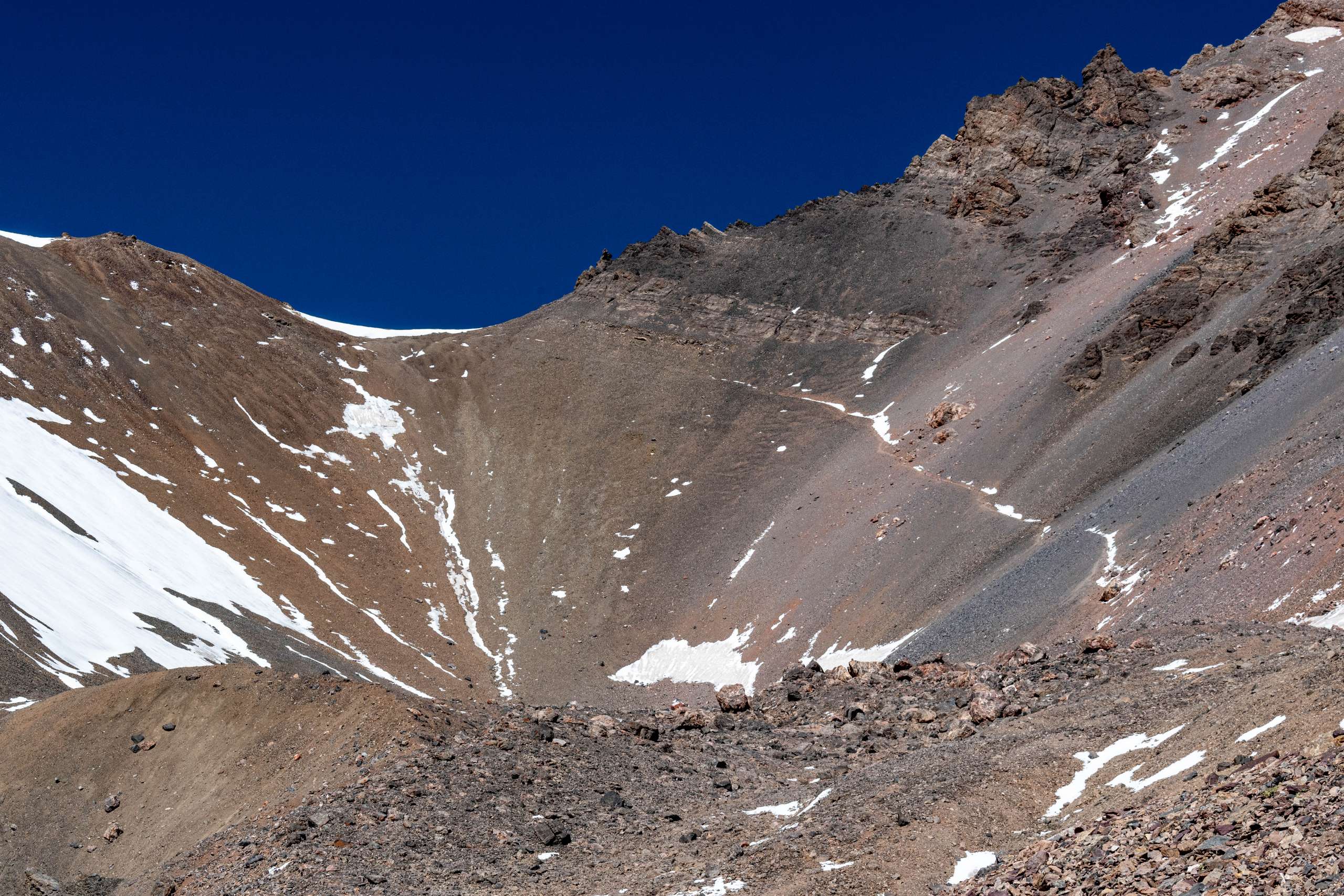
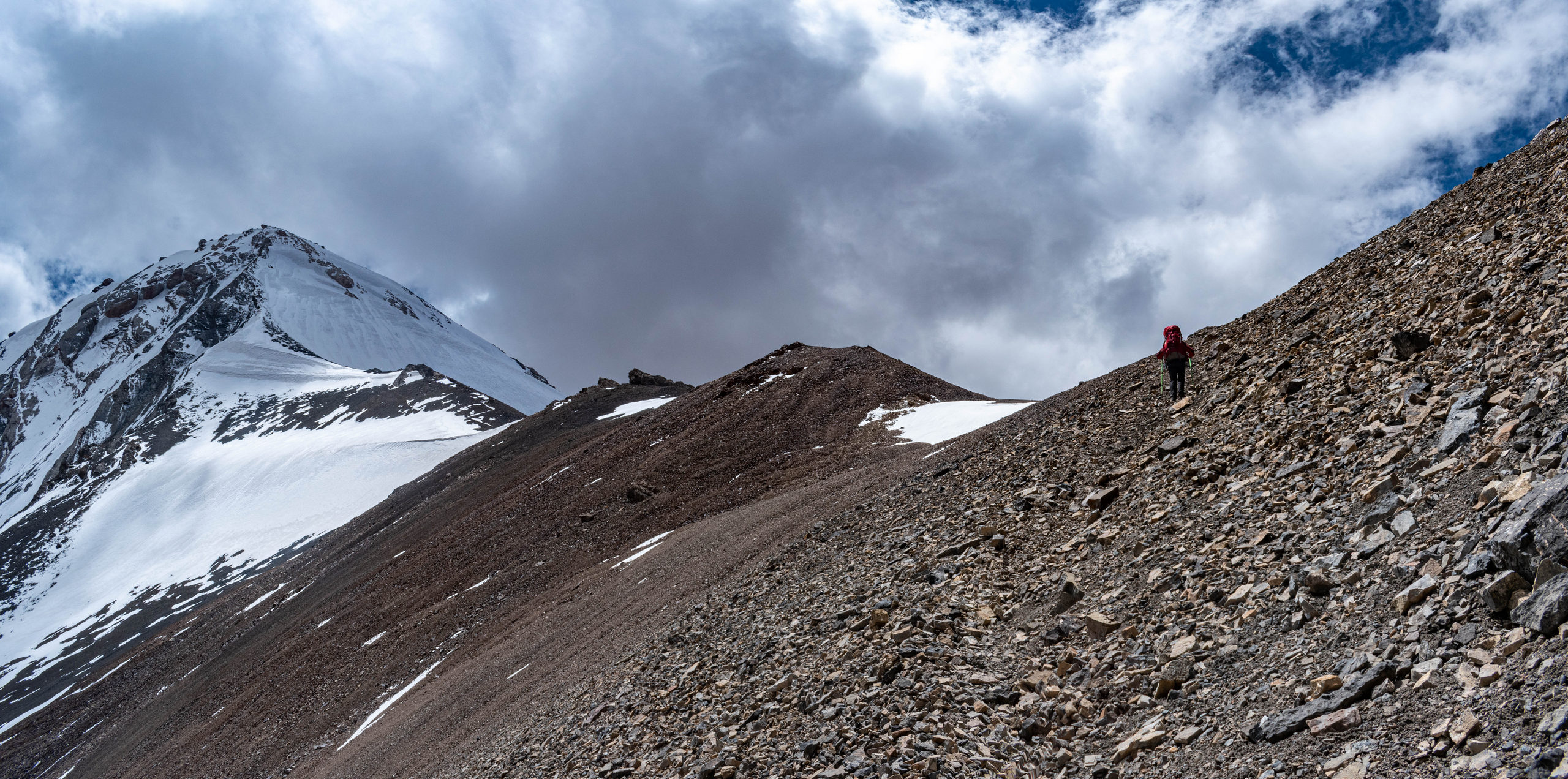
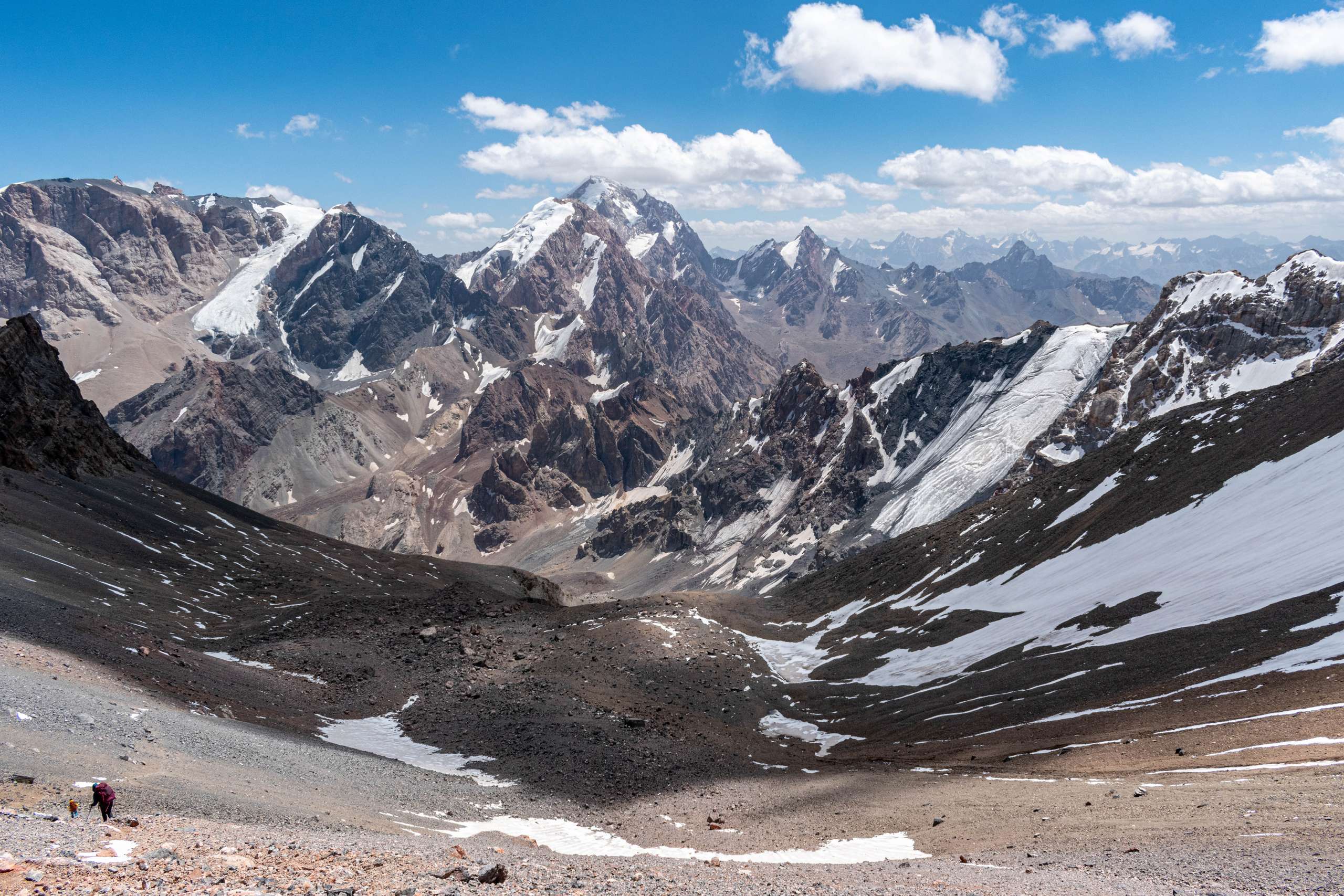
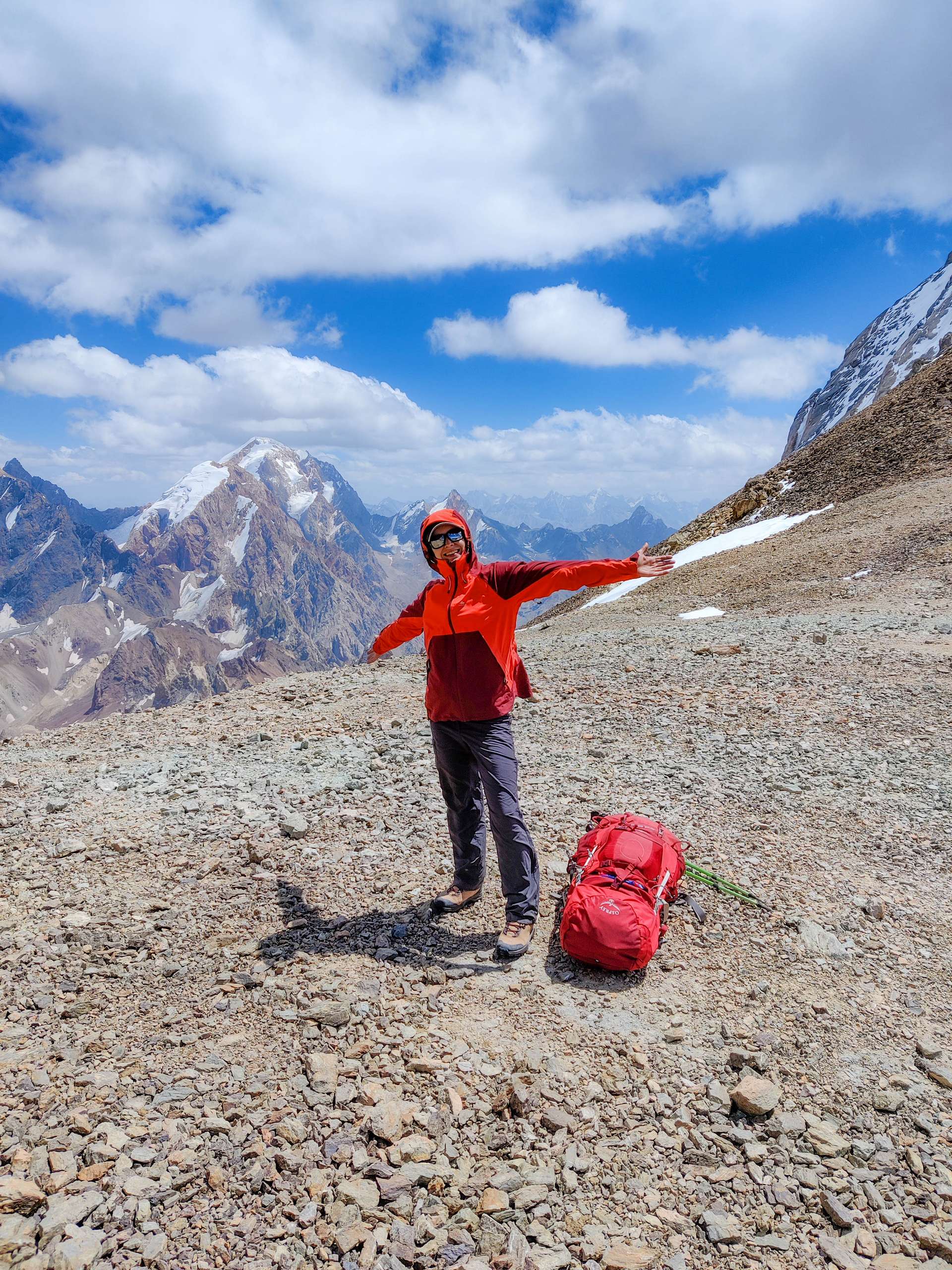
The view at the pass is stunning! High white clouds appeared, further enhancing the photos. On both sides of the pass, snowy mountains stretch into the deep distance, cold and majestic. To the right stands Chimtarga, its southern slope, and to the left, the peak of Energia, which many come here to conquer. The Chimtarga pass (1B, 4740 m) is the highest point we reached. The wind here is very strong, almost knocking us off our feet. So, we quickly took photos, shot a video, and hurried down.
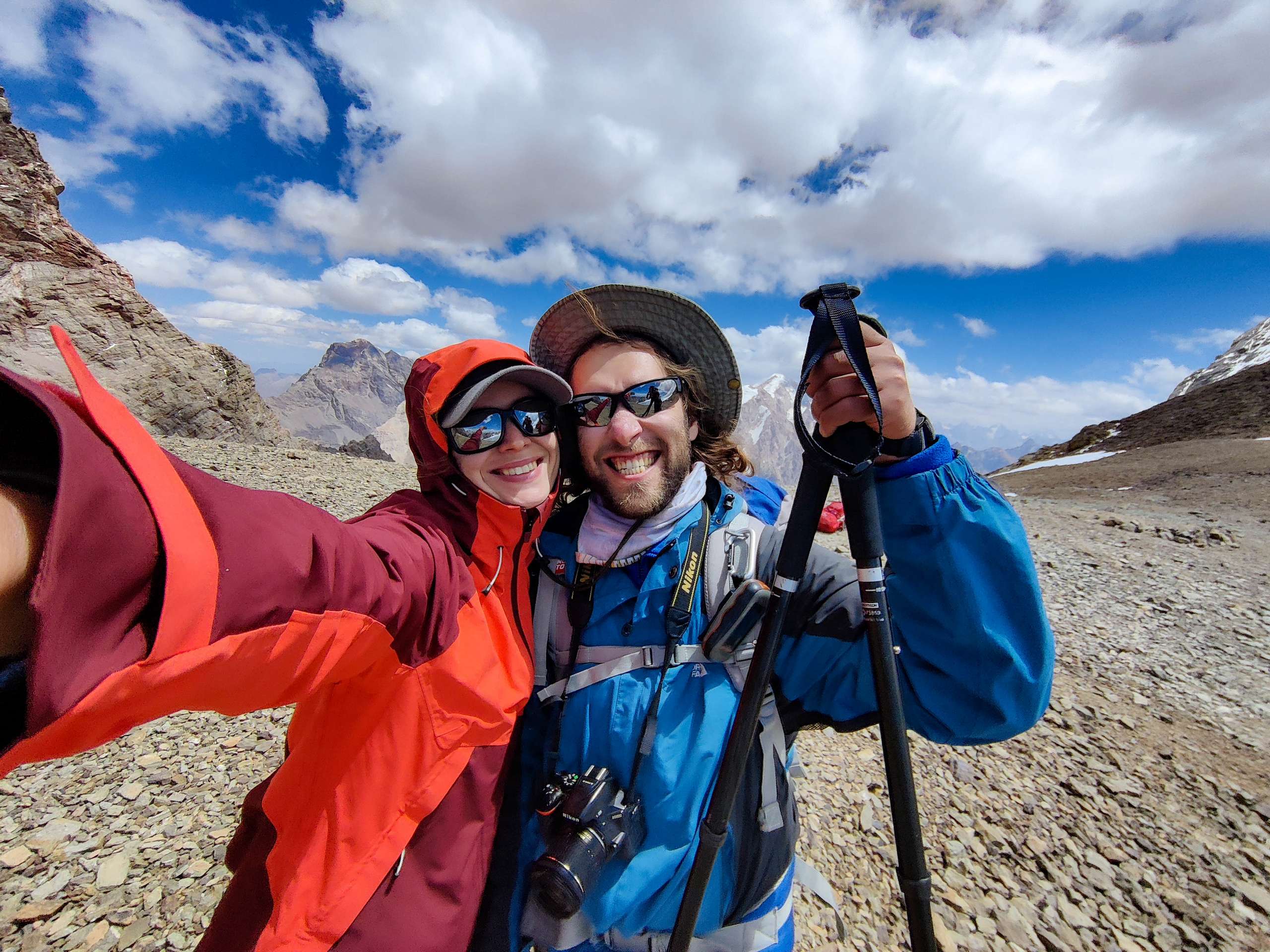
We read a lot about the descent from the Chimtarga pass. According to descriptions, there’s a very loose scree, where you slide down quickly, or rather, almost float. That is, you take a step forward with your foot, and after shifting your weight, you slide another meter or two along with a pile of rocks. Because of this section, we even considered taking helmets, but after watching videos of commercial tour groups navigating this area, we decided not to overweight our backpacks.
On the descent, there is a giant snowfield to the left, and the trail from the pass misleadingly veers off to the left. At first, we followed it too and cheerfully ran along, but after checking the GPS navigator, we corrected our path to the right. Later in the day, we met a couple who had passed through here the previous day, and they had followed that trail almost to the snowfield. About 50 meters before it, they encountered ice under the rocks and were carried down, they said they slid about 50 meters and couldn’t stop.
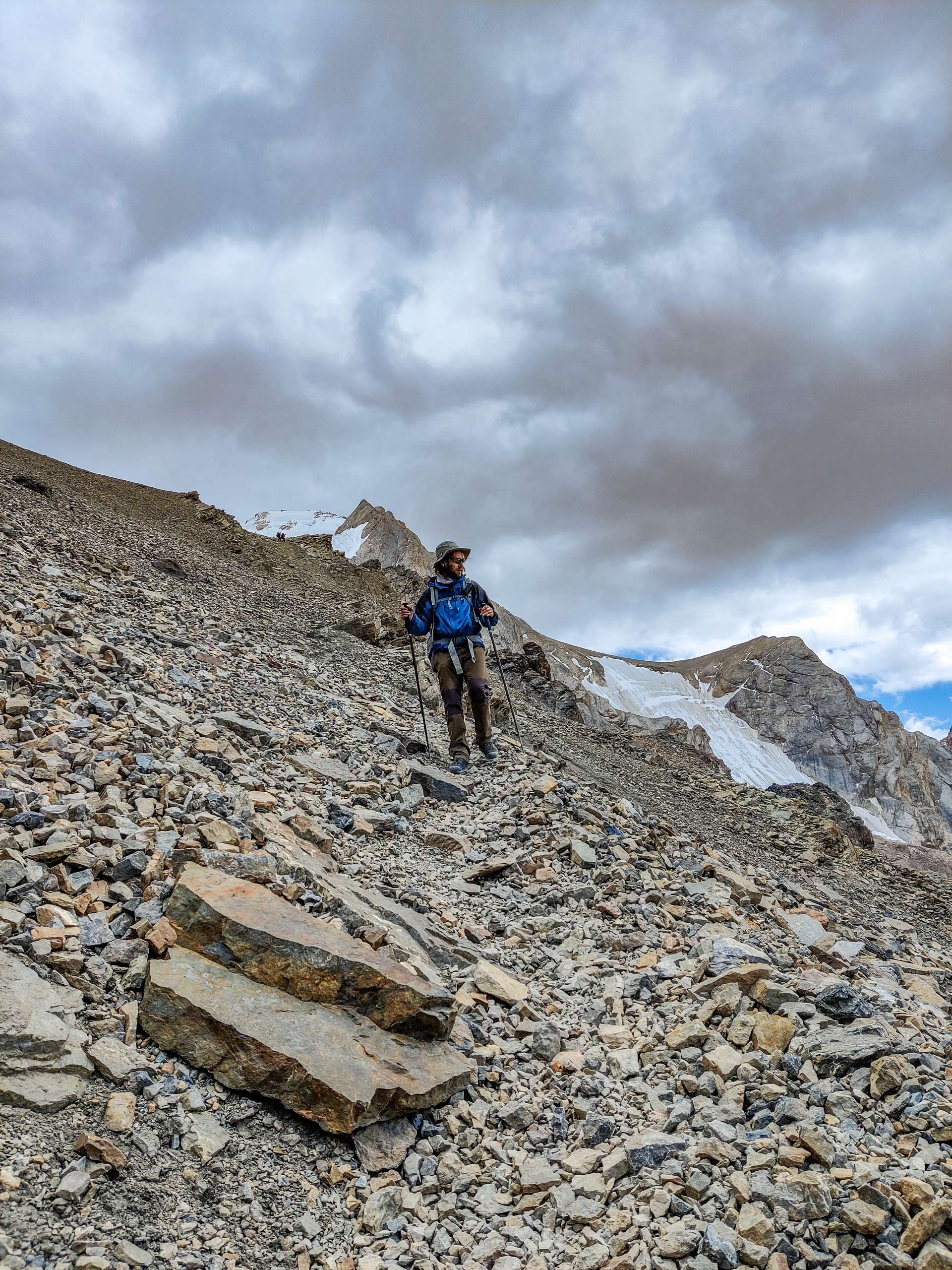
The streams we were hoping to use for lunch turned out to be dry. For some reason, we didn’t melt snow, even though we had plenty of gas. We managed to stop for a break only around 15:00 at an altitude of 3900 meters by the Right Zindon river. We struggled to get there, feeling weak, thirsty, and hungry, with our legs feeling heavy as we had covered about 7 km, with an ascent of 1240 meters and a descent of 780 meters. The trail was difficult — constant scree and, at times, very steep slopes. However, we got used to descending on such scree, and once we found a rhythm, it felt a bit like skiing, allowing us to descend fairly quickly. By the way, the boots take a real beating in this rocky terrain.
We had some tea and sandwiches by the river, which made us feel much better. We hadn’t been this tired in a while, our legs were literally shaking. Around 15:30, we moved on. There were still 6 km to the campsite at Lake Bolshoi Alo, with a descent of 700 meters. Along the river, there were two more campsites, and we passed by a tent where some people were staying. The wind here was still strong, and it was really cold. Since we truely wanted to take a rest day tomorrow and not go anywhere, we decided to push ourselves and try to reach Lake Bolshoi Alo.
The trail along the river is quite pleasant, with a gentle incline on average, although there are occasional steep descents along waterfalls. The mountain landscape is very beautiful and unique, with the color of the rocks varying significantly from one mountain to another. Many of the rocks are a deep reddish color. We also encountered numerous interesting flowers and plants — bushes with vibrant red flowers pushing through the rocks, and a plant with fleshy leaves covered in small white hairs.
By 17:00, we reached a steep descent from 3500 meters down to a small valley where the river spreads out. A beautiful view of this river delta opened up, even more stunning in the sunset light. We descended, dipped our feet in the river, and finally took off some clothes. It seemed like we had only a little left, around 2 km and 200 meters of descent.
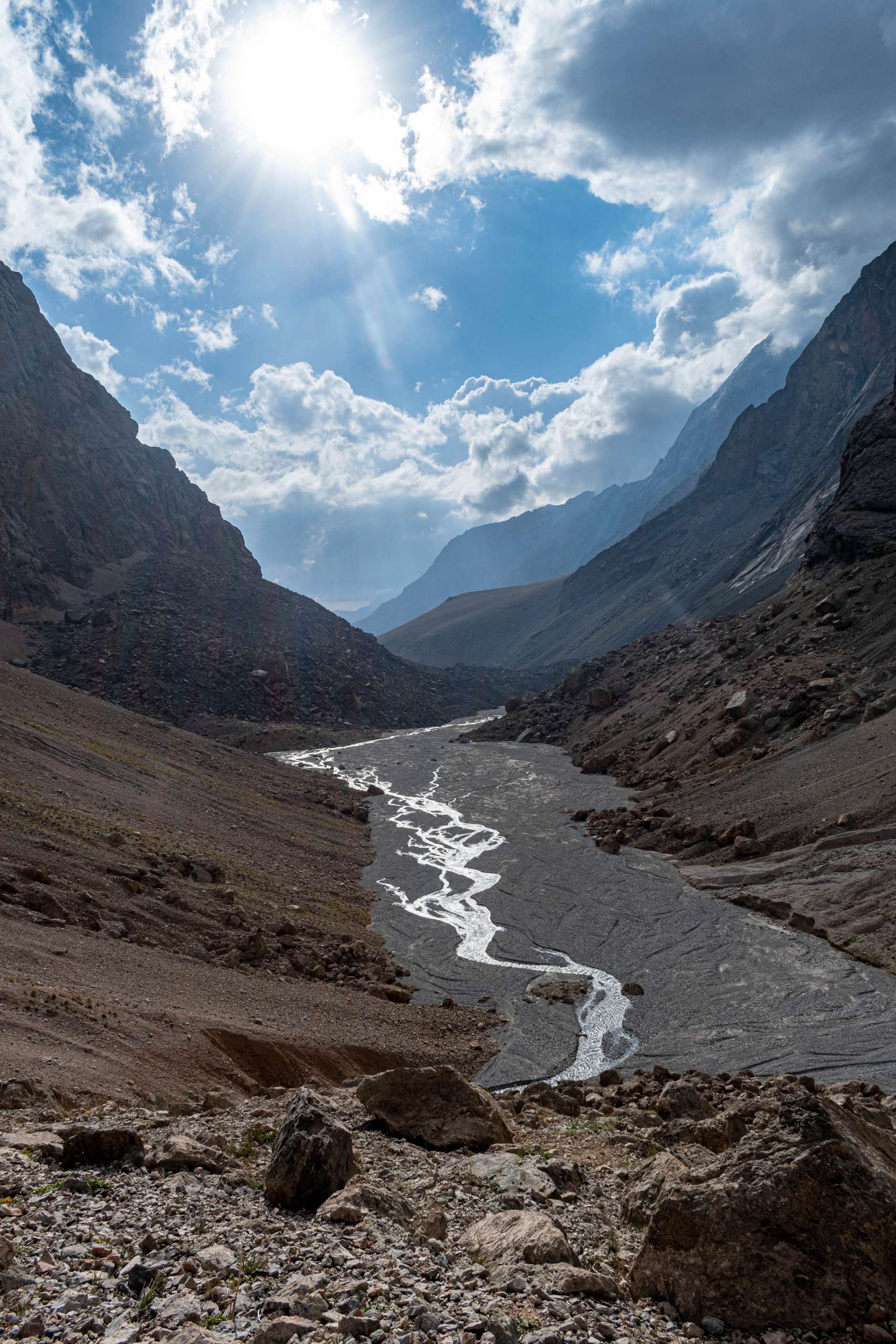
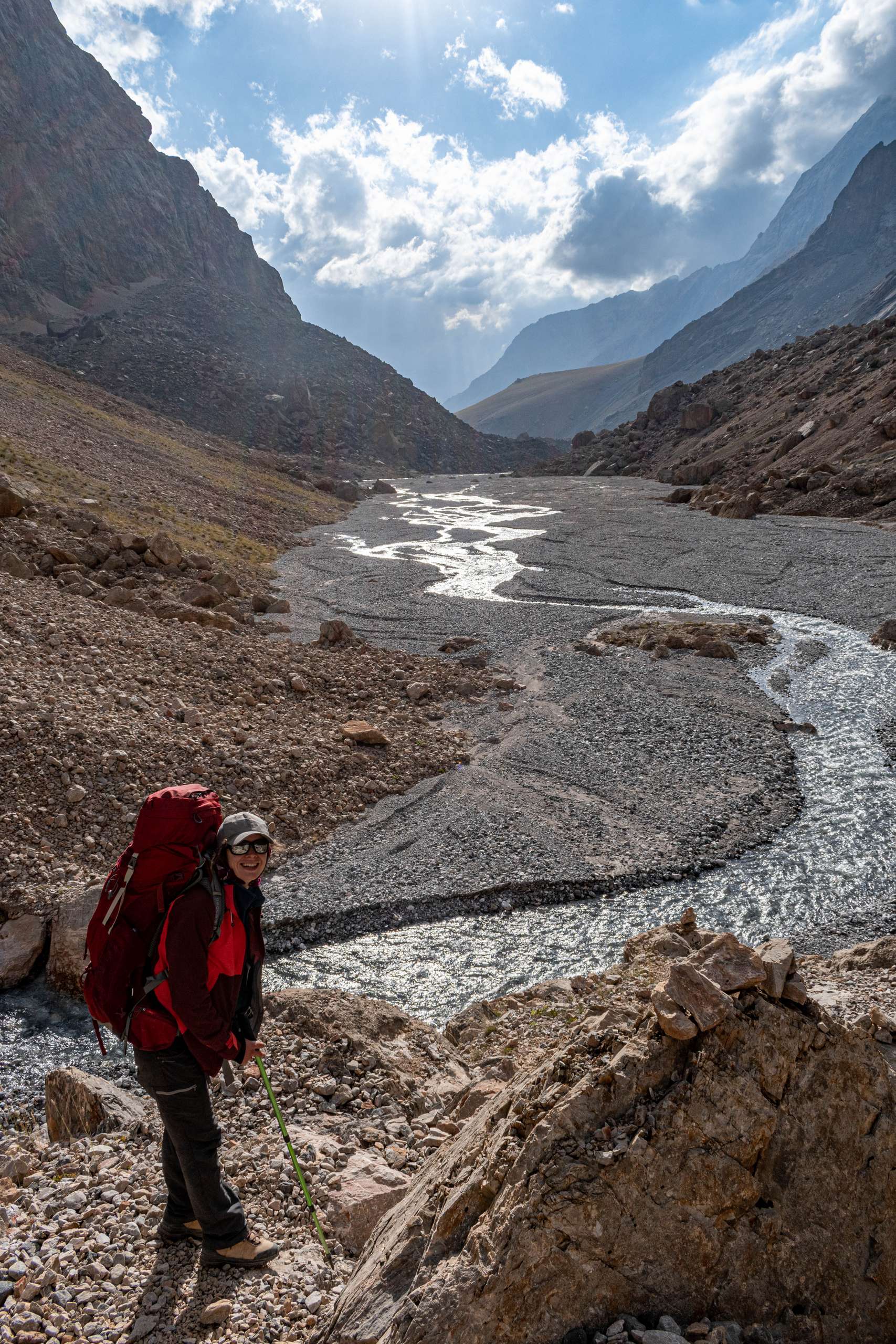
By 18:00, we reached the muddy lake. It was quite large, and the entire surface looked like wet sand, resembling quicksand. Near the center, there was a sinkhole. Apparently, water flows here, depositing the mud, while the water seeps underground.
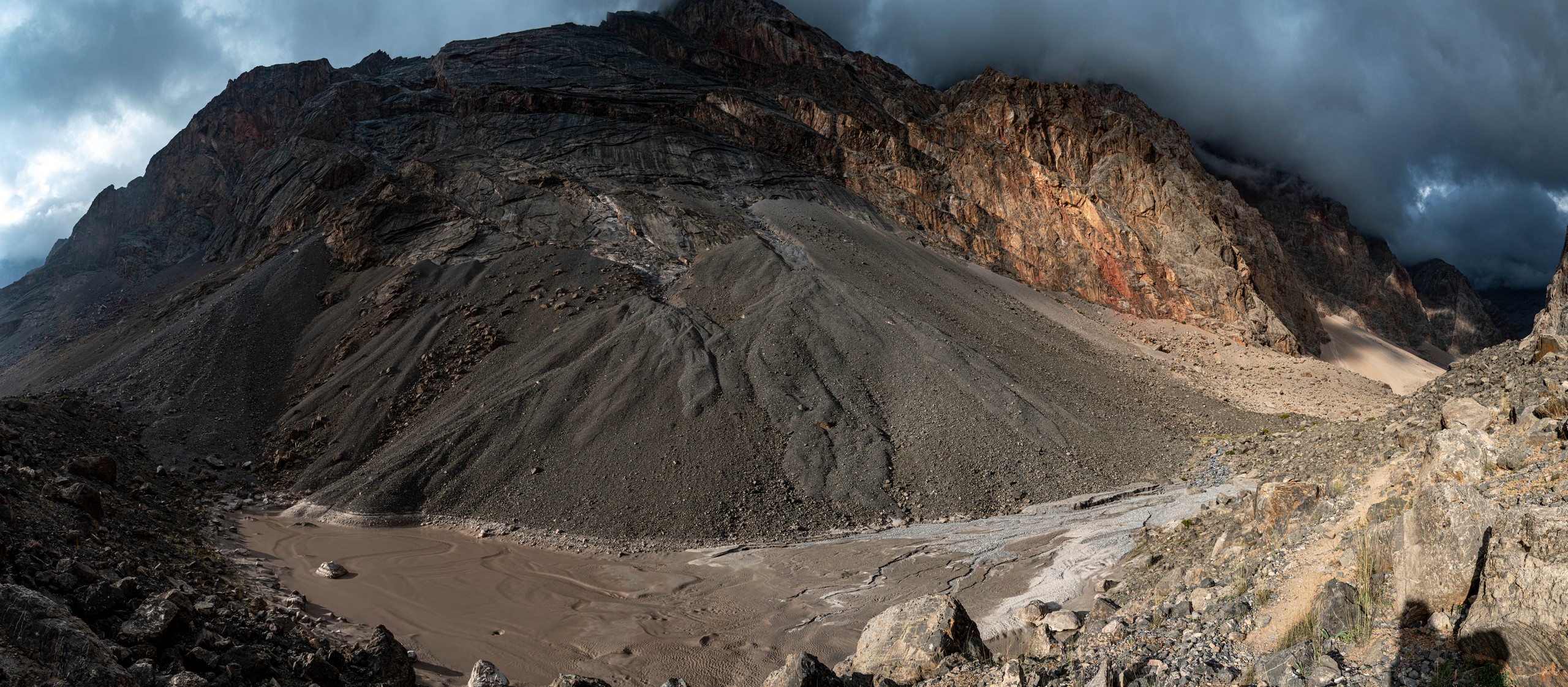
As it turned out, we had the final passage through a stone labyrinth. The trail winds between boulders, constantly getting tangled. Cairns are placed everywhere, wherever someone managed to squeeze through. There are a lot of high steps and constant searches for the right path.
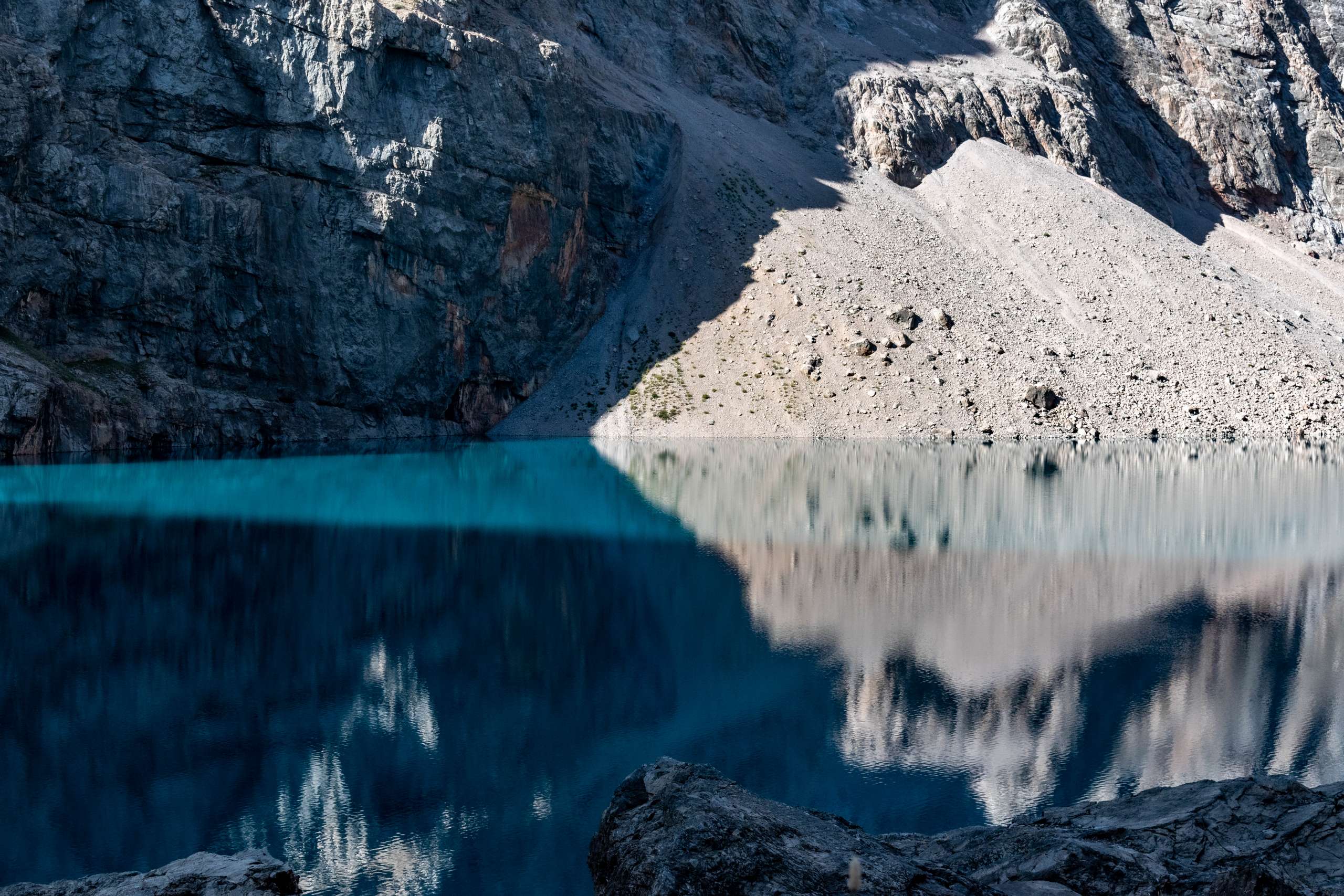
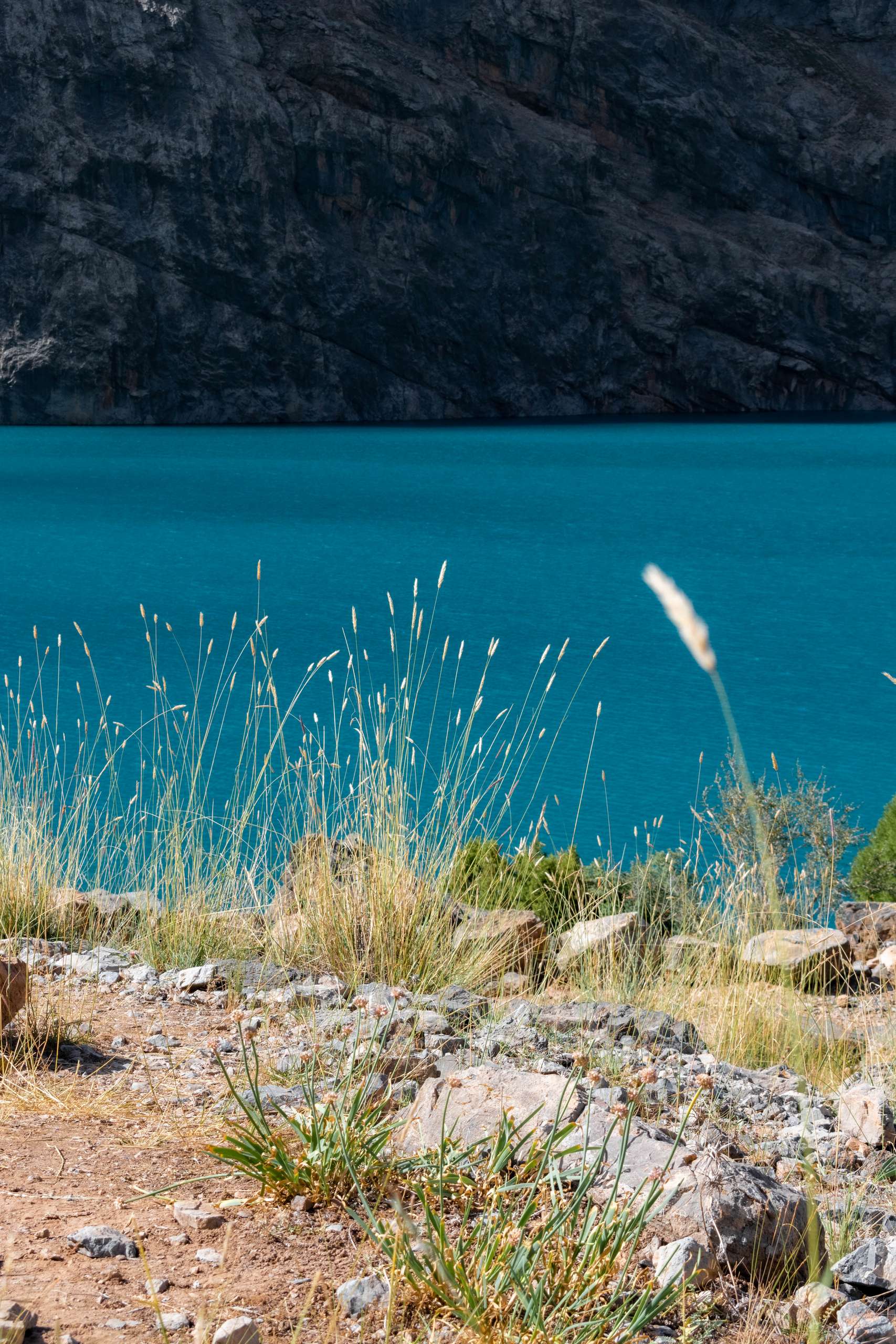
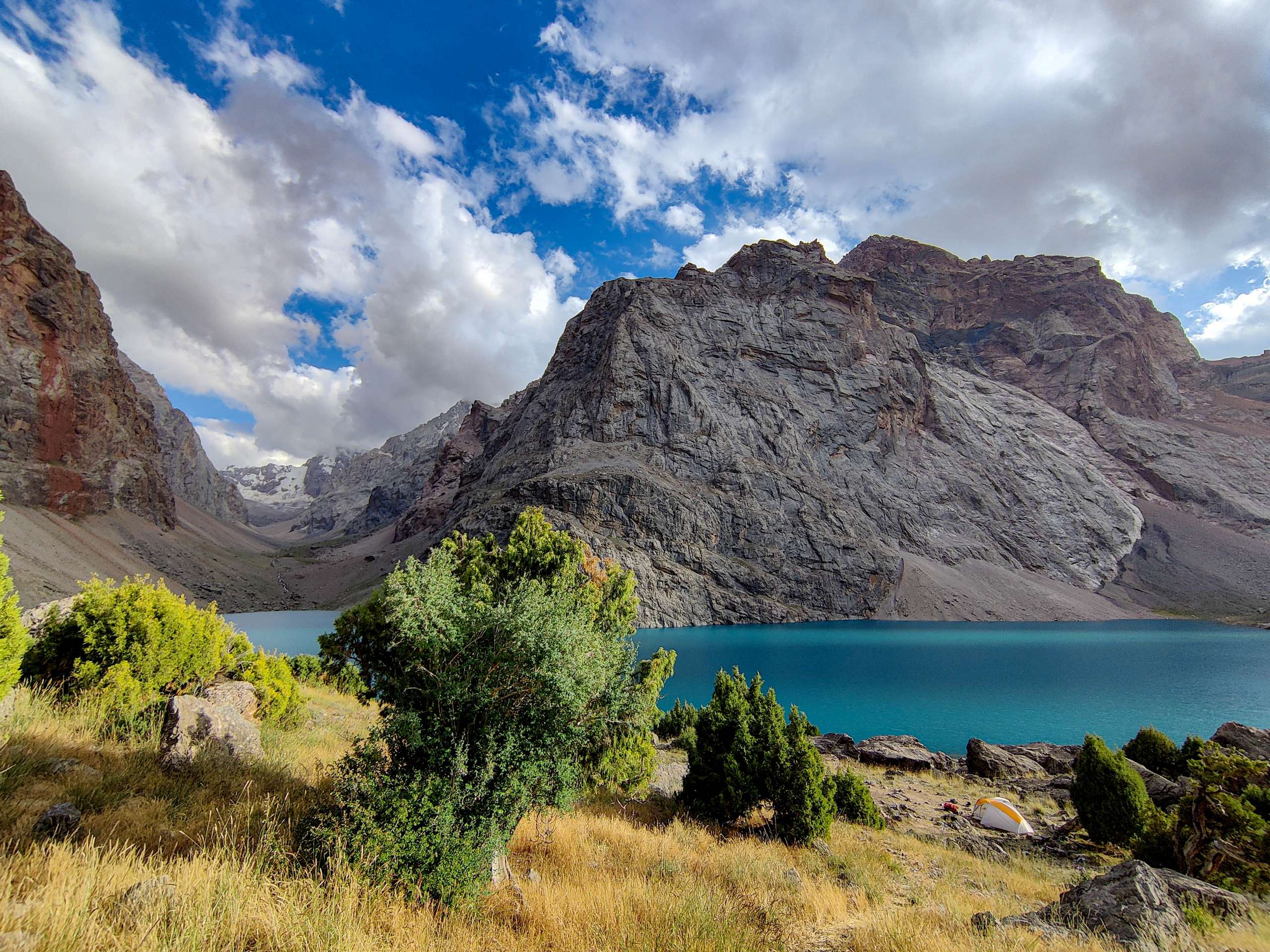
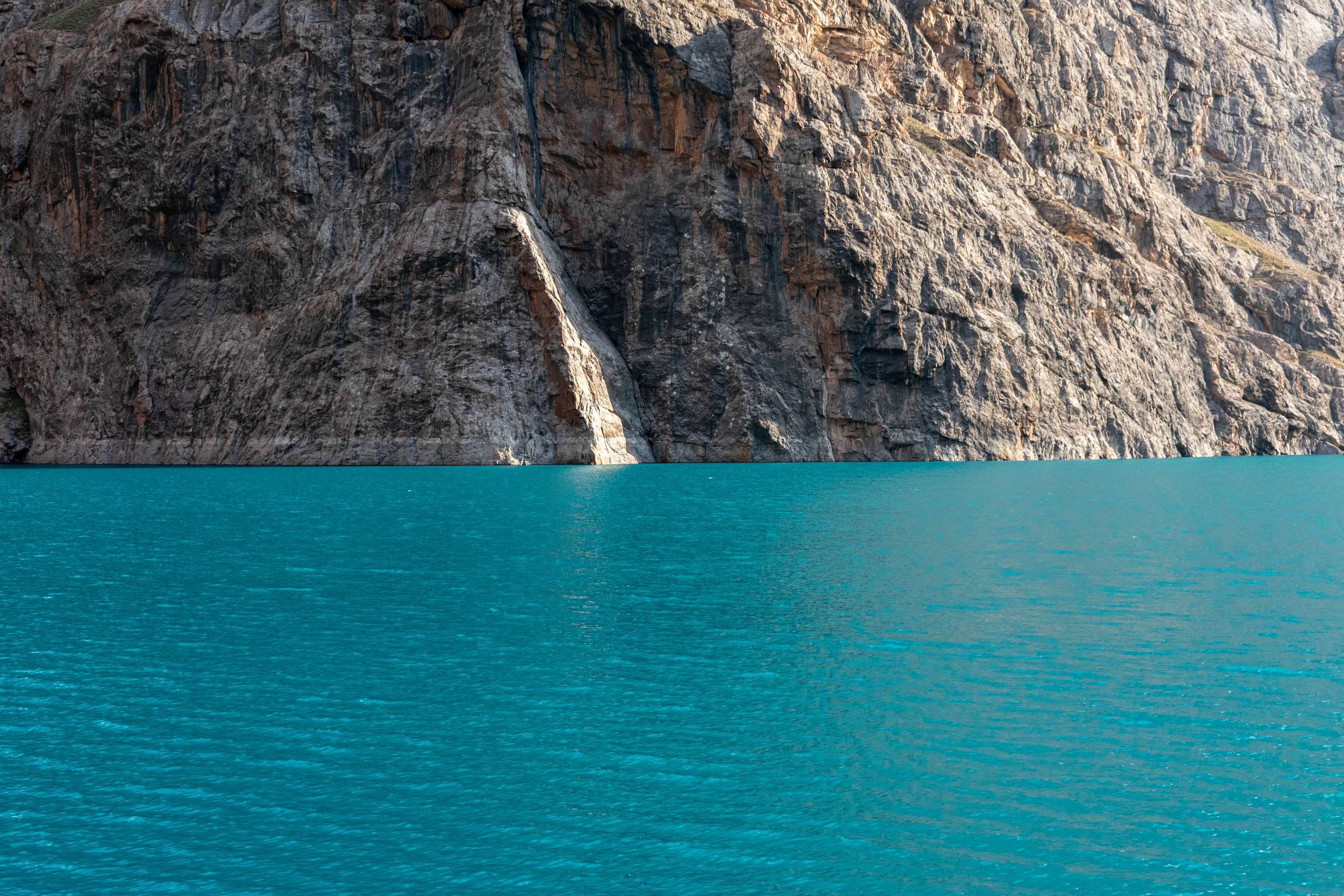
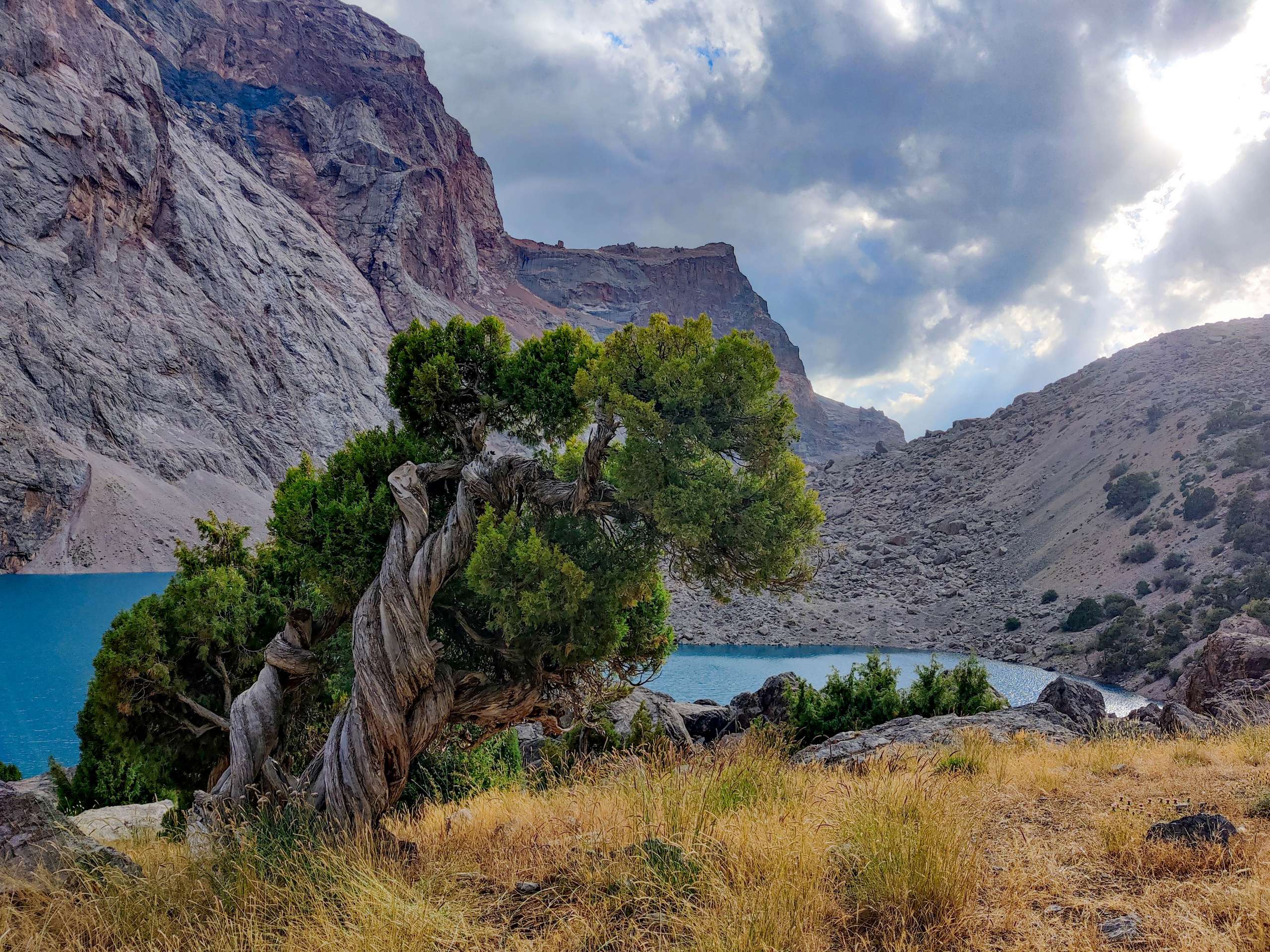
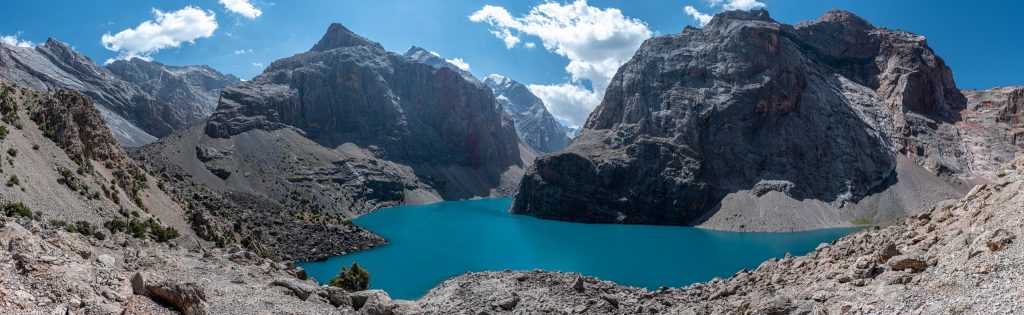
Finally, at 18:30, the Lake Bolshoi Alo opened up before us from above. It’s said to be one of the most beautiful lakes on the route. The color is very striking, a bright, rich, almost sea-like hue. The mountain wall opposite rises vertically into the water, creating a perfectly straight line of water level on the rock. To the left, the canyon of the Left Zindon River stretches into the distance and upward towards the snowy peaks. Below us, in the rays of the setting sun, was the only campsite by the lake, covered with junipers. One tent was visible there.
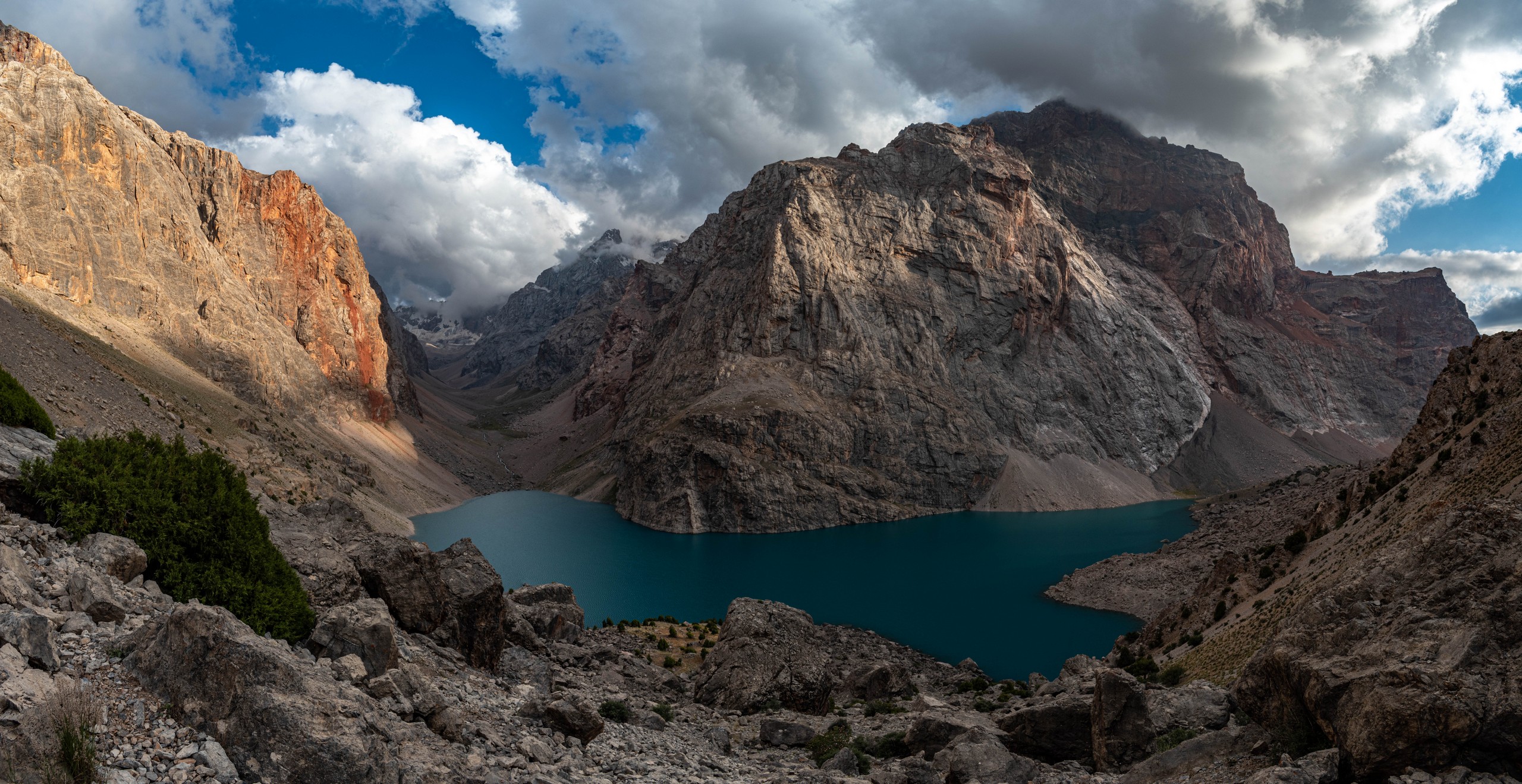
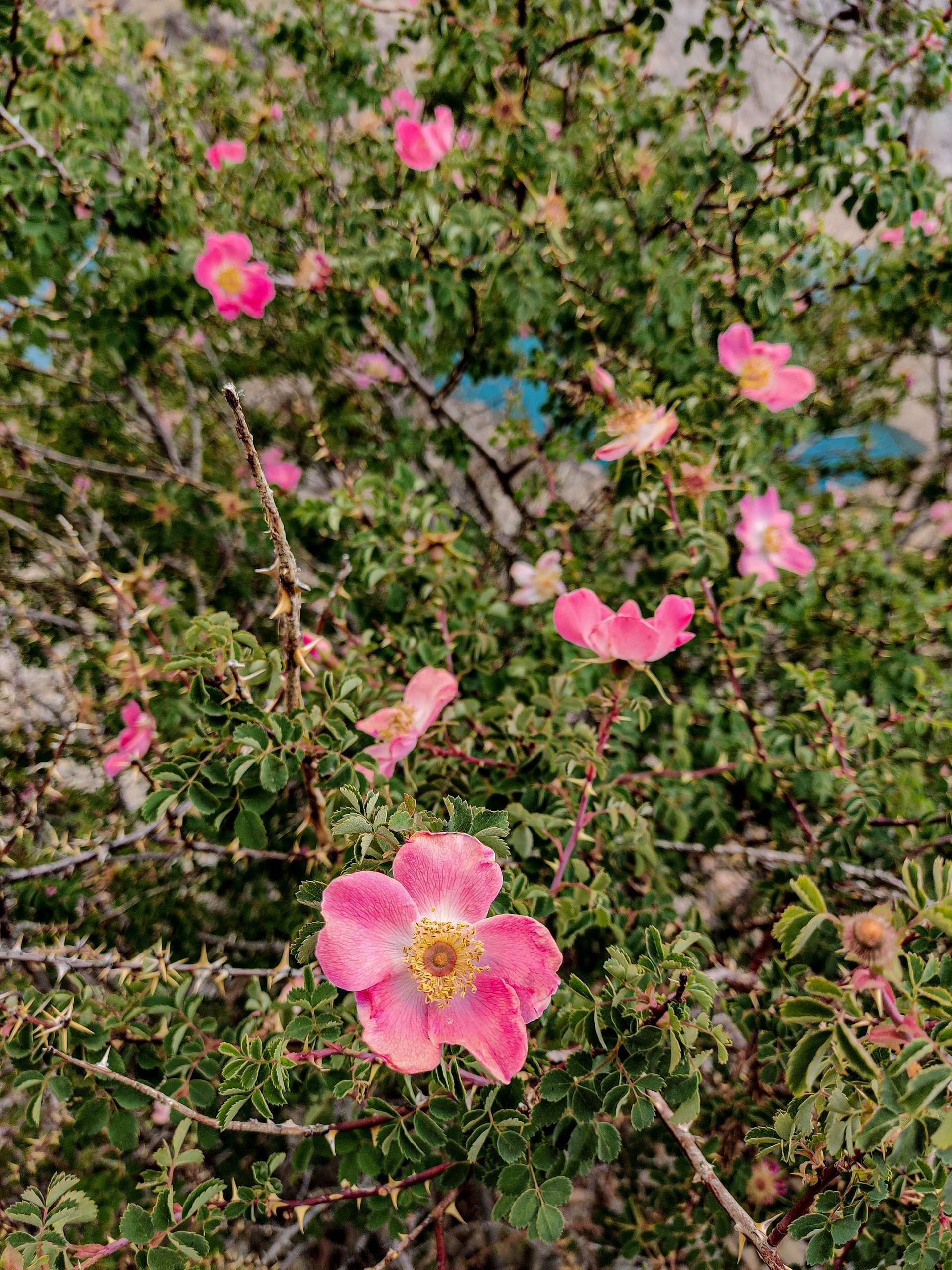
With the last of our strength, we began the descent to this charming meadow. Our feet kept slipping on the rocks. On the way down, we saw a large bush of blooming wild roses, and the smell was amazing. The meadow, or rather a small hill, was covered in beautiful junipers, their trunks twisted in spirals. Near the tent, a guy and a girl were preparing dinner, and they told us how they had slipped down from the scree to the snowfield the day before. When they learned that we had come from the Muddy Lakes in one day, they were amazed. They also shared that they had been very cold at the 4500 m campsite during the night stay.
After that, we spent a long time choosing the best spot for the tent. The places were all incredibly beautiful! Initially, we chose a flat area under a juniper tree – a pretty large, flat spot along the tree’s roots, shaded by its sprawling canopy. But after setting up the tent and struggling unsuccessfully to stretch the rainfly, we realized that the spot wasn’t as spacious as we had thought. We had to move the already assembled tent, with poles and rainfly, to a different spot, a few meters higher.
The water was far from here, but there was a path down to the lake along well-trodden trails. For dinner, we decided to have something not too heavy – noodle soup with freeze-dried meat and dried vegetables. By 20:30, we were in the tent with tea, eating dried mango and peaches, and after that, it was time for the long-awaited rest.
Day 6. 2022-08-08 Monday
We slept like the dead and woke up early, around 07:00. The sun takes its time to reach this camp because of the high mountain ridge to the east, so it was quite chilly in the morning. The altitude of 3200 meters still made its presence felt.
Today we have a rest day planned — time to relax, read, write, wash up, and fully recover.
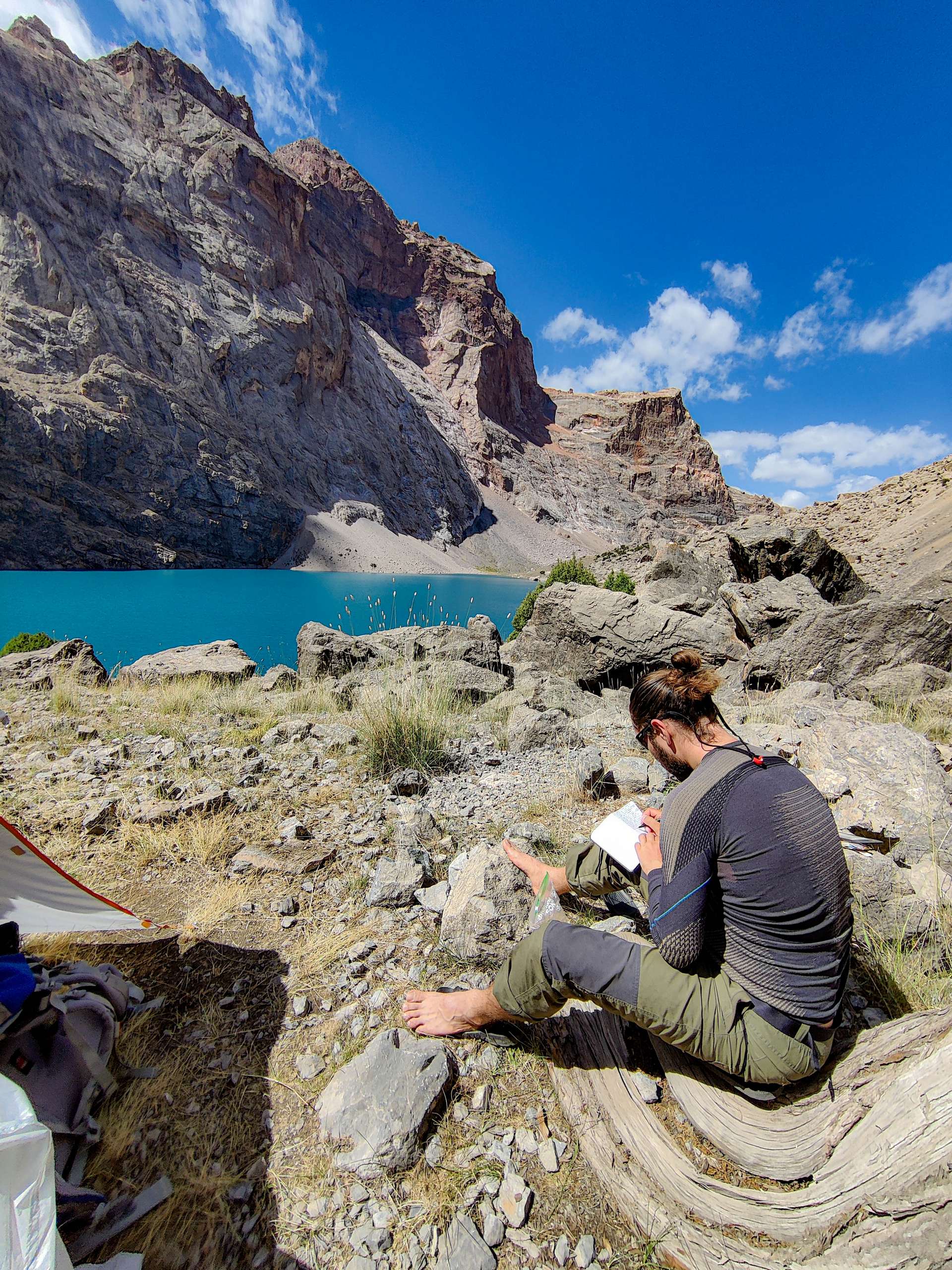
From early in the morning, I started shooting timelapses of the sunrise, both on the mountain opposite and on the Left Zindon River. We had breakfast and rested until 13:00. While writing this report in the sun, I managed to get a bit sunburned, especially the lower part of my right shin, which bothered me for a couple of days afterward. To go wash up, we waited for the sun and for the other group to leave their tent. Although they got up around 08:30, they were still packing leisurely and not in a hurry. At 13:00, we took a kettle, stove, a couple of empty bottles, and headed to the lake to wash up. For washing, you heat the water, pour it into a bottle, and pour it over yourself. The sun wasn’t very cooperative, as there were many clouds and a strong wind, so the bath day turned out to be quite refreshing.
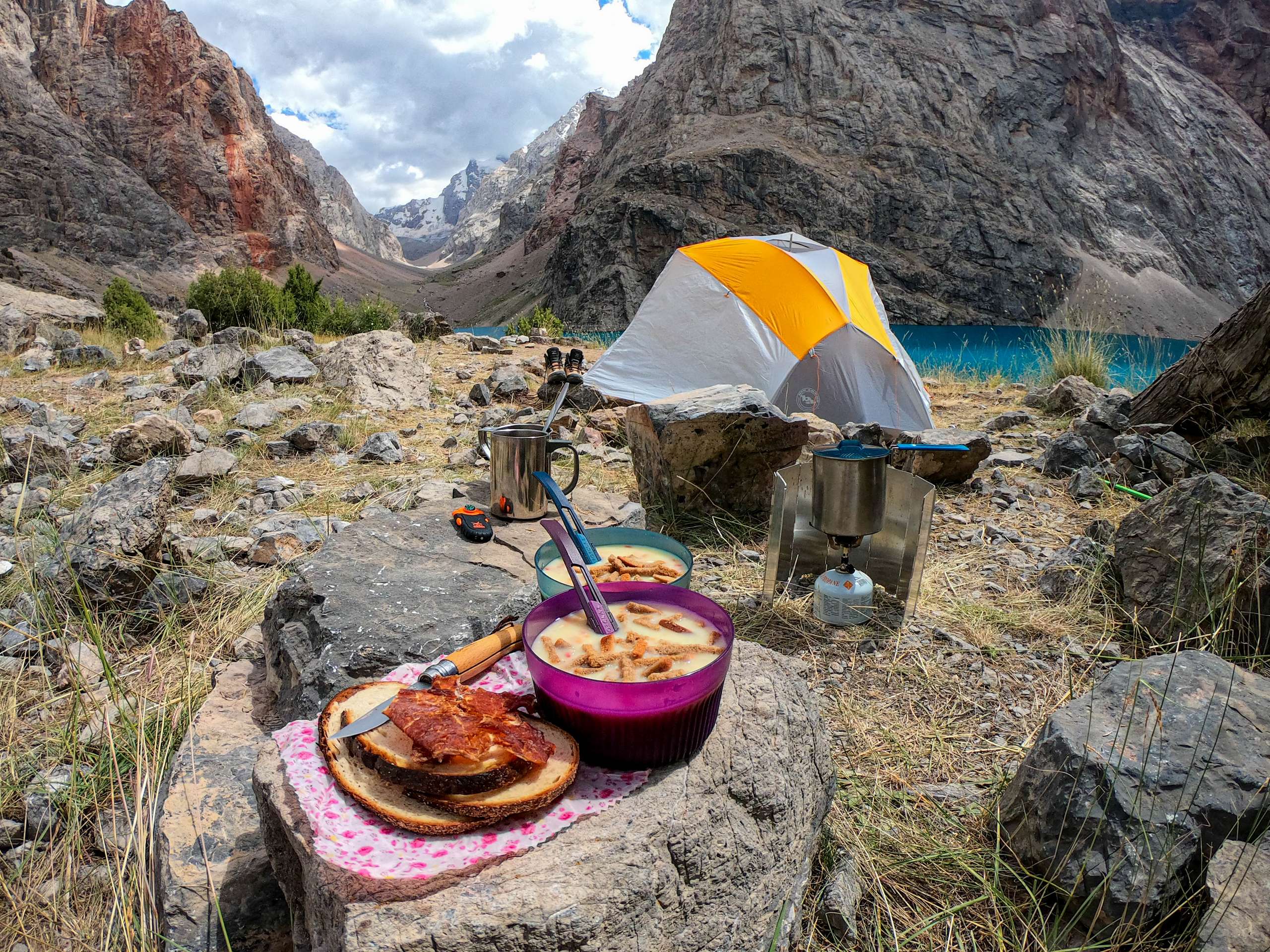
By 14:00, we prepared lunch – potato soup with melted cheese, vegetables, dried meat, and various croutons. We also had sandwiches with basturma. It hit us that the hike was coming to an end, but we still had plenty of food left. For our ready-to-eat meal, Katya set up a little photoshoot. She planned to make a menu book of dishes for the hike, since we already have a lot of experience in this matter and we love to eat deliciously.
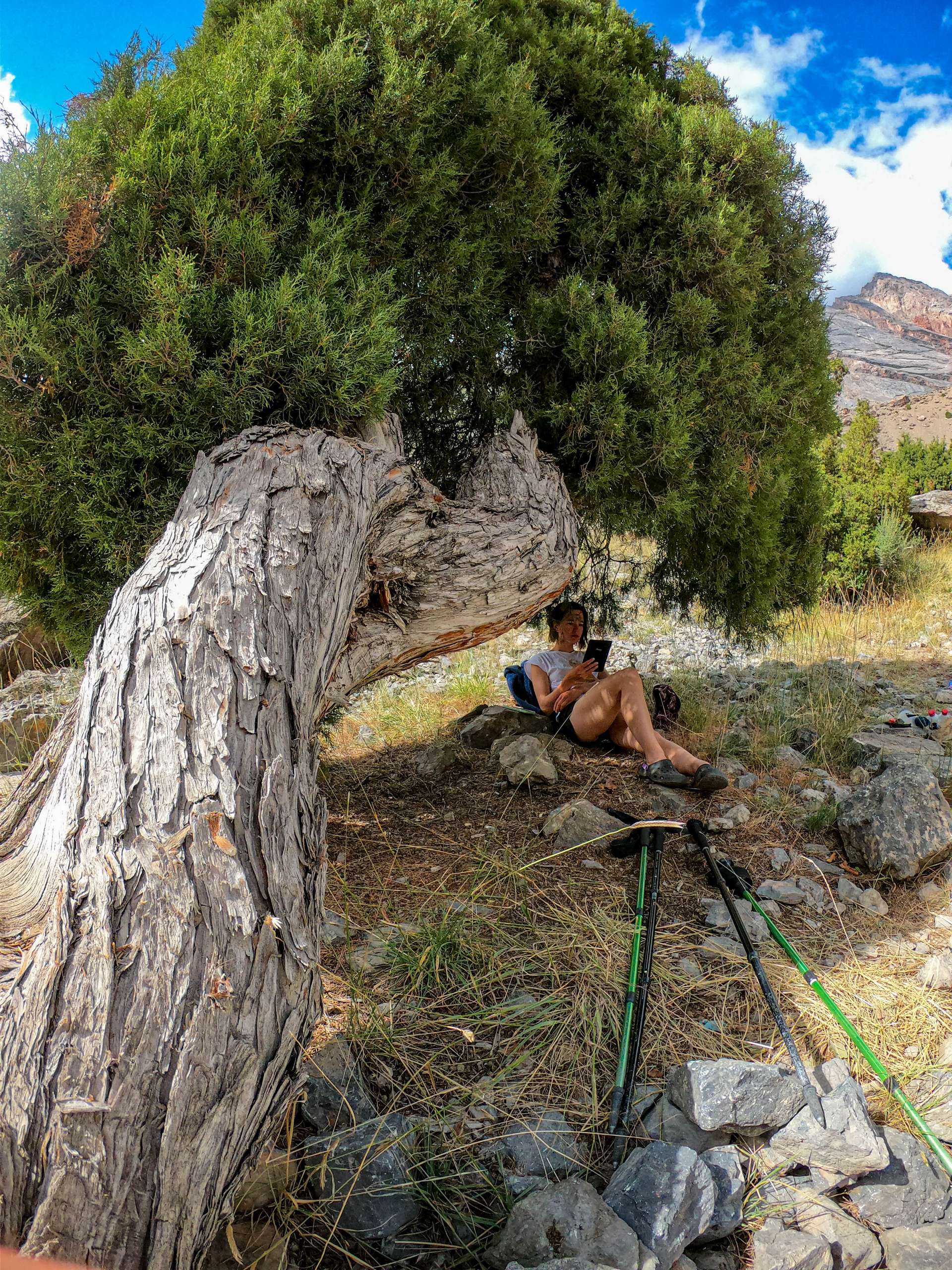
The rest of the day was spent reading in the shade of the junipers, walking around, taking photos, and enjoying the Mediterranean-like scenery of the turquoise waters of Lake Bolshoi Alo. We came across huge bushes with berries that resembled honeysuckle. It was only after the hike that we found out it was barberry.
In the evening, we tried to walk to the Left Zindon River, but the trail along the shore was washed out, and climbing around the mountainside was far from appealing. So, we returned to camp to prepare dinner. At 19:00, we indulged in buckwheat with canned stew right in the tent, with a view of the mountains.
After 20:00, the moon, like a lantern, appeared again, occasionally covered by light clouds. During the night, it seemed we didn’t sleep as soundly, and around 02:00-03:00, we were awakened by a deafening crash. At first, we thought it was thunder, but the noise didn’t stop. Listening closely, we realized that it was rocks tumbling down the southwest shore of the lake. The rest of the night, sleep was restless and uneasy.
Day 7. 2022-08-09 Tuesday
The first day that I was hiking in shorts and a t-shirt!
We woke up around 07:30, with almost no clouds in the sky; the day looks promising. According to the plan, today and tomorrow will be light walking days, aiming to finish the day’s route by around 14:00. Today’s route is about 7 km with a descent of around 900 m.
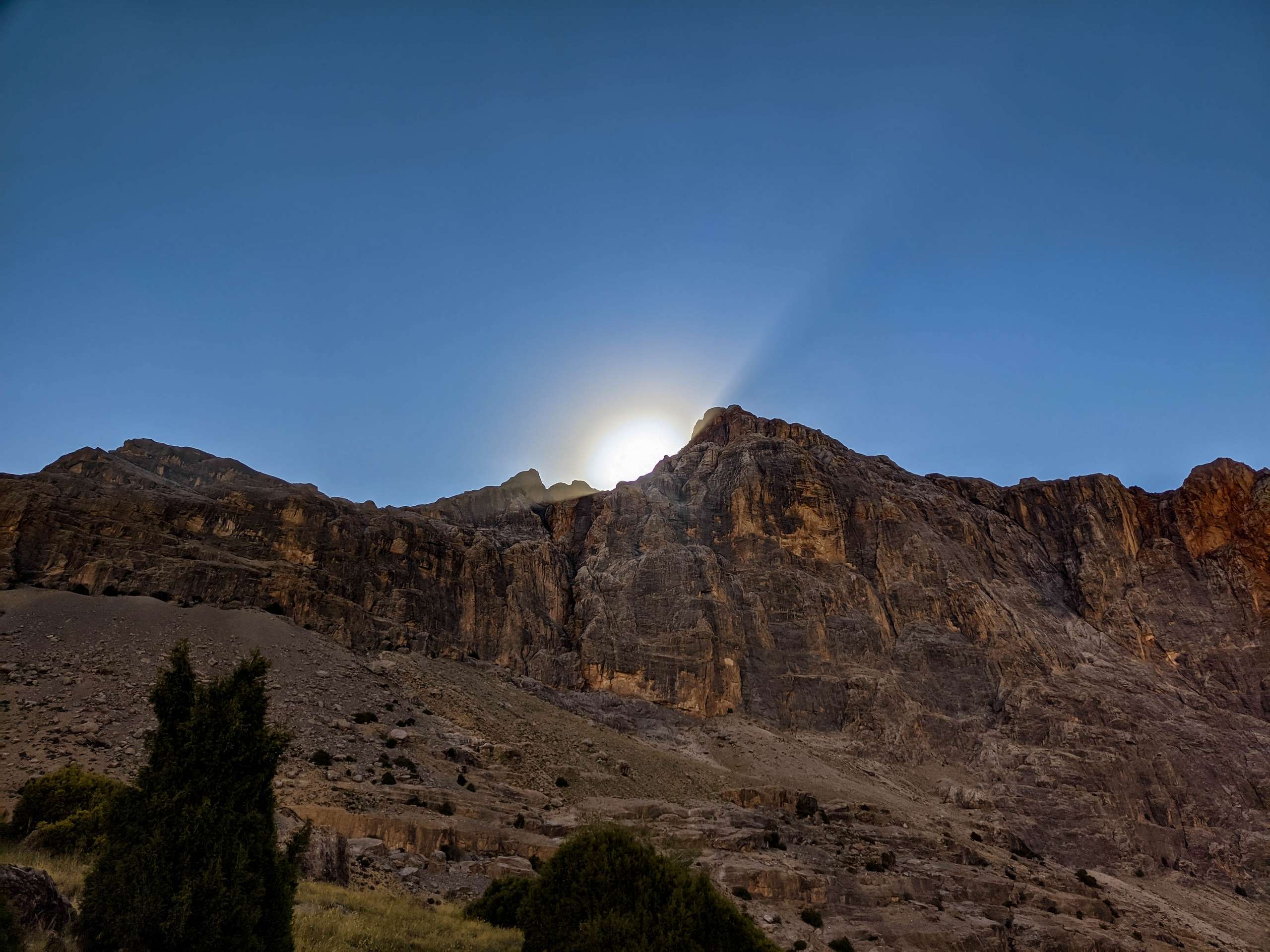
At 08:40, the sun began to rise from behind the mountain, and the outlines of its rays were clearly visible in the morning haze. By 10:00, we finished packing up the camp and set off. According to the GPS navigator, we needed to climb back up to where we came from and then follow the trail to the left along the lake. We didn’t see any other cairns, and since we hadn’t done any scouting the day before, we decided to follow the navigator and climb back up.
After the rest, our legs could barely move when walking uphill. Upon reaching the top, we didn’t see any trail to the left, only a different descent down a diagonal path. In short, climbing up was pointless, and then we decided to head directly across the scree to the trail… Our legs were sliding, rocks were tumbling, and we were balancing like mountain goats. After about an hour of pointless scrambling, we reached the trail by 10:30. The view from above of the lake and the steep cliffs in the sunlight strongly resembled the coastal scenery of Greece or Turkey.
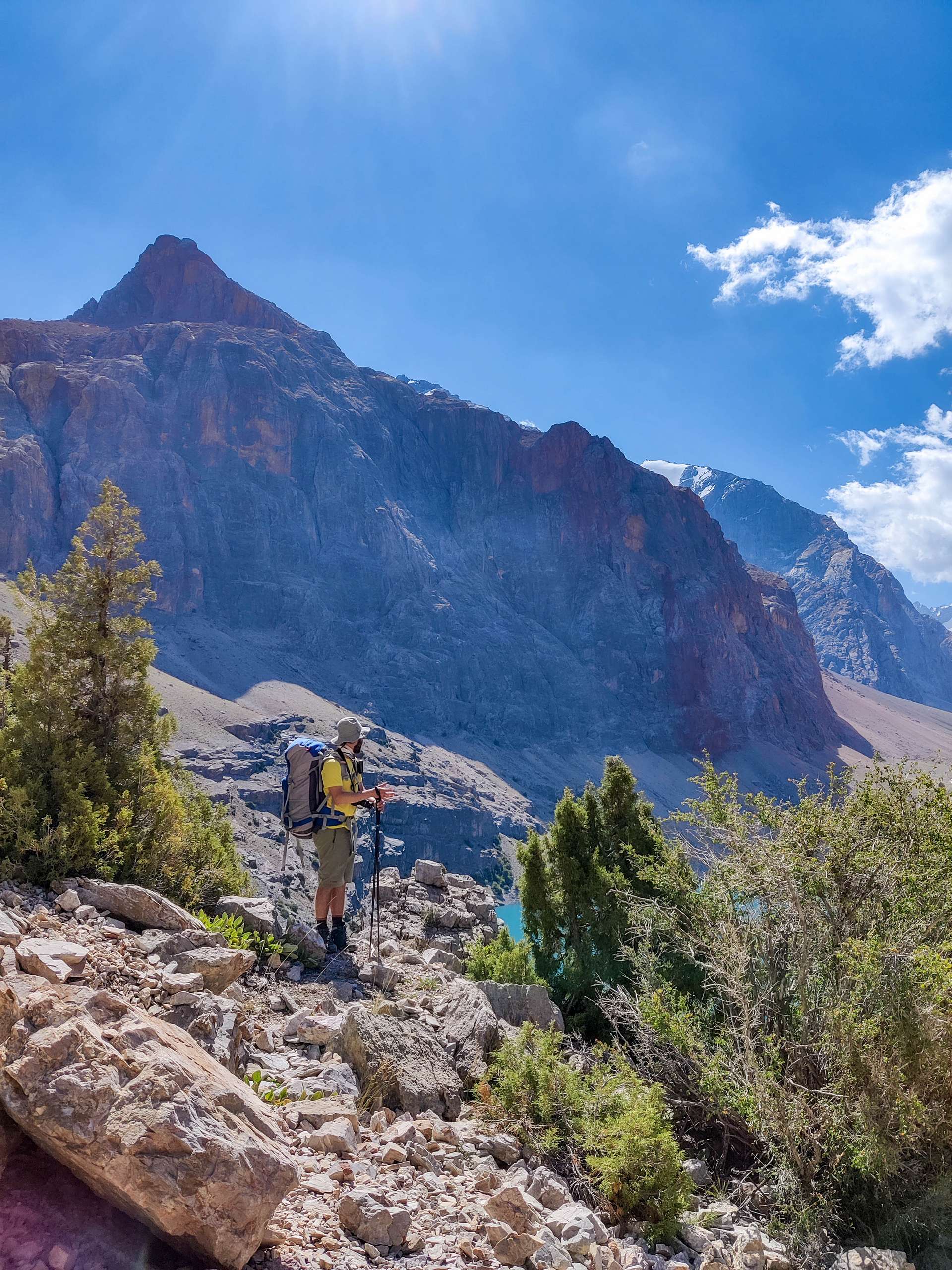
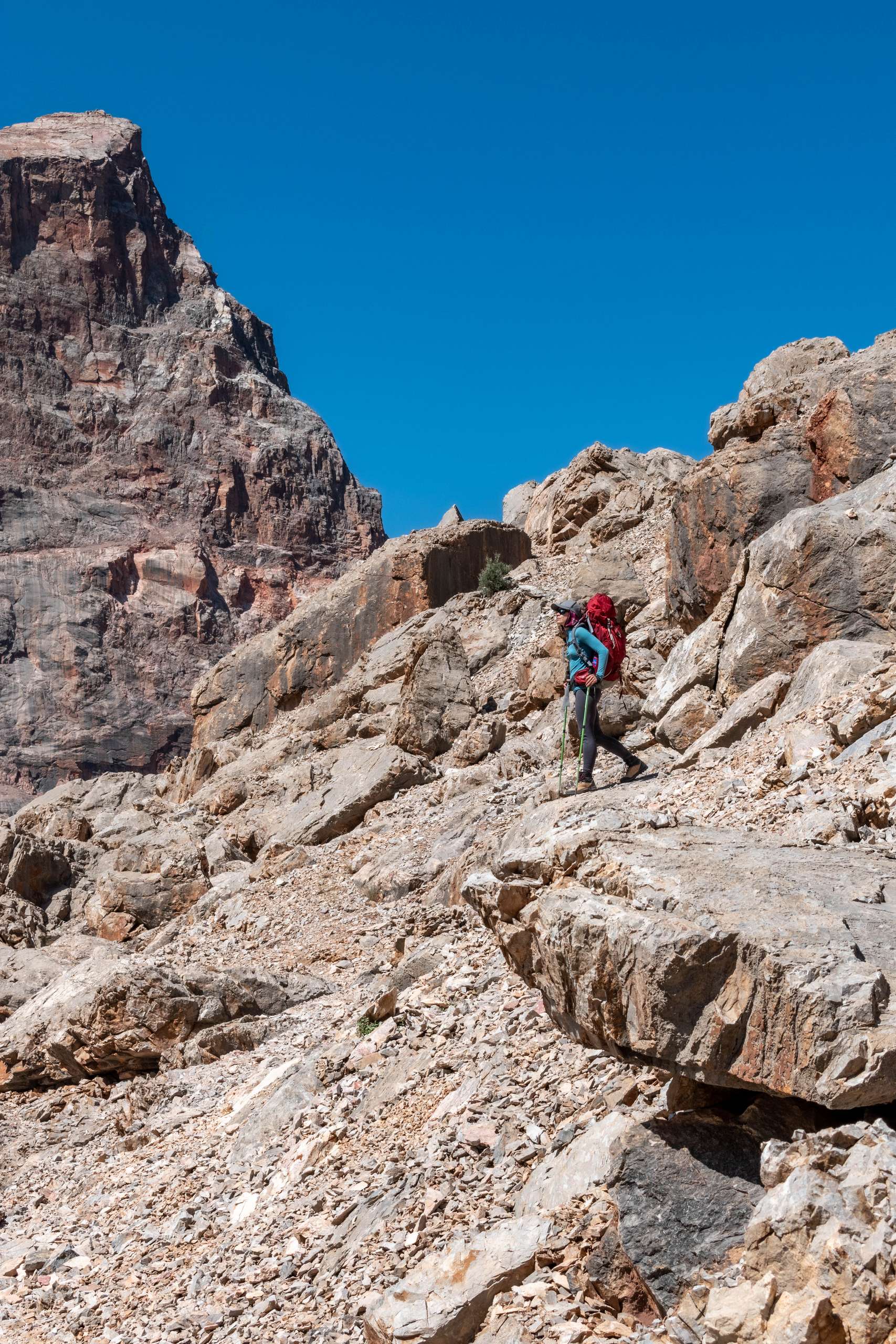
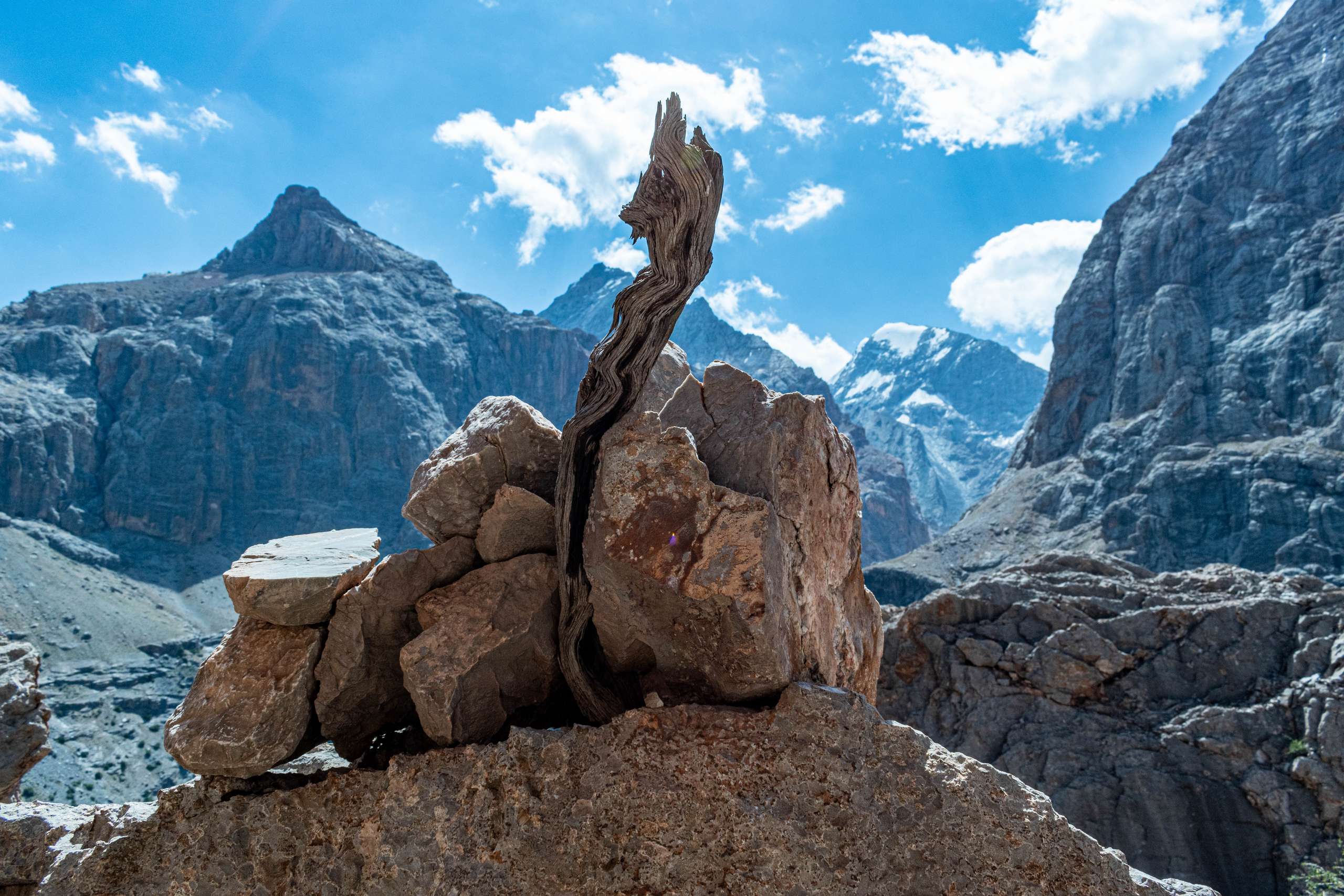
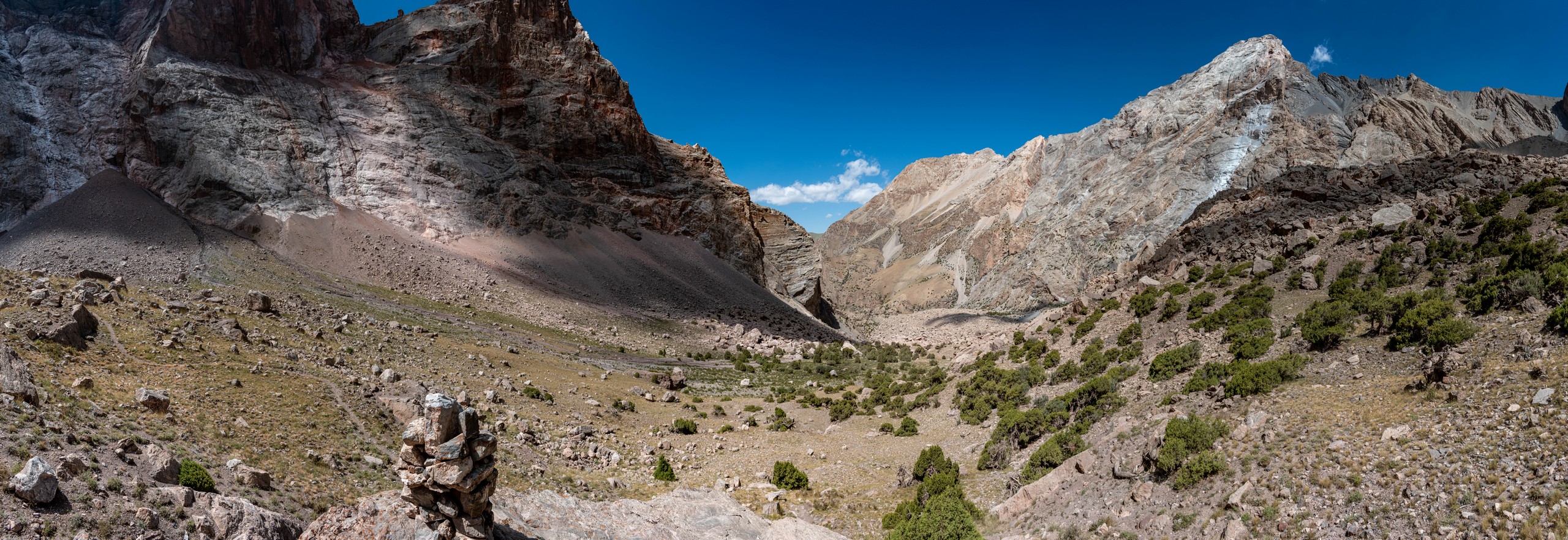
The trail from the lake passes through the left, southern slope of the hill, which is covered with huge boulders. However, while the labyrinth of dark gray stones we encountered the night before was challenging, today we faced a labyrinth of reddish rocks. Cairns were scattered everywhere, but it was unclear where to go, so we tried to follow the trail on the GPS navigator. After about 30 minutes, we finally emerged from the labyrinth and started a pleasant, gentle descent through the valley. Along the way, we occasionally came across twisted juniper trunks. At 11:30, we had a snack with a bar under the wide canopy of a juniper tree.
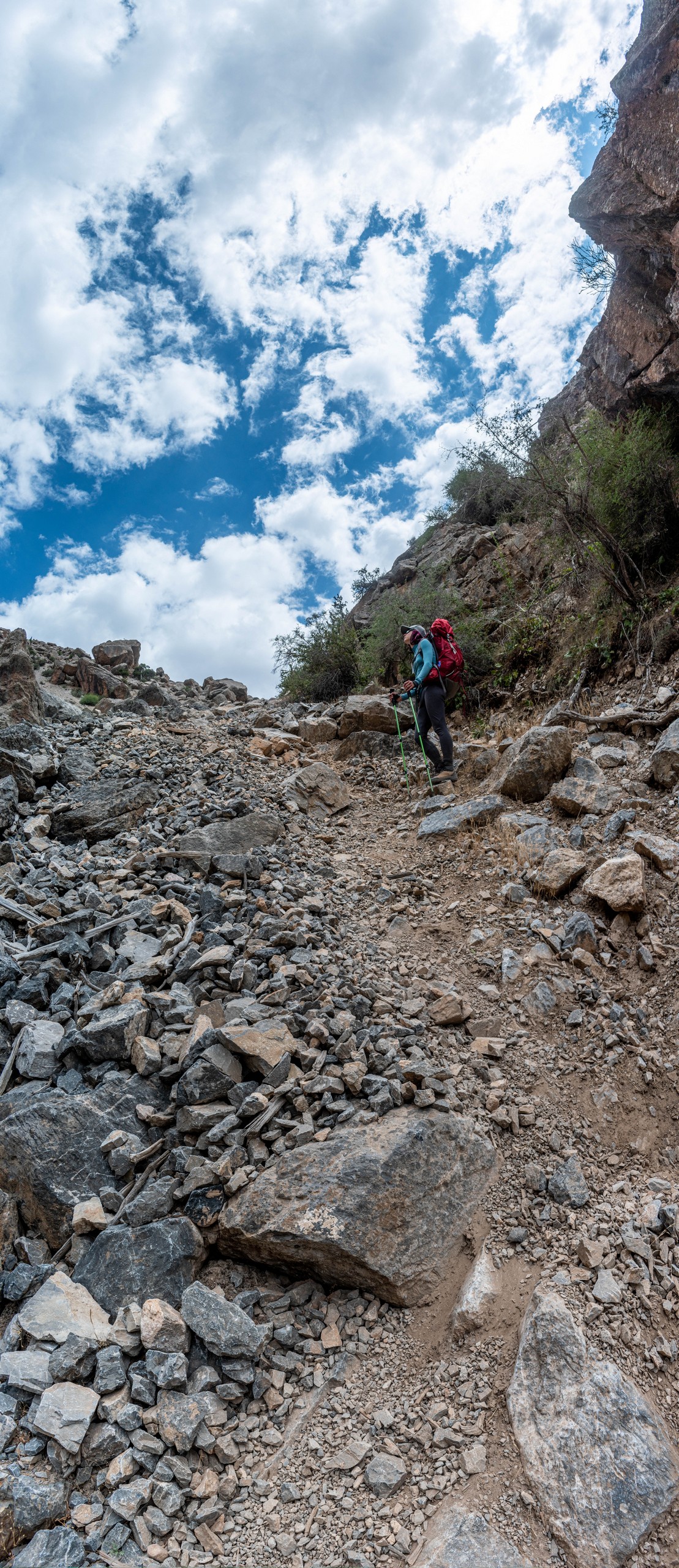
Then the trail sharply descended down the stepped scree. We stayed on the left trail, which was pretty steep and not particularly pleasant. But from below, we saw that there was a second trail, which traversed the slope in zigzags. It seemed that this trail would have made the descent easier.
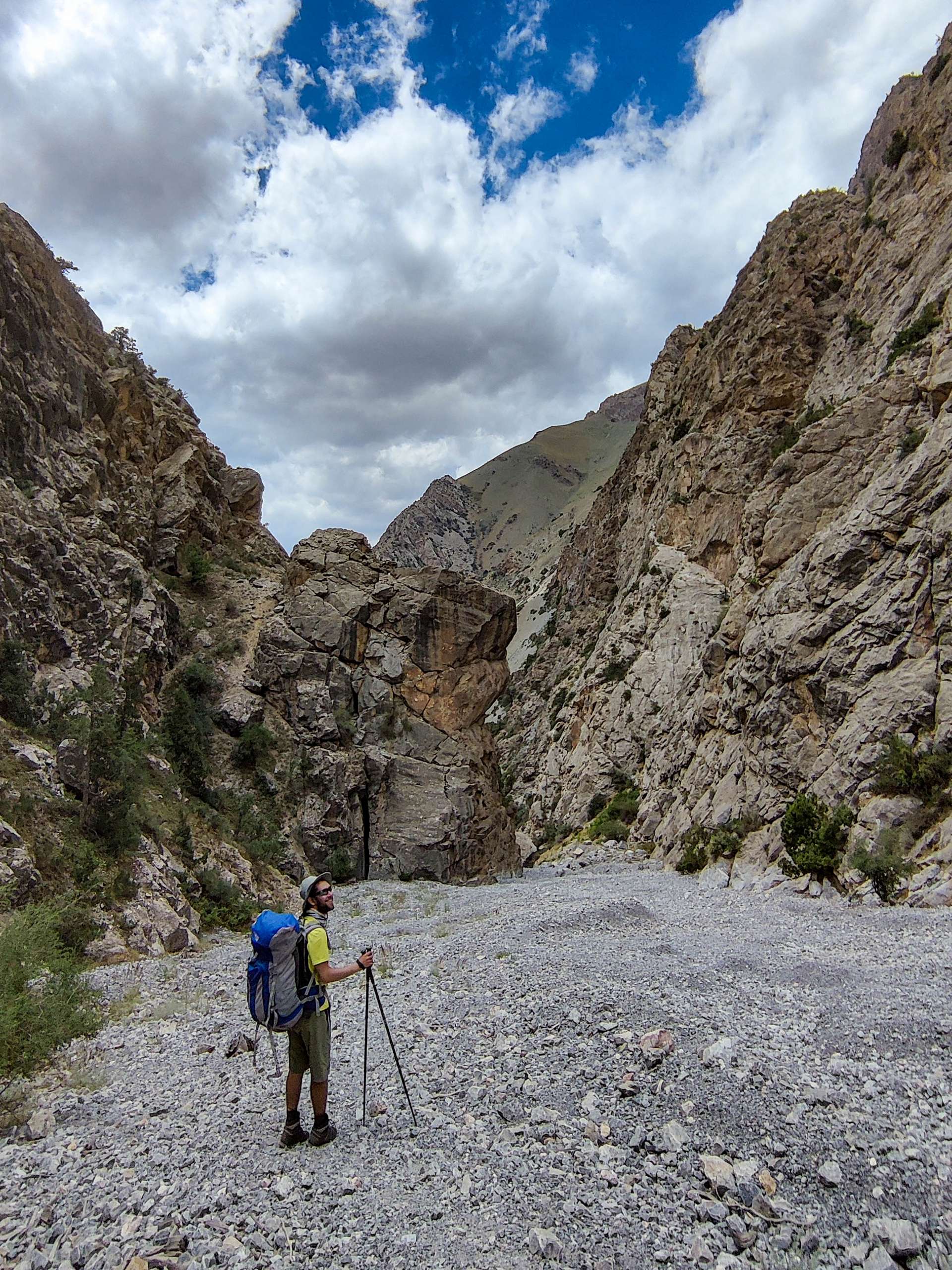
By 12:20, we descended to an interesting spot – a gorge that narrows sharply to a width of 5-7 meters. Clearly, after rains, the river roars through here. Above this narrow section, a massive boulder has already detached from the main mountain and seems ready to fall soon, blocking the water flow and the passage.
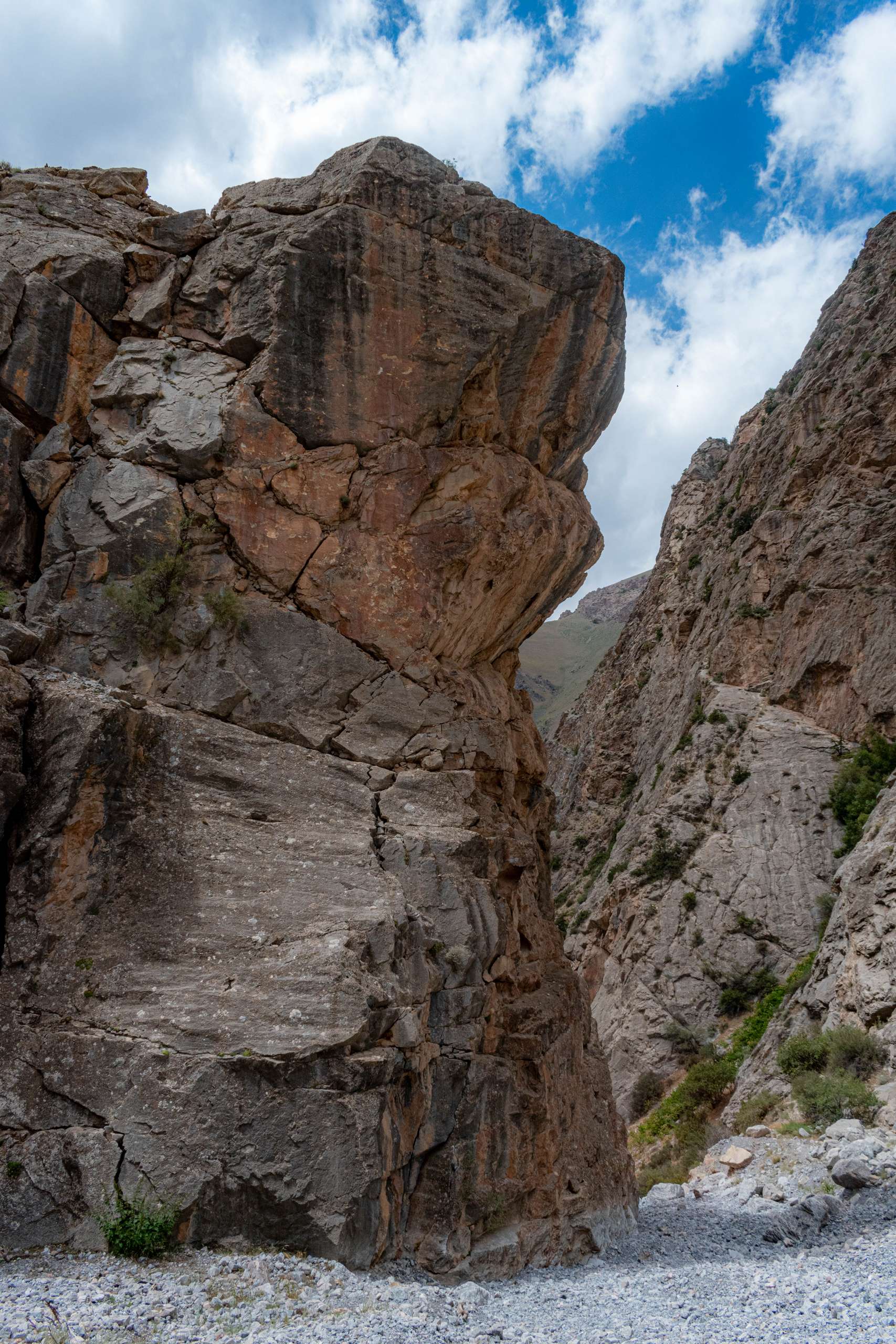
After the narrowing, the descent continues straight down the riverbed, leading us to the actual river. The Zindon River here quickly gains strength and a strong current. The river seems to appear out of nowhere. Upon closer inspection, we realize that streams are feeding into the river from several directions, emerging from underground. So, the river was flowing right beneath us during our descent!
Near the source of the Zindon River, there’s a giant flat stone where tourists leave their rock art “masterpieces”. We simply lay on it, watching the clouds drift across the sky.
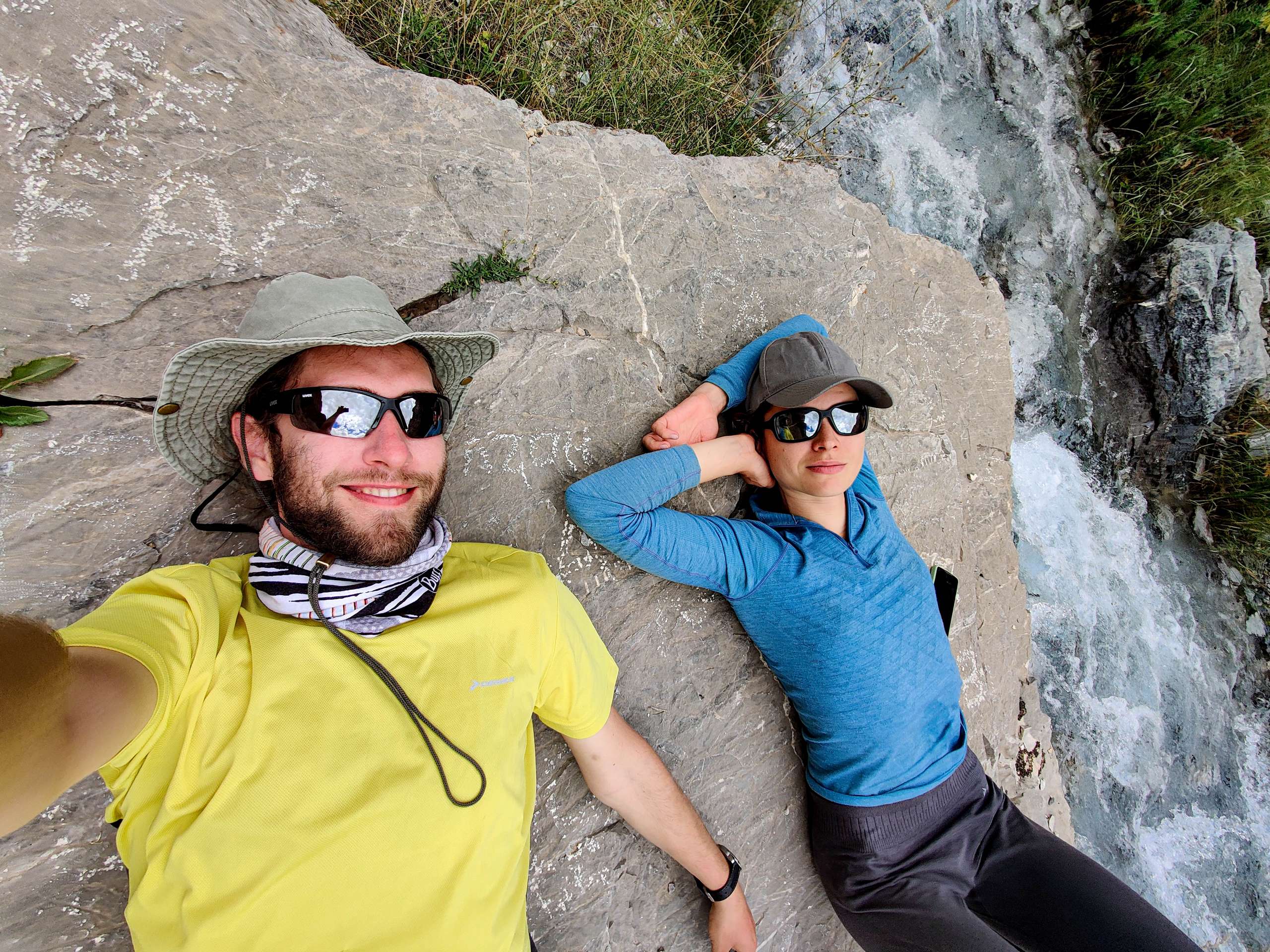
The trail on the GPS navigator was supposed to follow the left bank of the Zindon River, but in reality, we didn’t see any trail there. We had to walk along the cairns on the right bank, and closer to Lake Maloye Alo, there would be a ford. The trail was very pleasant until the ford, it has a gentle slope, cozy meadows, abundant vegetation, and the river constantly murmuring on the left. We reached the ford at 13:30. We changed our shoes, the ford was quite deep, the current strong, and we had to push harder with our poles. About 10 minutes later, we were treated to a view of Lake Maloye Alo from above.
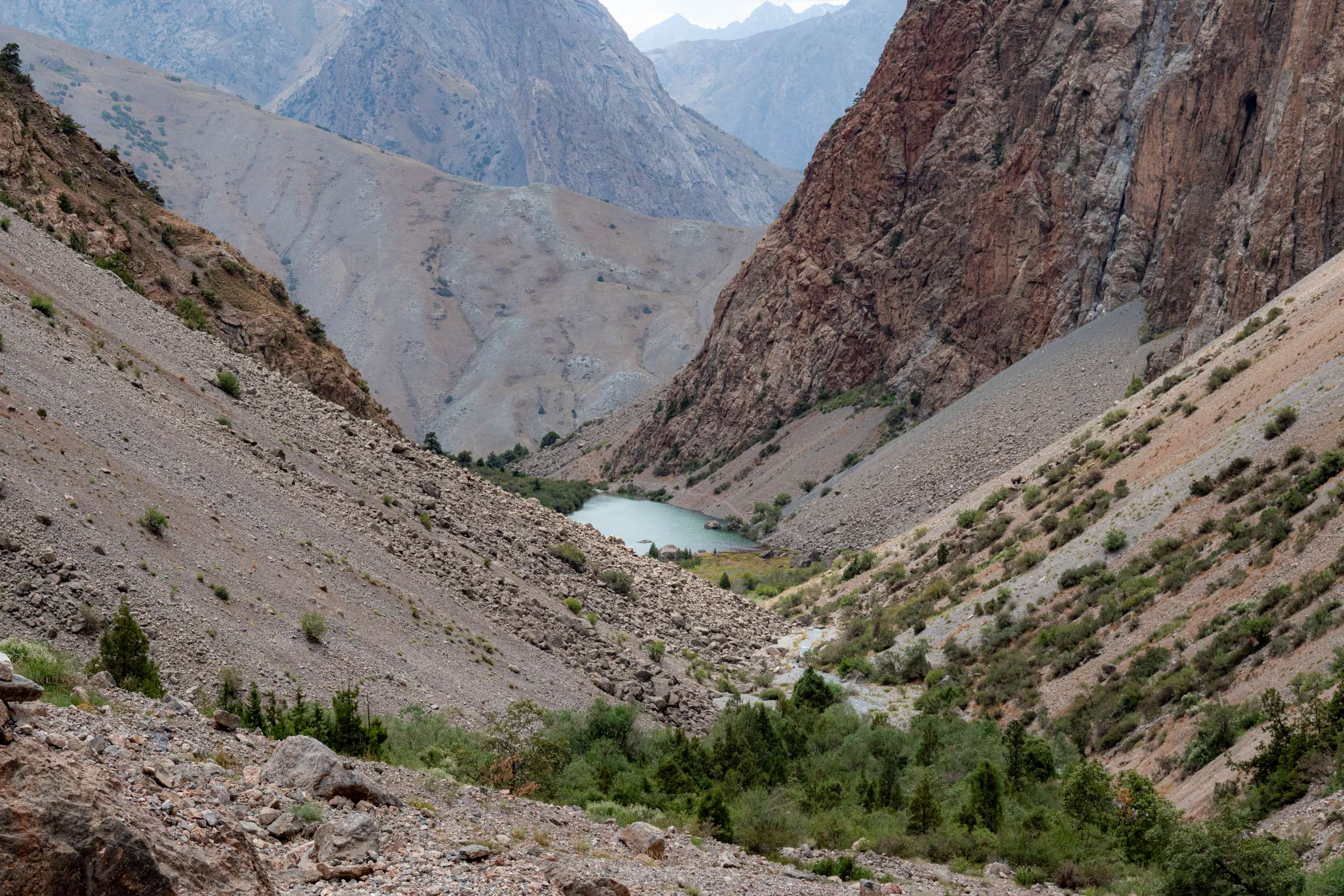
According to the map and reports, the campsite is not right on the lake, but about 100-200 meters beyond it, where a campfire site is marked. We had hoped to camp right by the lake, but from the height, it became clear that this isn’t possible. Before the lake, there’s a river floodplain with many streams. The trail runs along the right (north) side of the lake, and it’s just a rocky scree. We’ll have to reach the campfire site.
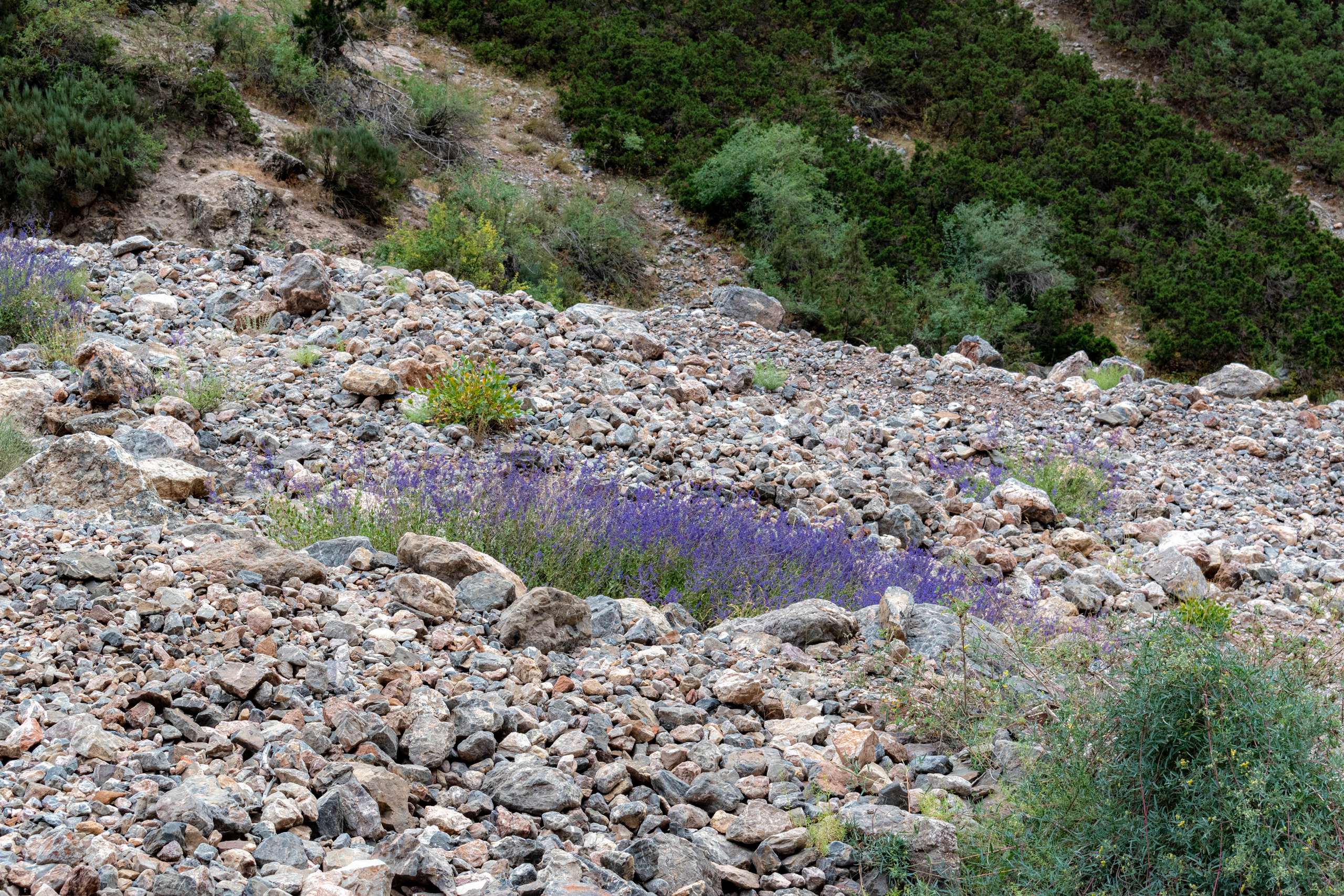
On the way, we came across a furry, fleshy plant growing alone from the gravel. Thanks to Google Lens, we later learned that it was a “verbascum” or “holy glow”.
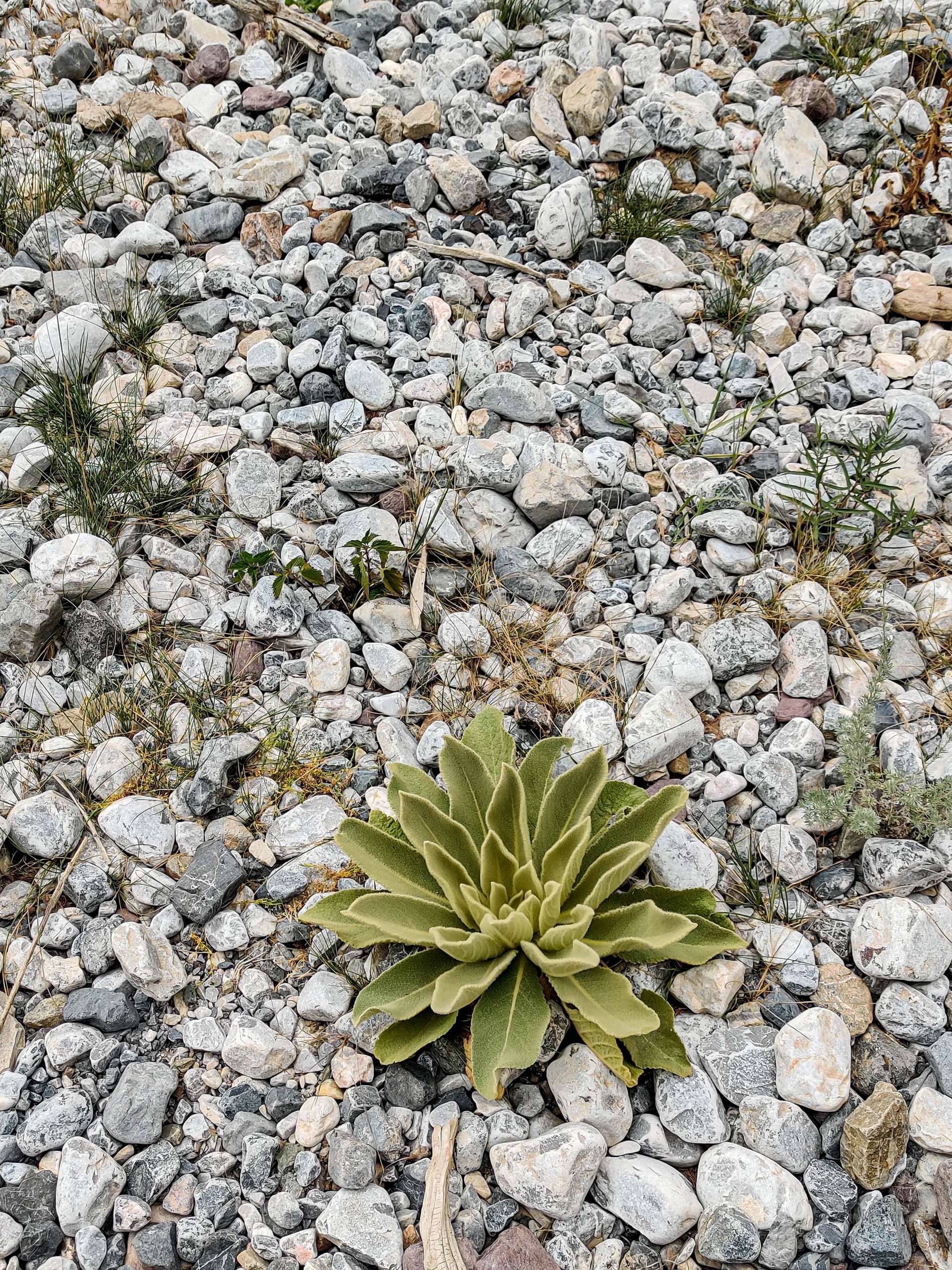
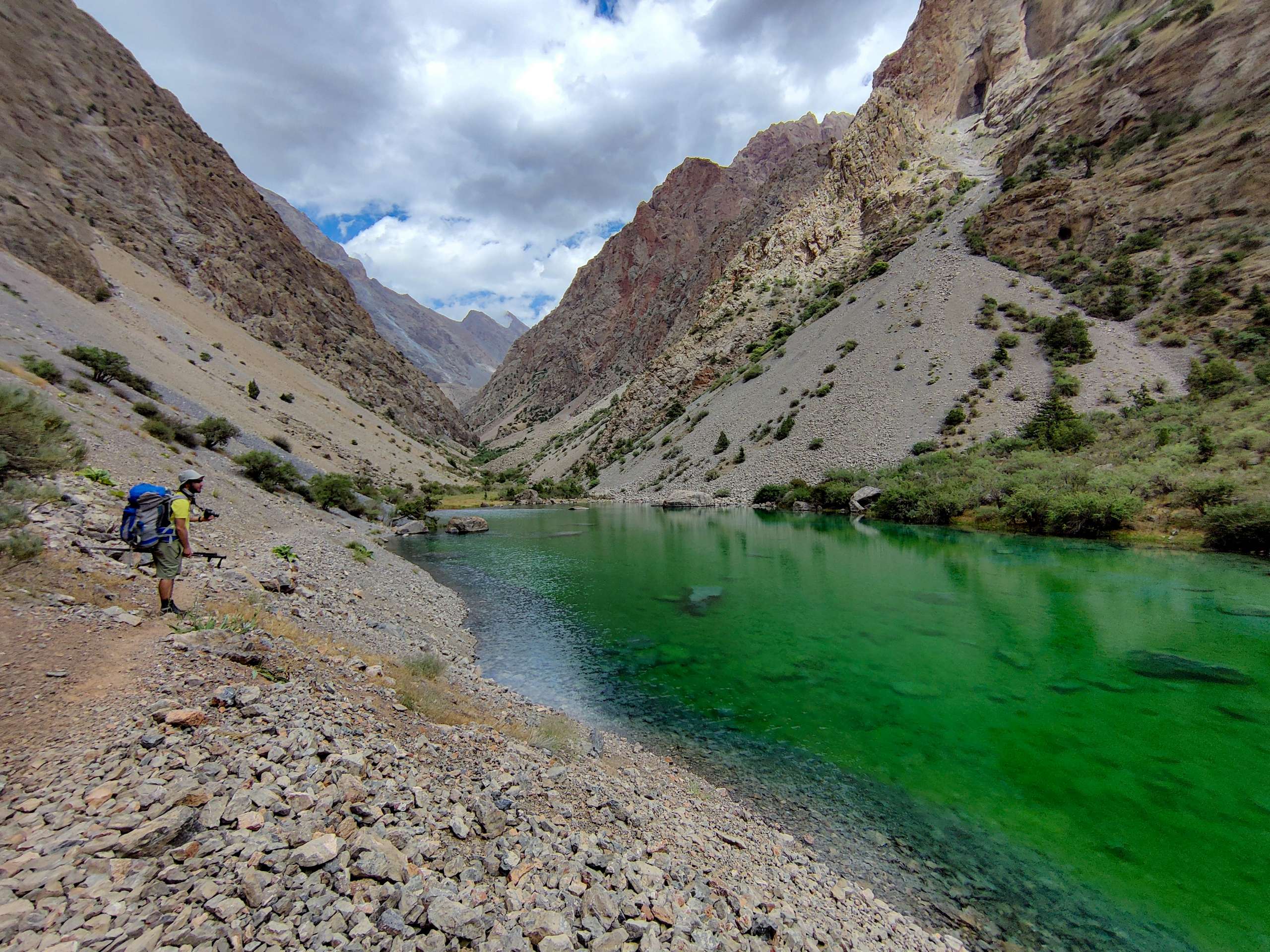
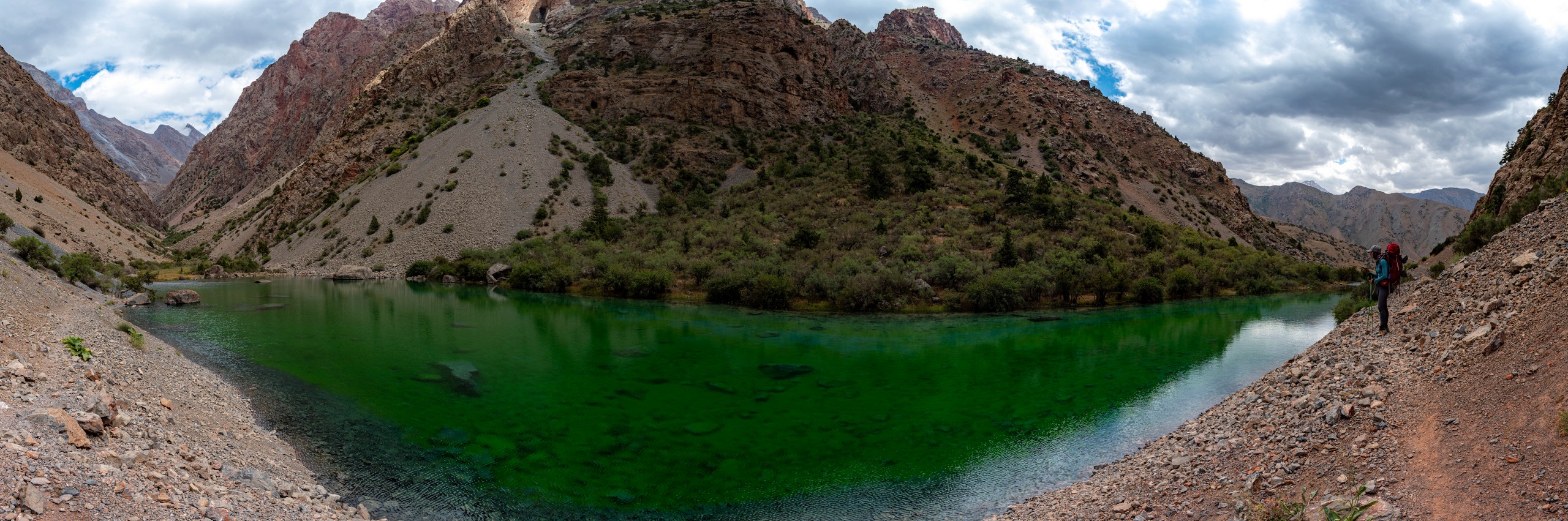
Close to the lake, Maloye Alo turned out to be an acidic green color, with transparent water, likely due to some algae. One could almost imagine it as a giant tarragon lake! After the lake, the trail along the river was washed out, so we had to climb up the steep, loose slopes.
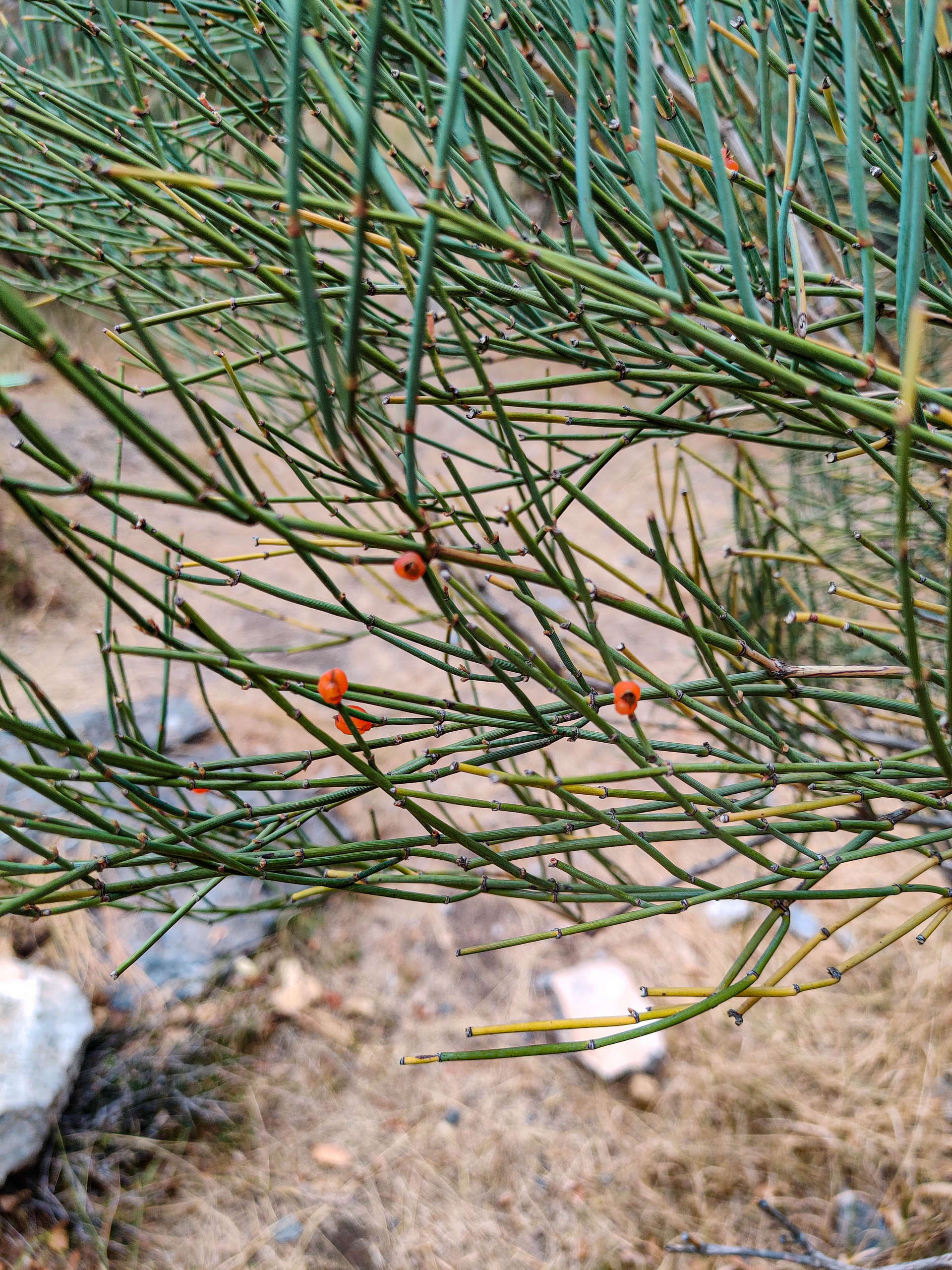
The campsite by the bonfire is easy to read, there are many great spots for tents. We chose to set up under a huge rock, and the best part is that it’s only about 7 meters to the river, which is a real treat after the campsite by Lake Bolshoi Alo. The trail was blocked by another new plant for us – the conifer, with long needles like pine, and from each needle, another needle grows, and so on! It forms a long branch of needles with many joints. There were only the two of us at the campsite. The altitude is 2400 meters, and it feels noticeably warmer here.
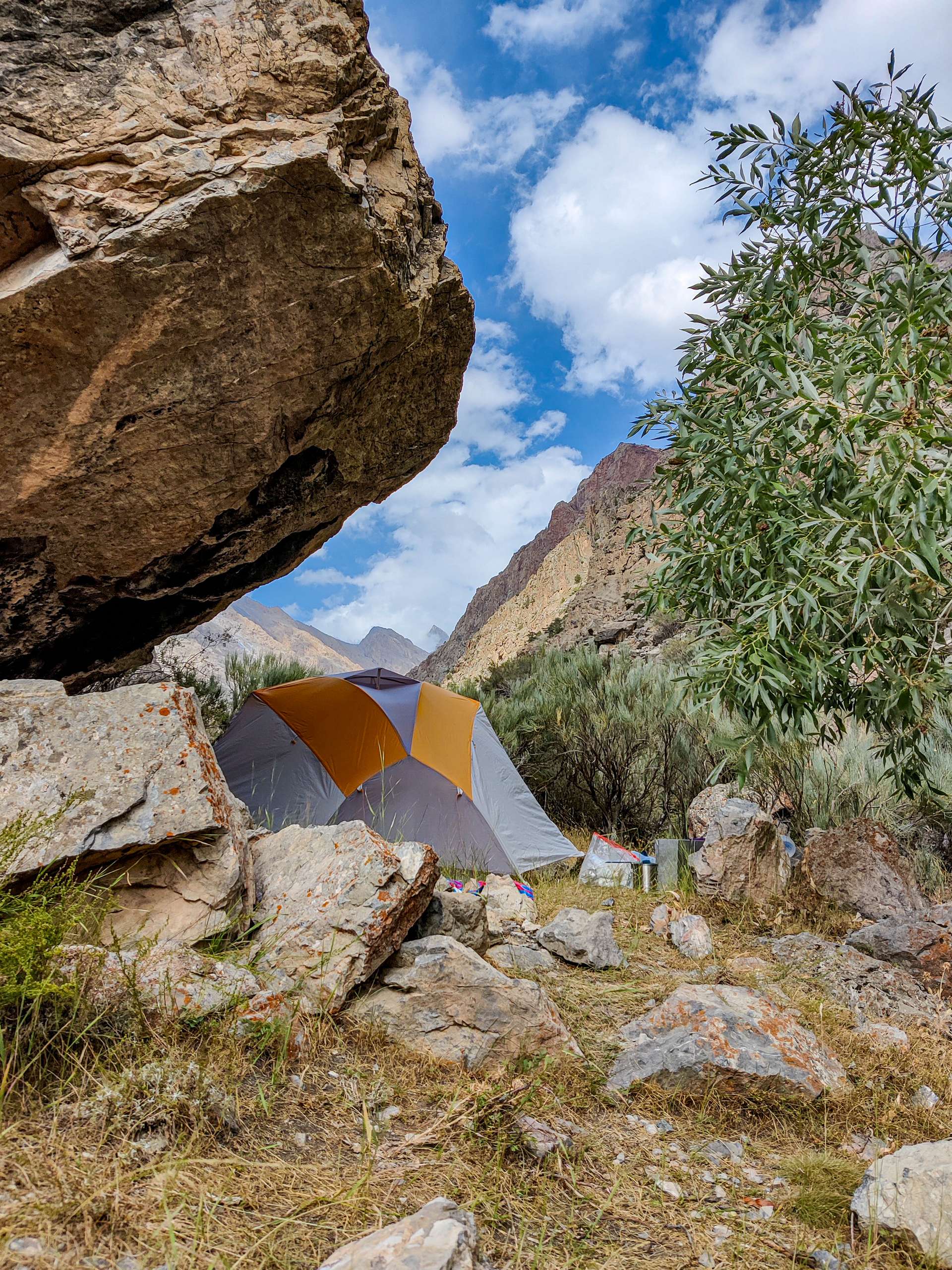
By 15:00, we had set up the tent and made asparagus soup for lunch. We spent the rest of the afternoon reading, writing, and resting. We decided that in the evening, it would be a sin not to take advantage of such a magnificent bonfire spot, even though we’re not particularly fond of campfires due to the smoke that soaks into your clothes and yourself. At 19:00, we began gathering firewood around the area, which wasn’t a problem. I wanted to find more juniper wood, so I climbed the hill to search for a grove of trees. All I found there was a shed snake skin, and I ran back to camp.
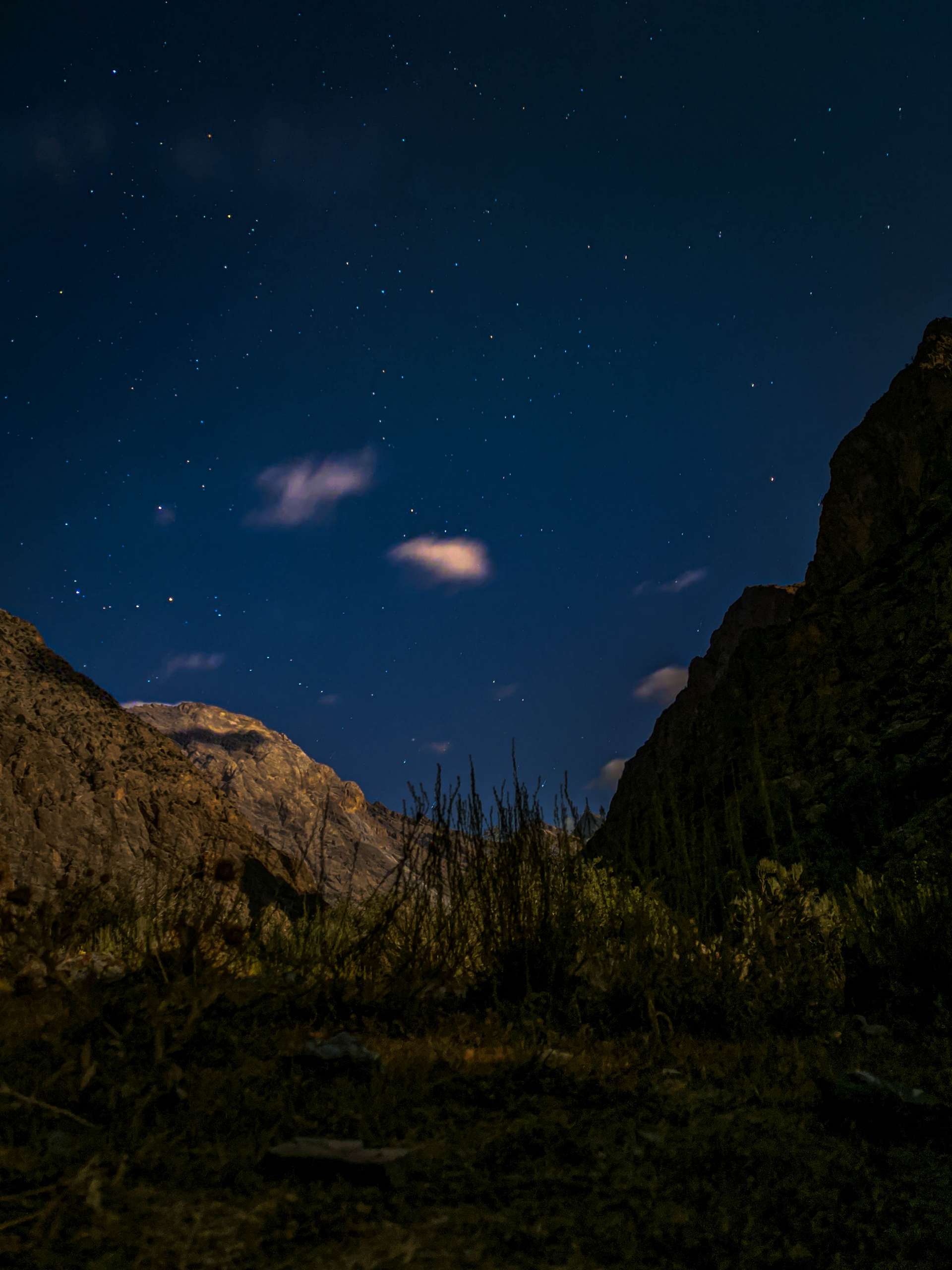
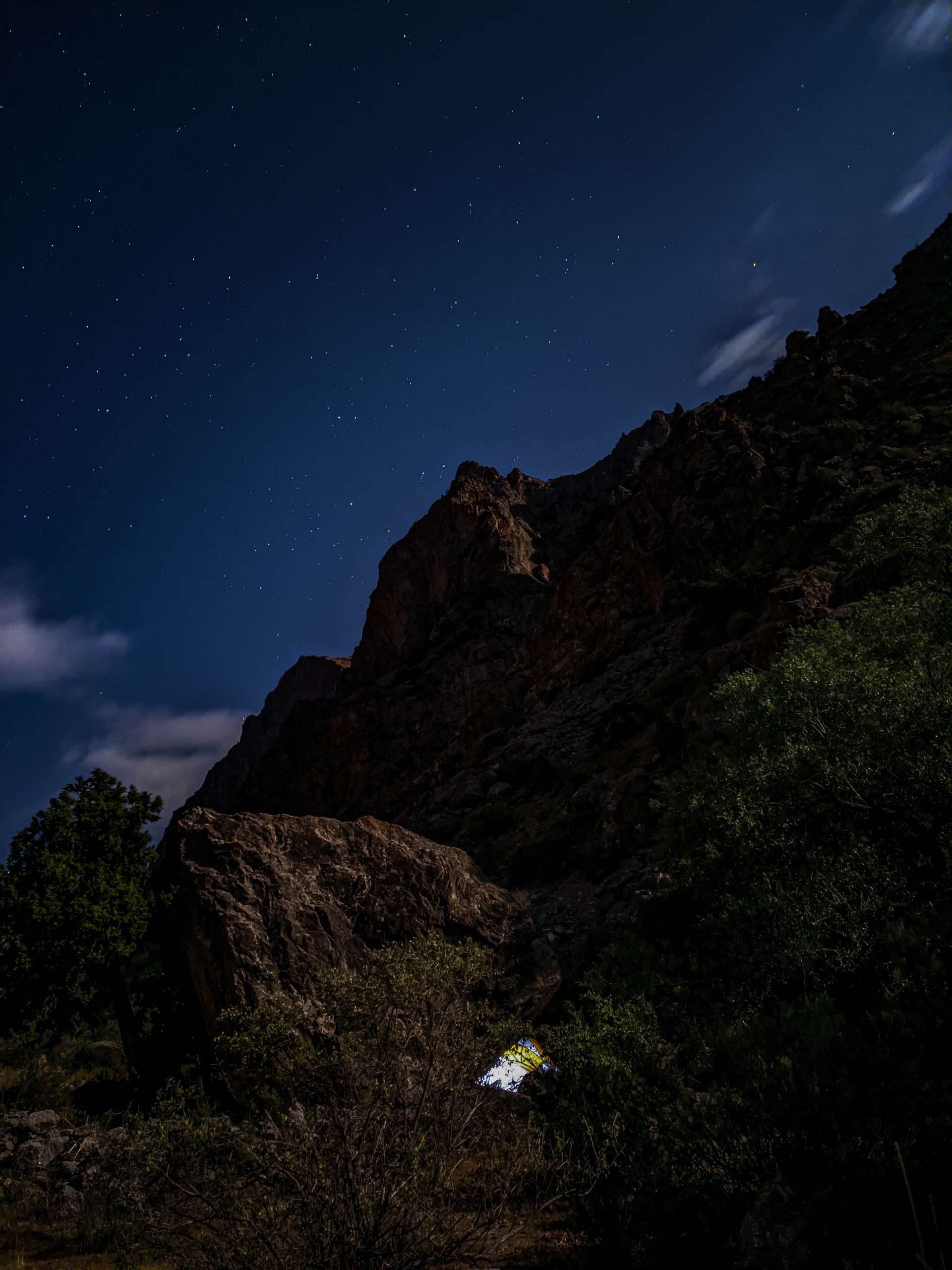
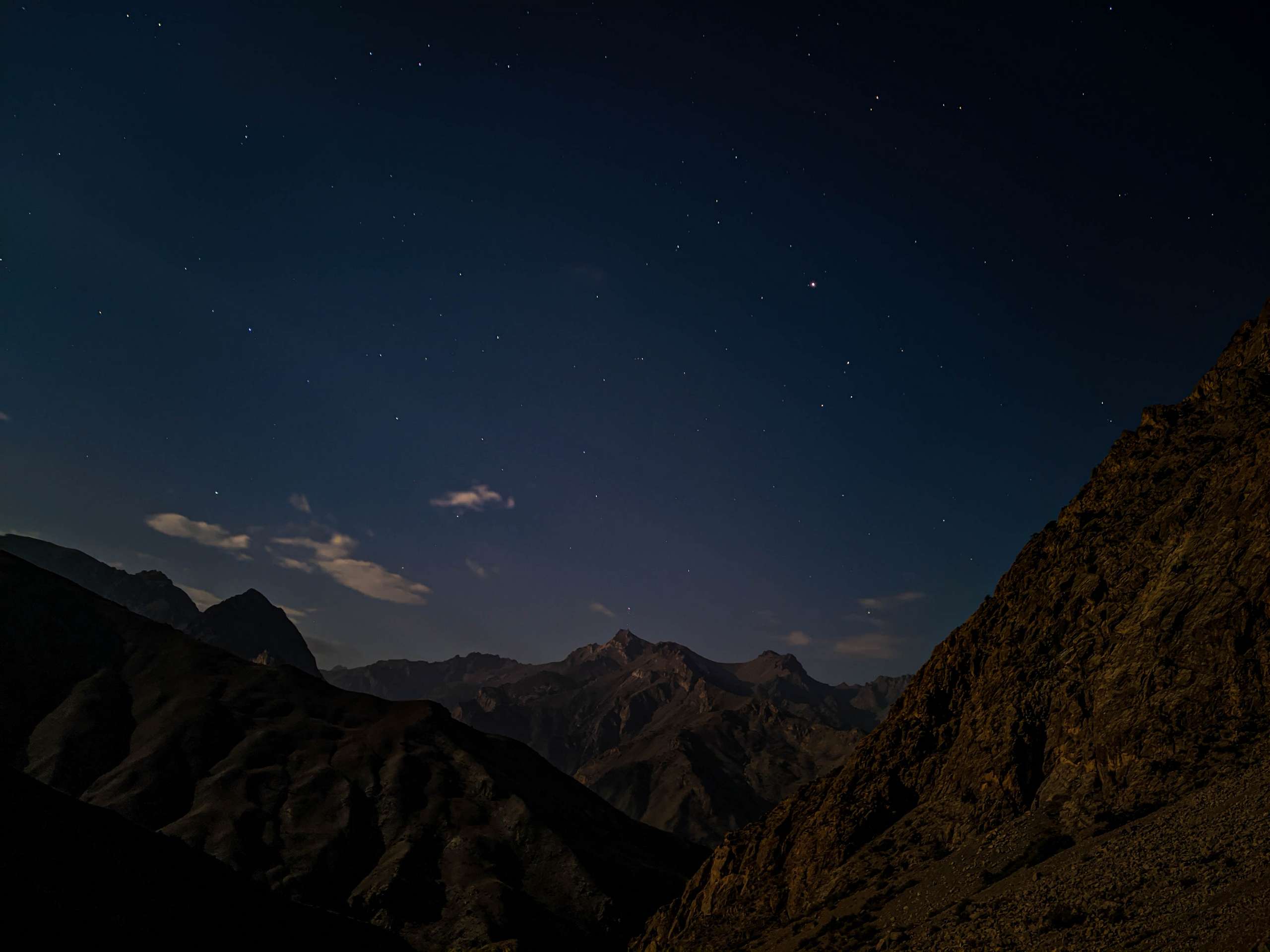
By 20:30 we had built a huge bonfire, and it was roasting hot! A couple of juniper logs gave off a delightful, very intense aroma. We had dinner by the fire, and around 22:00, I went to photograph the stars. The night was warm, with a few scattered clouds in the sky. The moon was shining brightly like a lantern, so photos in its direction didn’t turn out well.
On interesting thing to mention – I climbed up a high rock to take photos. The camera exposure lasts for about 4-5 minutes, and I was sitting in the dark, enjoying the stars. Then, I hear a deep “meow” somewhere nearby – I quickly turned on my flashlight, but found no one. It’s unclear what kind of animal it was, but I was pretty scared.
Day 8. 2022-08-10 Wednesday
Extraction day. It should be a very simple day, about 6 km to walk and a 600 m descent. At 15:00, a transfer iss supposed to meet us on the road to take us to the border with Uzbekistan.
We woke up quite early, around 07:00. Due to the slope, we had been sliding down all night. There was a deafening noise from the river, which echoed off the huge rock we were sleeping under, creating a stereo-like sound from both sides. When you’re asleep, you don’t hear it, but once you wake up, you can’t understand how it’s possible to sleep with such a loud racket.
At 07:30, we cooked porridge from the leftovers, adding dried peaches (very fitting), sugar, condensed milk, dried fruits, and nuts. It turned out to be a royal porridge. On top of that, we had a bunch of cheese. The more we ate, the less we had to carry on our backs.
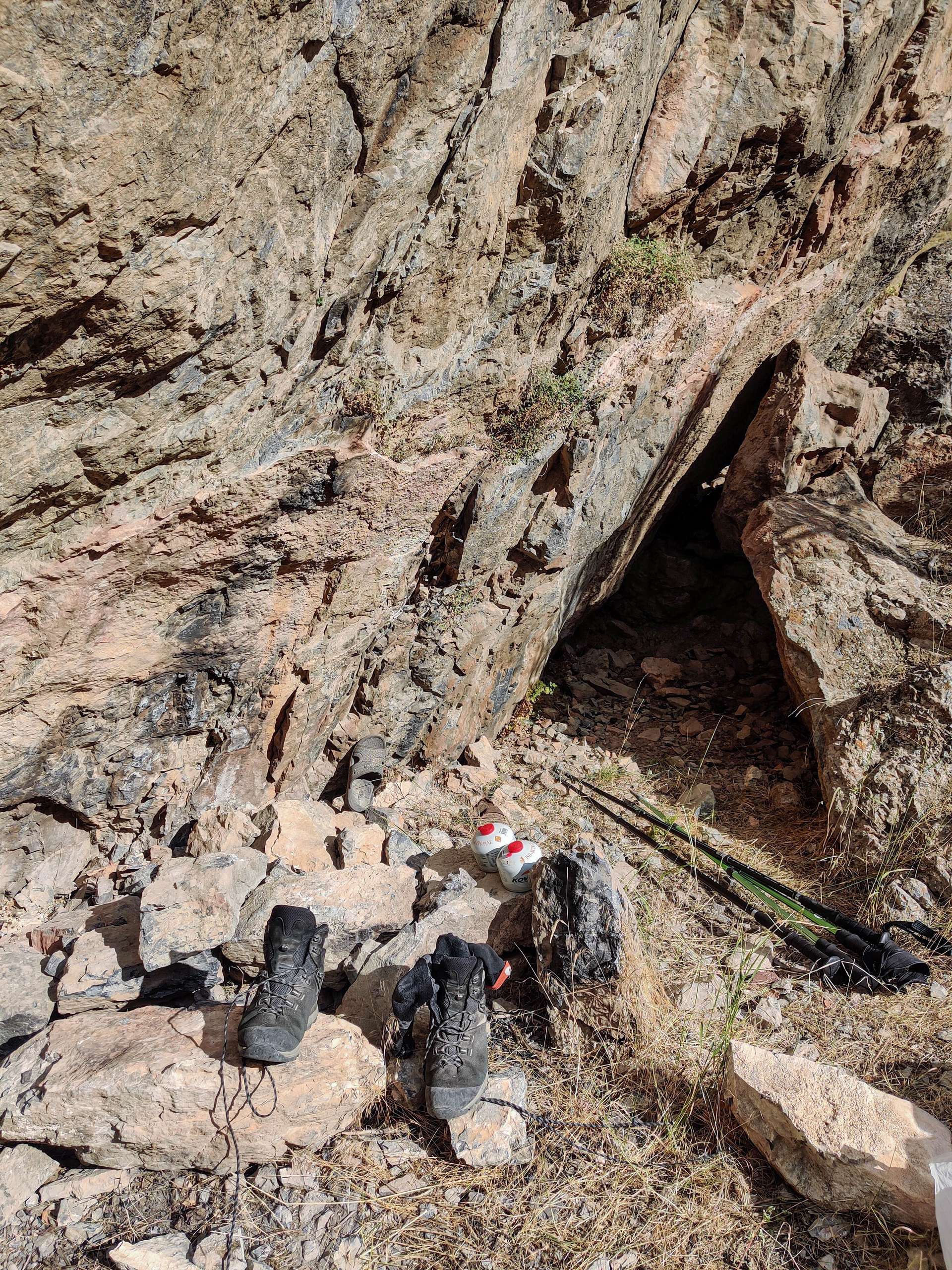
We left the camp at 09:00. Almost immediately, we encountered a ford, which we crossed without changing our shoes. After that, the trail split into two: one, shorter, immediately turned to the right and followed the right edge of the valley. For some reason, it seemed a bit steep to us, although later, from the other side of the valley, we saw that it was a great trail. The second trail went through another ford and followed the left edge of the valley. According to the reports we had prepared from, the second trail was the one recommended, and it promised wild apricot trees along the way, so we decided to take that one as well.
We crossed the second ford with a jump, dipping our shoe into the water, but it didn’t manage to get soaked. The trail wasn’t very clear and it kept trying to lead us left and uphill. We had to push forward using the GPS navigator, heading downhill without a trail. Near the ruins of an old house (perhaps shepherds’?), the trail became more defined, and we continued on it from there.
Down below to the right in the valley, a lush green oasis stood out, with apricot trees. There was a building, the roof of which was covered with something orange. Only as we got closer did we realize that they were drying apricots on the roof. From below, a dog was persistently barking at us.
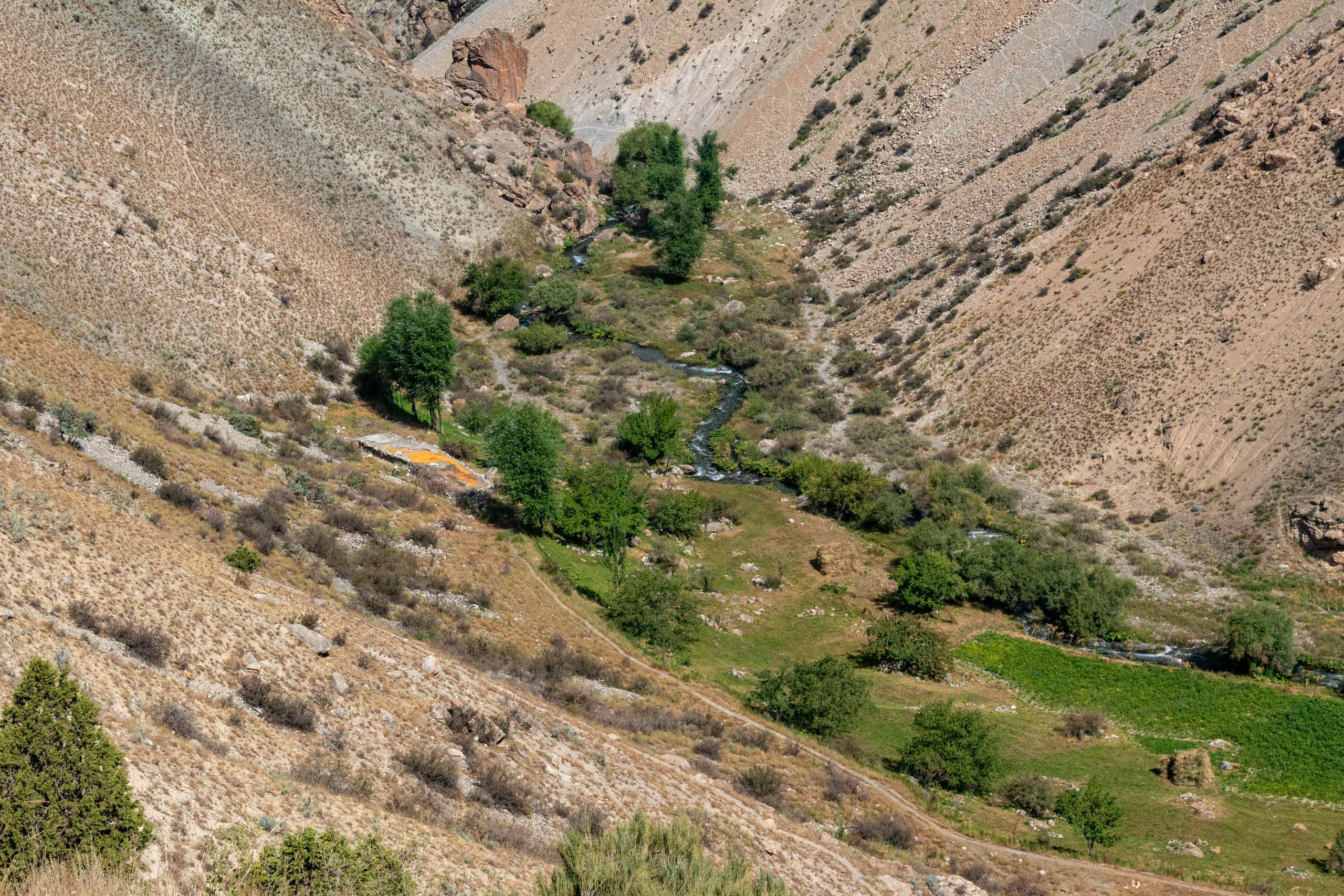
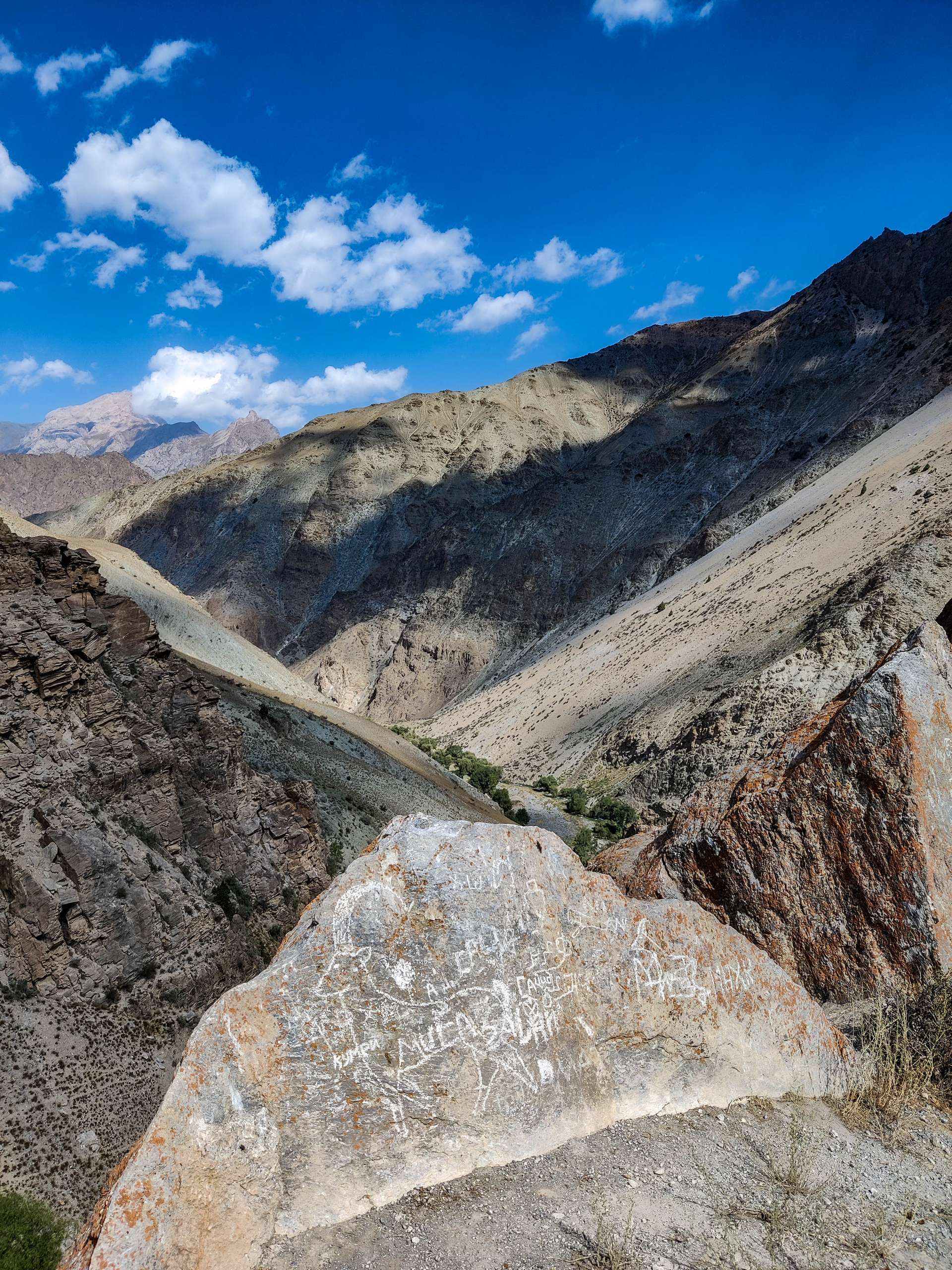
We followed the trail straight to the end, where it met a rock. On the left was a valley with apricots, and on the right was another one (along which we had been walking). Here, we made a couple of zigzags along the trails and descended into the left valley. At the beginning of the descent, we came across another rock with petroglyphs. Soon after, we started encountering stone huts with “apricot” roofs.
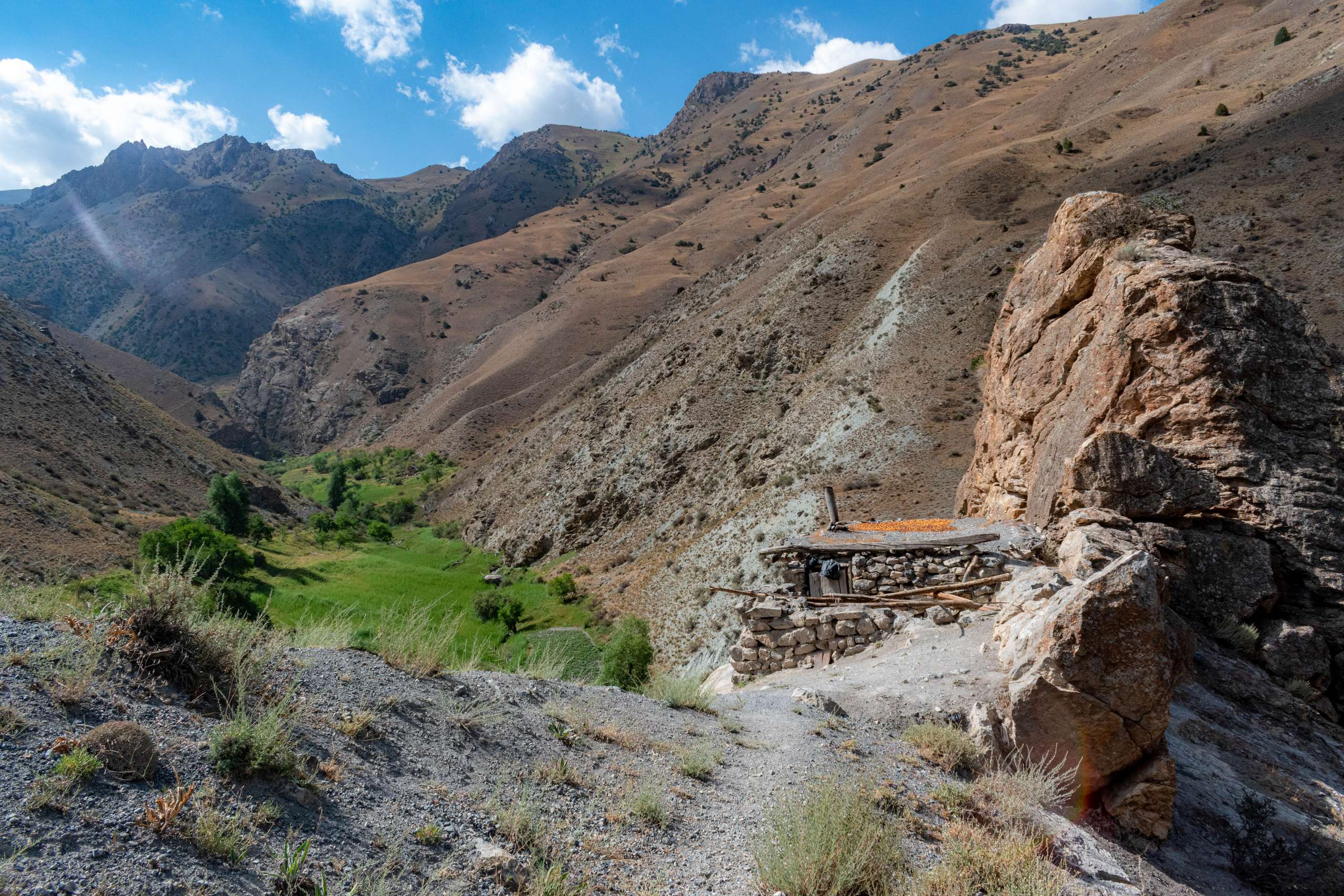
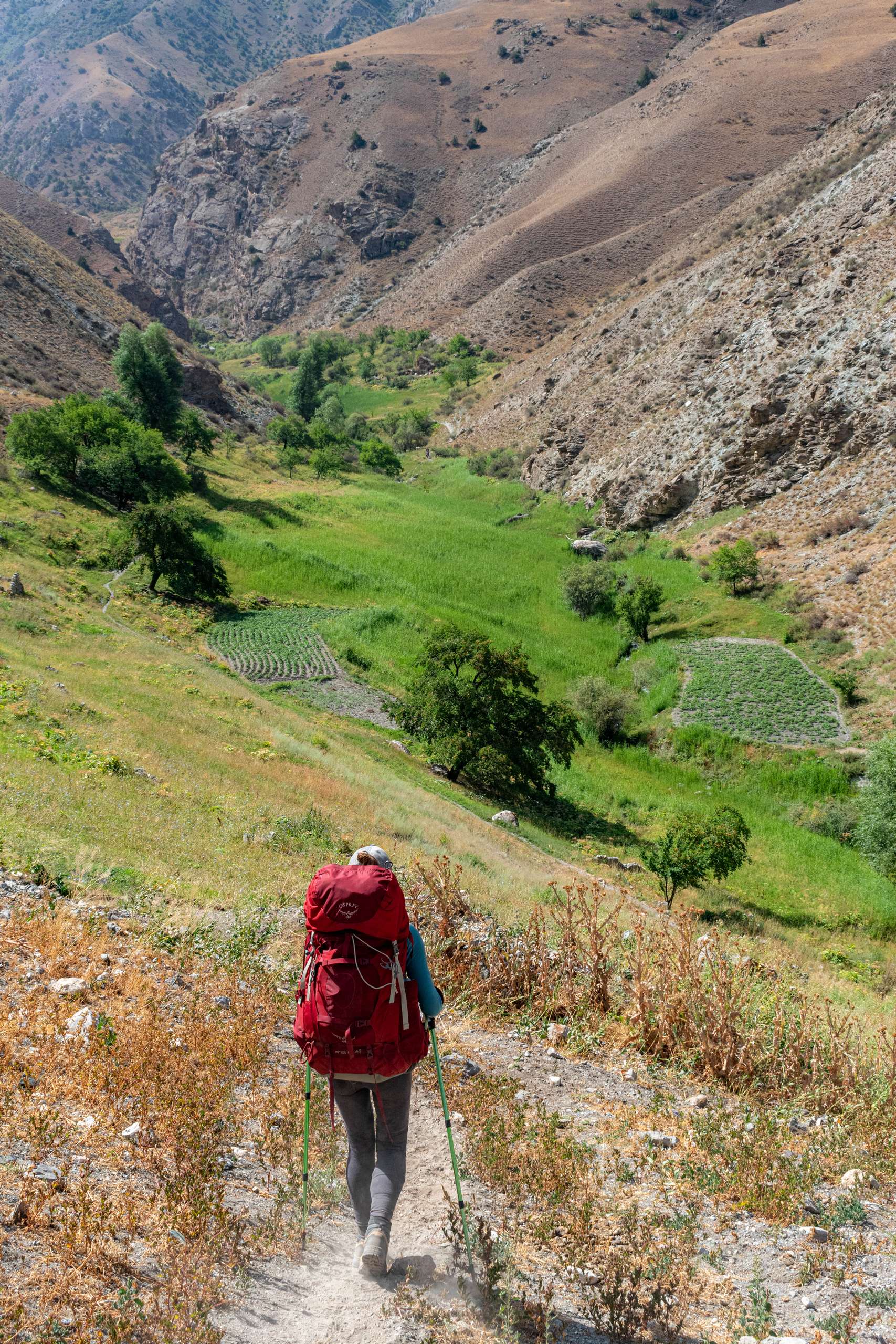
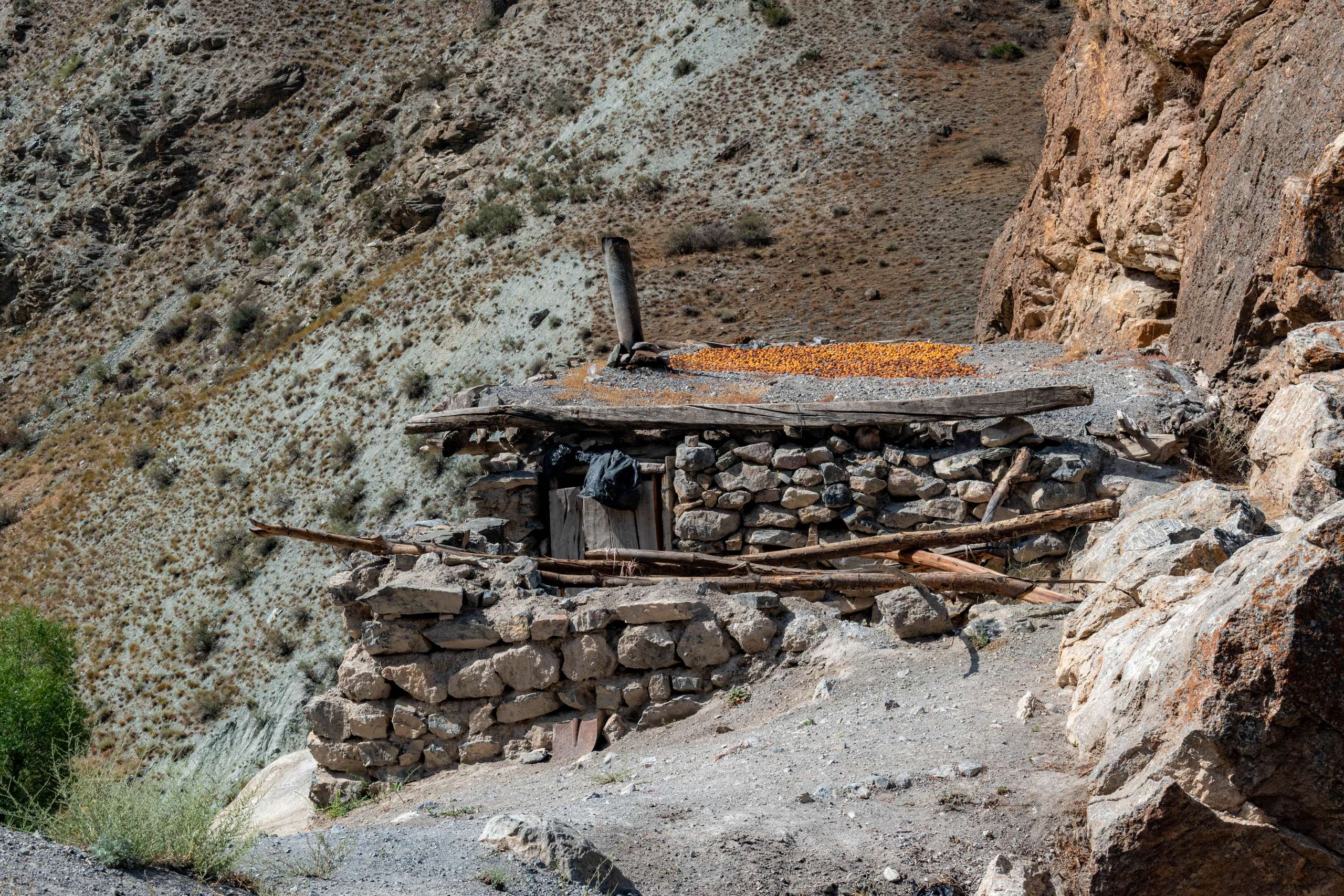
In the valley, we could now see trees up close, covered in apricots. We really wanted to pick and try a couple, but everything looked very well-kept, like someone’s garden. Additionally, we heard someone coming down from the top of the valley on donkeys, shouting. We thought they might be the owners, so we decided to move on.
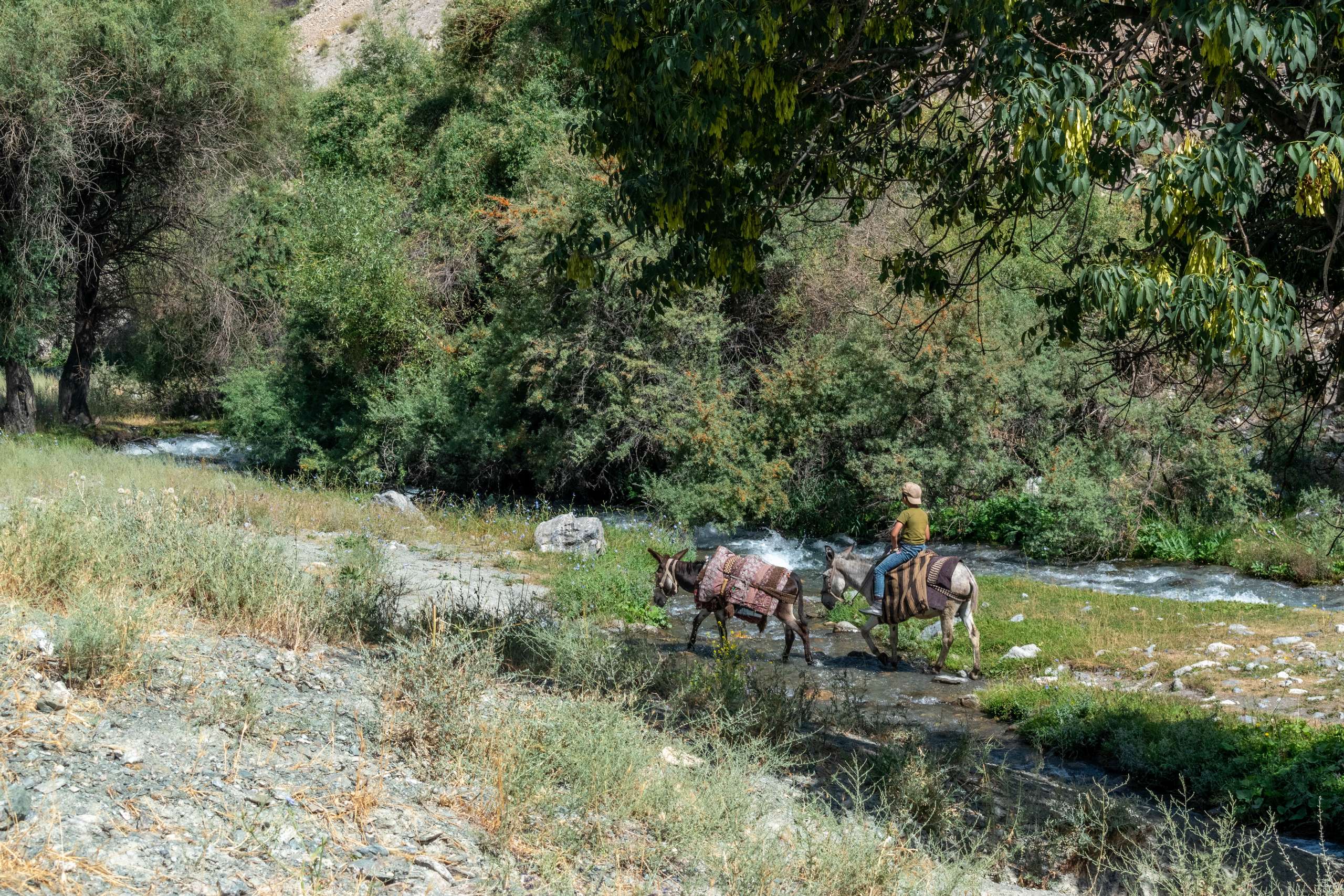
About 500 meters later, the donkeys caught up with us. There were two kids, around 12 years old, riding them. Each of them had a donkey, and there was one more donkey walking alongside, empty. We let them pass us. One of the kids sat backward on his donkey so it would be easier for them to talk to each other.
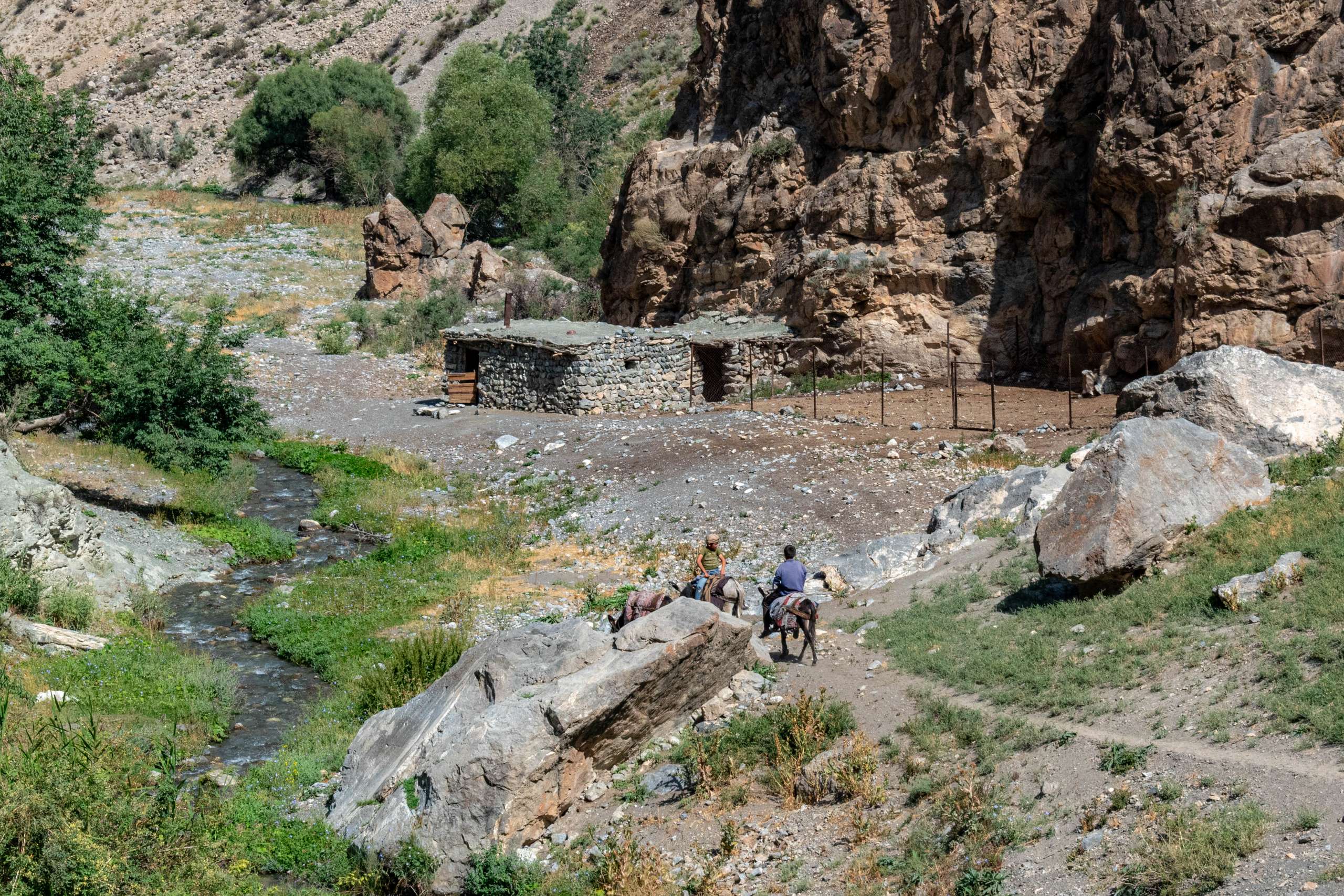
Below, there is another stone barn, and next to it, an empty pen extending onto the rocks. It’s quite large and surrounded by a fence. It’s curious, I wonder who it’s for.
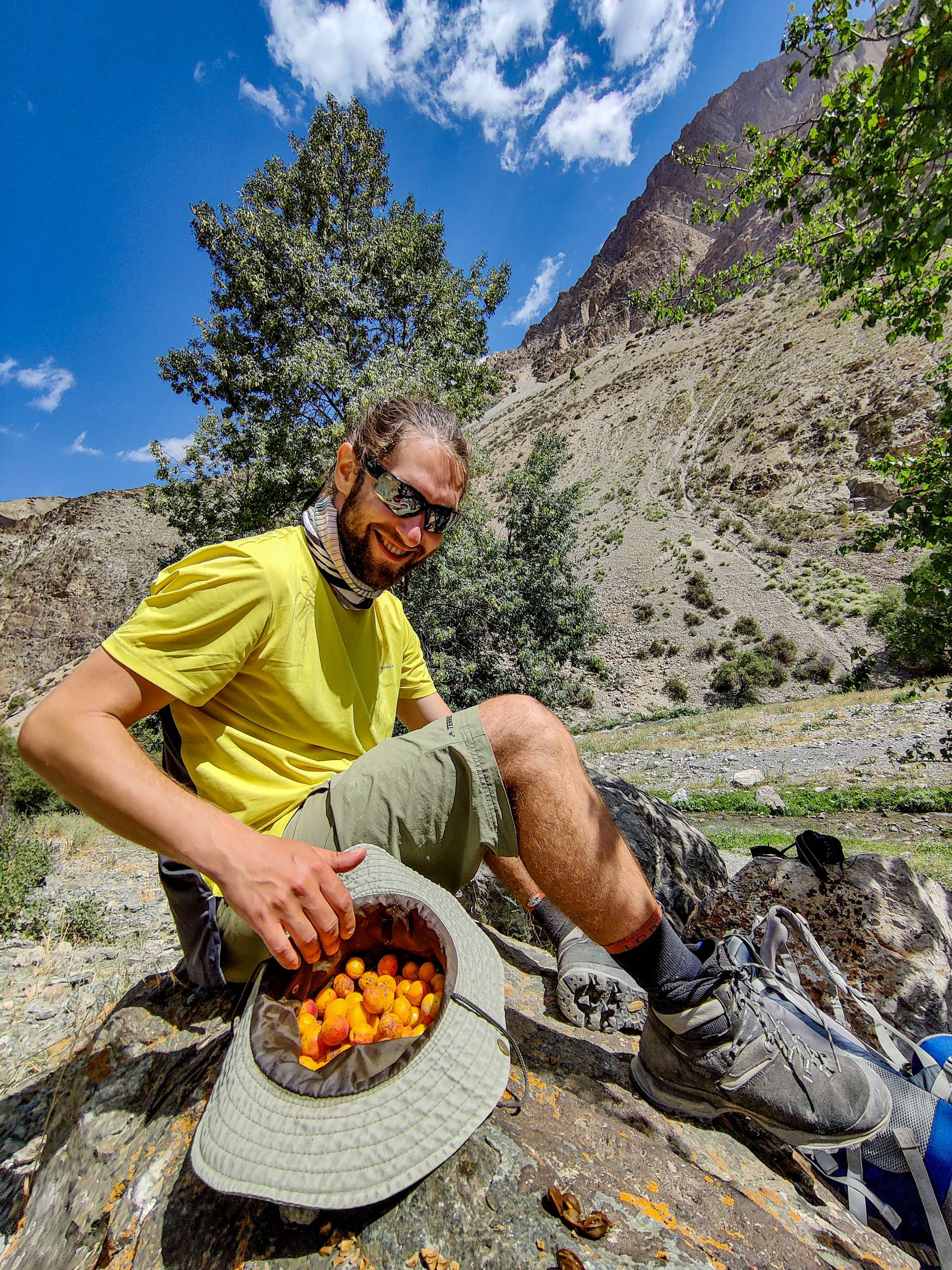
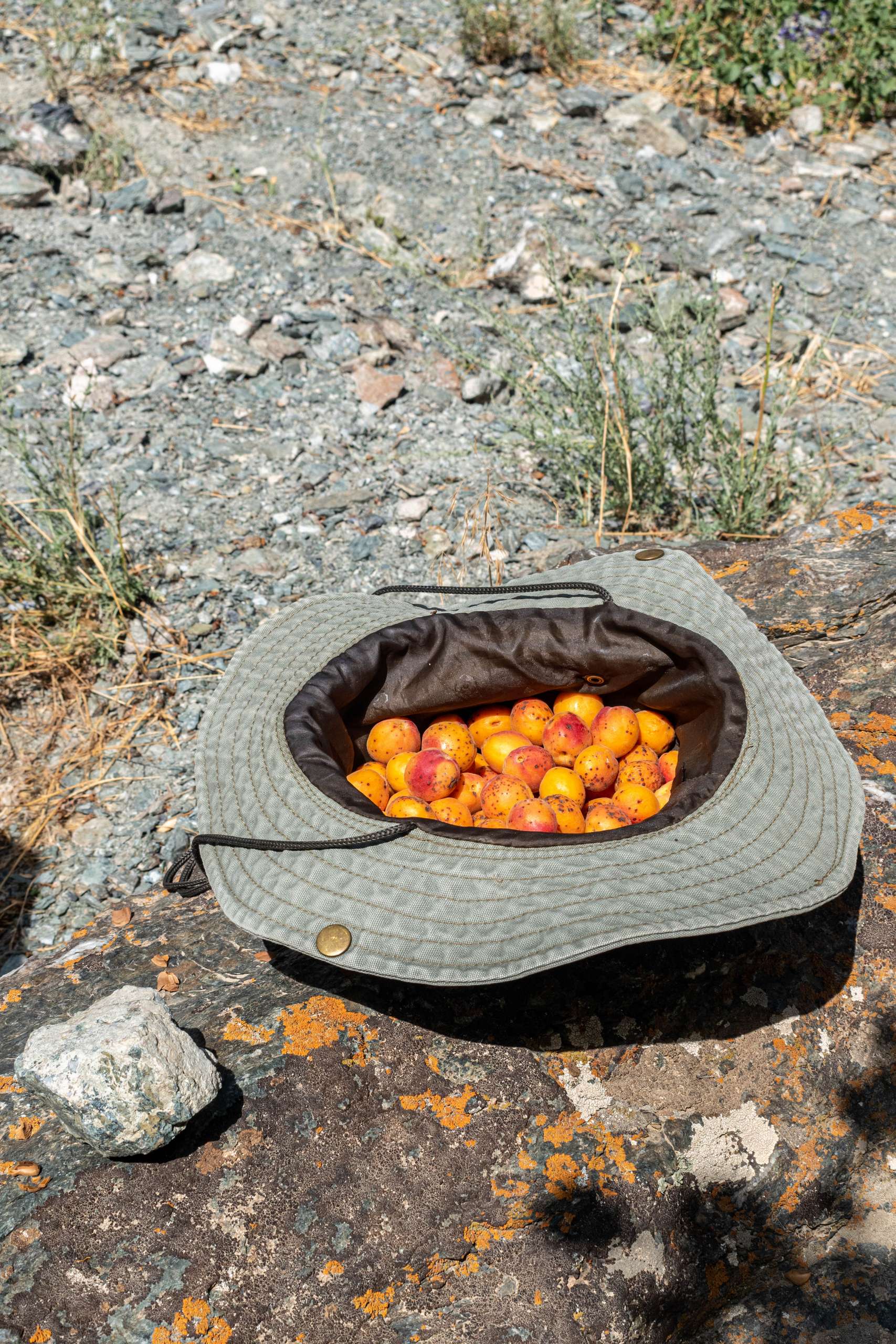
Another 500 meters later, we saw a wild apricot tree across the river on the left. Now, nothing could stop us! We first tried the apricots from the lower branches. They were amazing — fresh, moderately sweet, with a nice tang, and a pleasant texture. Nearby, on a large rock, there was a stone that was perfect for cracking apricot kernels from the pits. The broken shells clearly showed we weren’t the first ones. The same kids on donkeys passed by us. In the opposite direction, there was an adult man with a couple of women (maybe his wife and daughter?), with the man riding and the women walking, though there were plenty of donkeys. He greeted us warmly. At the top of the tree, clusters of larger, meatier apricots were tempting us. I climbed up and used my hat as a bucket for apricots. In about 10 minutes, I filled it completely. We ate our fill and then continued on our way.
For river crossings, proper bridges began to appear. Before the first one, Katya noticed a worn donkey horseshoe on a rock, a very colorful item that she wanted to take as a souvenir. She planned to leave a coin in exchange, but we didn’t have any coins with us, so instead, we left the tastiest nuts from our supplies on the rock.
After that, nothing particularly interesting happened; we just kept walking along the trail. There was a small section of descent over scree, and there we met an adult couple coming towards us. We talked with them; they were from Magnitogorsk (Russia) and had come here for a month. They had already been to Artuch and the lakes we passed at the beginning. They hadn’t made it to Chimtarga, though, as they said the weather was bad, and groups were turning back from there. After that, they went on a trek to another part of the mountains — Seven Lakes — and managed to visit all of them. Now, they were heading up to Lake Bolshoi Alo and would decide what to do next. We shared some information with them about the trail and the water sources.
Before reaching the road, we decided to stop for lunch. We were worried that the transfer might arrive earlier, and we’d have to leave immediately without a meal (about 2 hours to the border, a 40-minute border crossing, and a taxi to the hotel, which takes around an hour). We stopped right by the river under a tree on the grass at 12:00. We cooked lunch. The water in the river here was very murky, like at the Mutnyi Lakes, so we filtered it. While sitting on the grass, we worried about ticks… it is what it is, even sitting on the grass in the mountains felt scary. Ticks have been reported up to a maximum of 1900 m, and here we were at around 1800 m. During this time, the man with the two ladies came down from the mountains again and greeted us warmly.
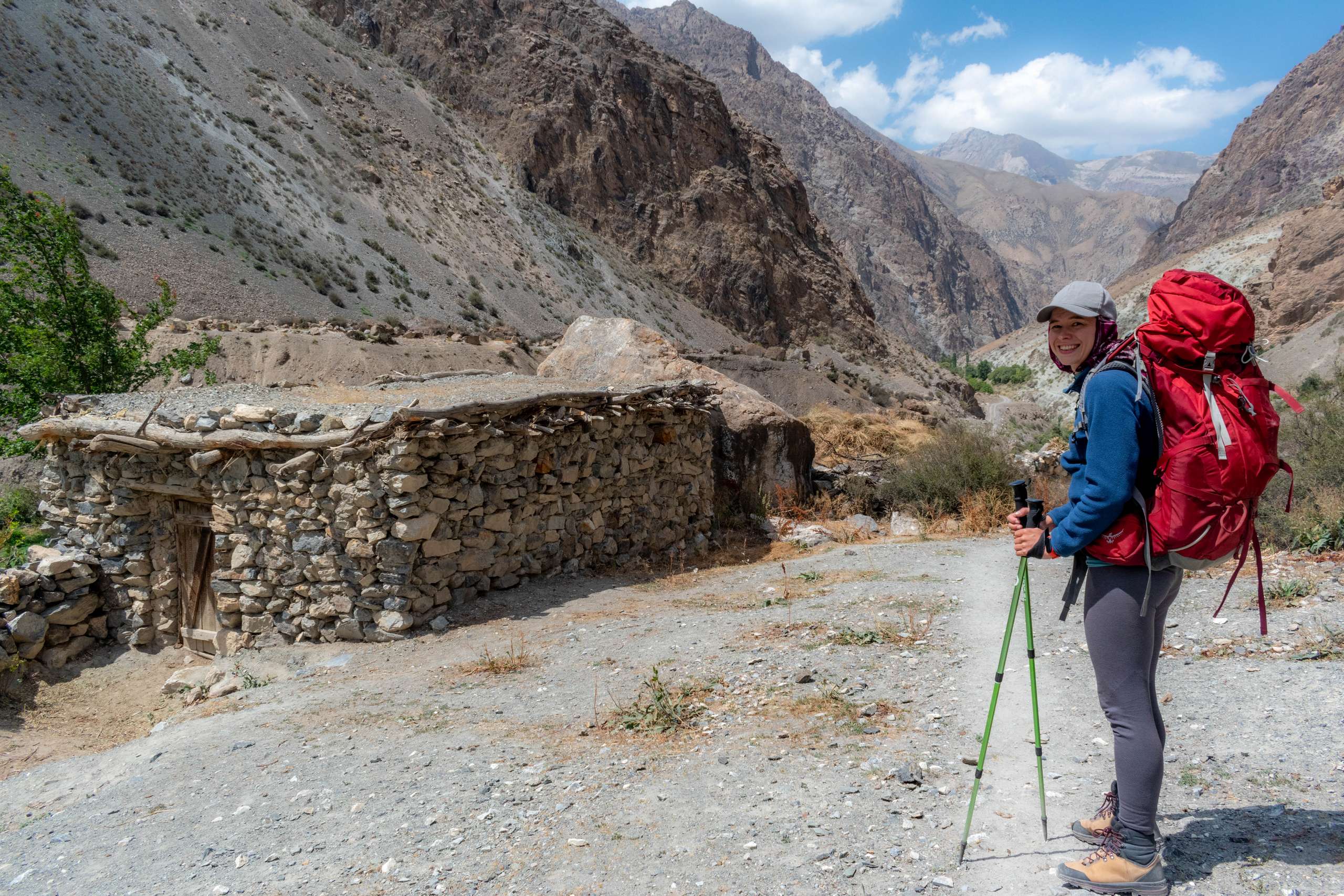
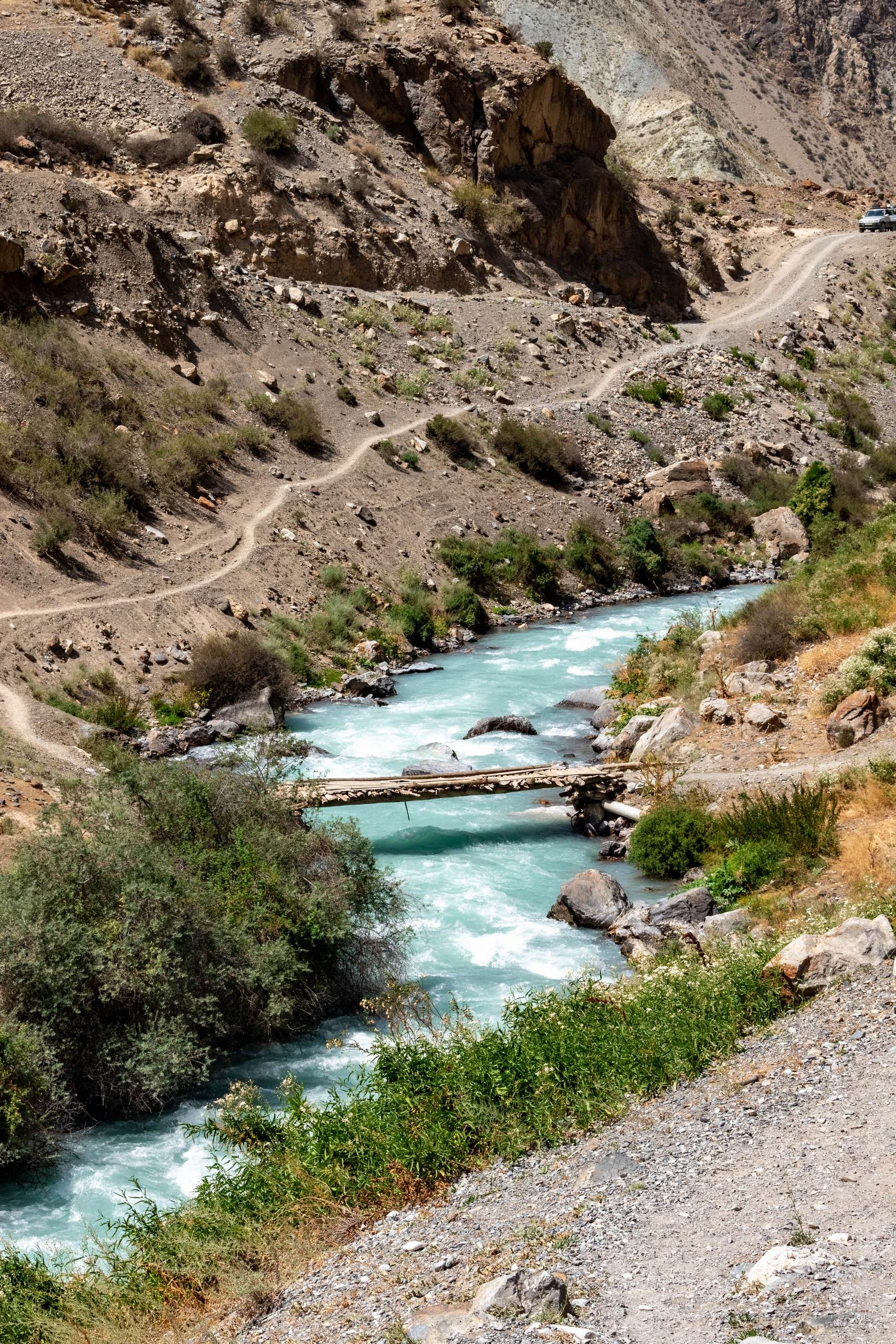
At a little past 13:00, we set out to leave, expecting the transfer to arrive earlier than 15:00. The exit turned out to be different from what we had imagined. Instead of the expected asphalt road, it was a dirt track winding between the mountains. Below, the milky turquoise water of the Archamaydon River was bubbling, and around us were monochromatic sandy mountains. This is Tajikistan!
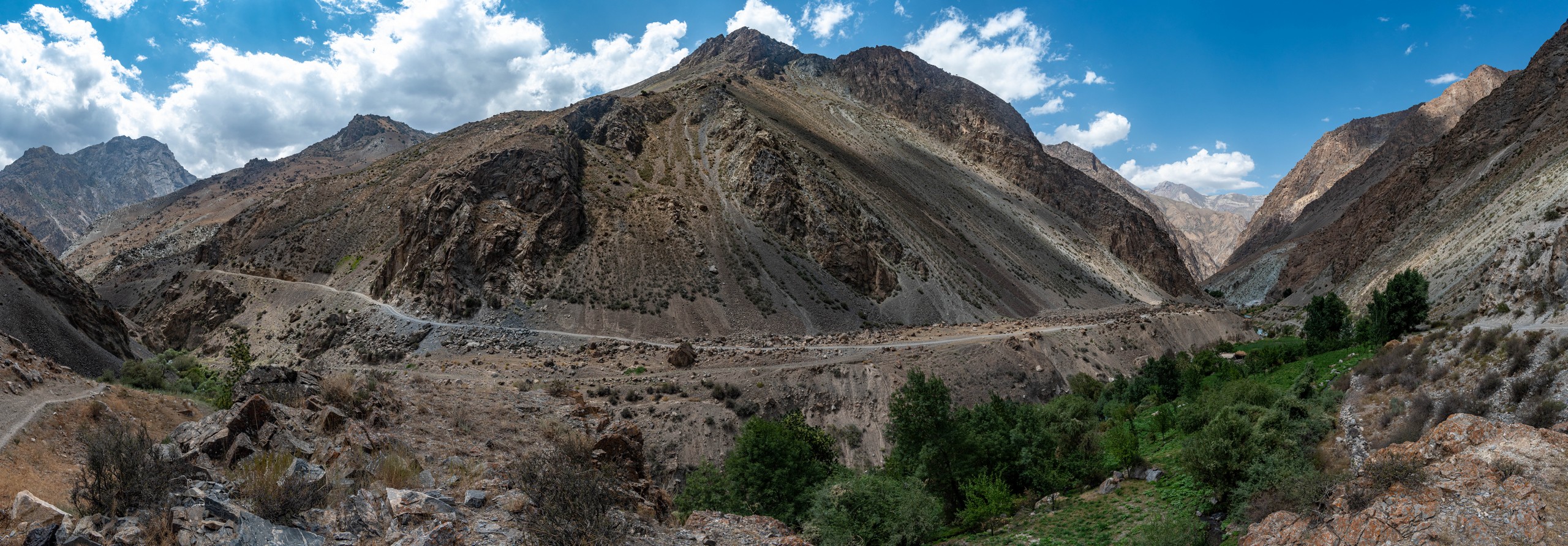
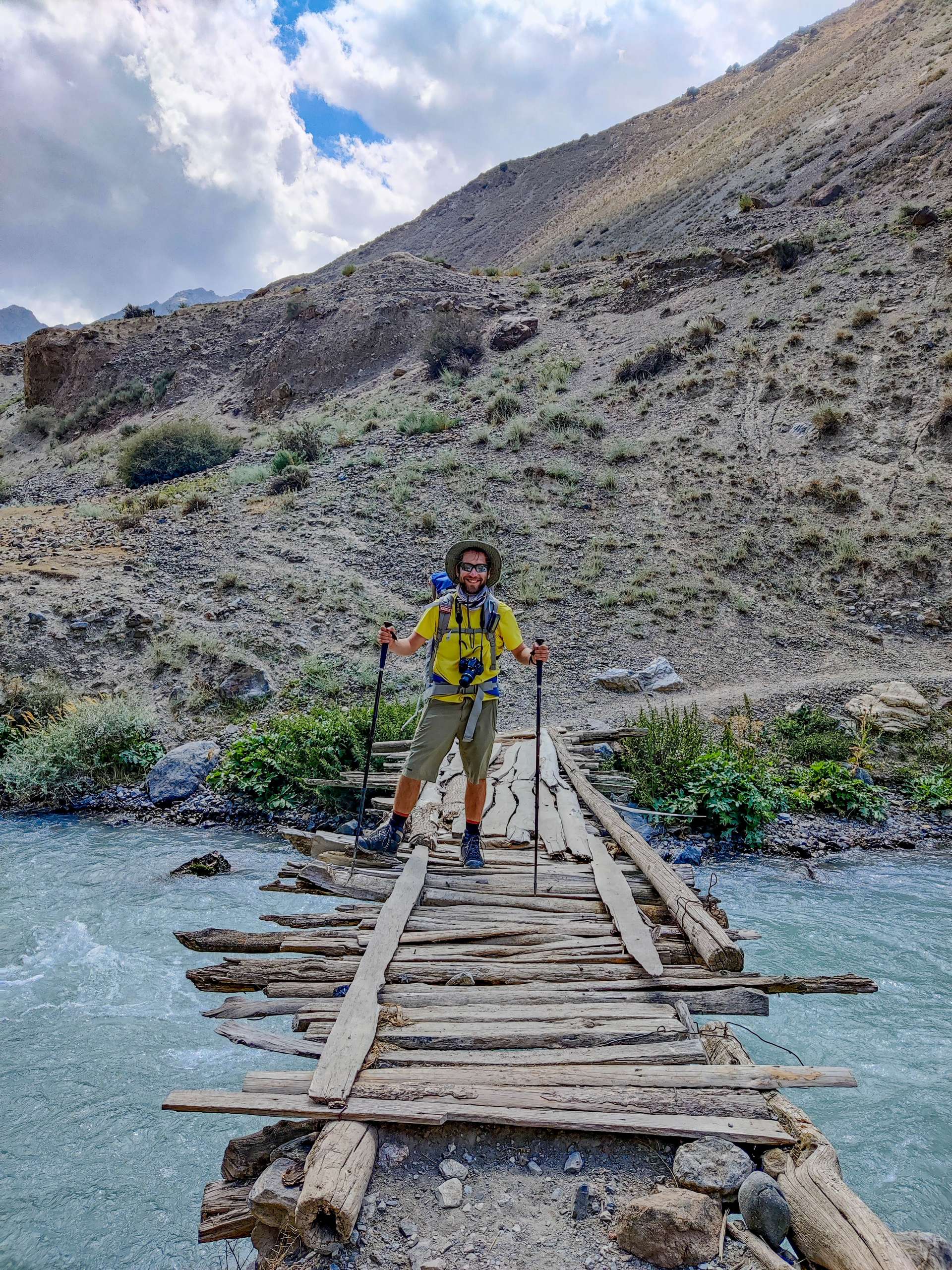
The trail turns to the right, passing by several residential houses. Along the trail, there’s a wide pipe with frequent holes (maybe a water pipe?). In the distance, we can see a bridge over the Archamaydon River, and we eagerly run toward it, anticipating a hot shower at the hotel. The bridge is extremely picturesque, and at 13:40, we take a few photos with it before heading up to the road.
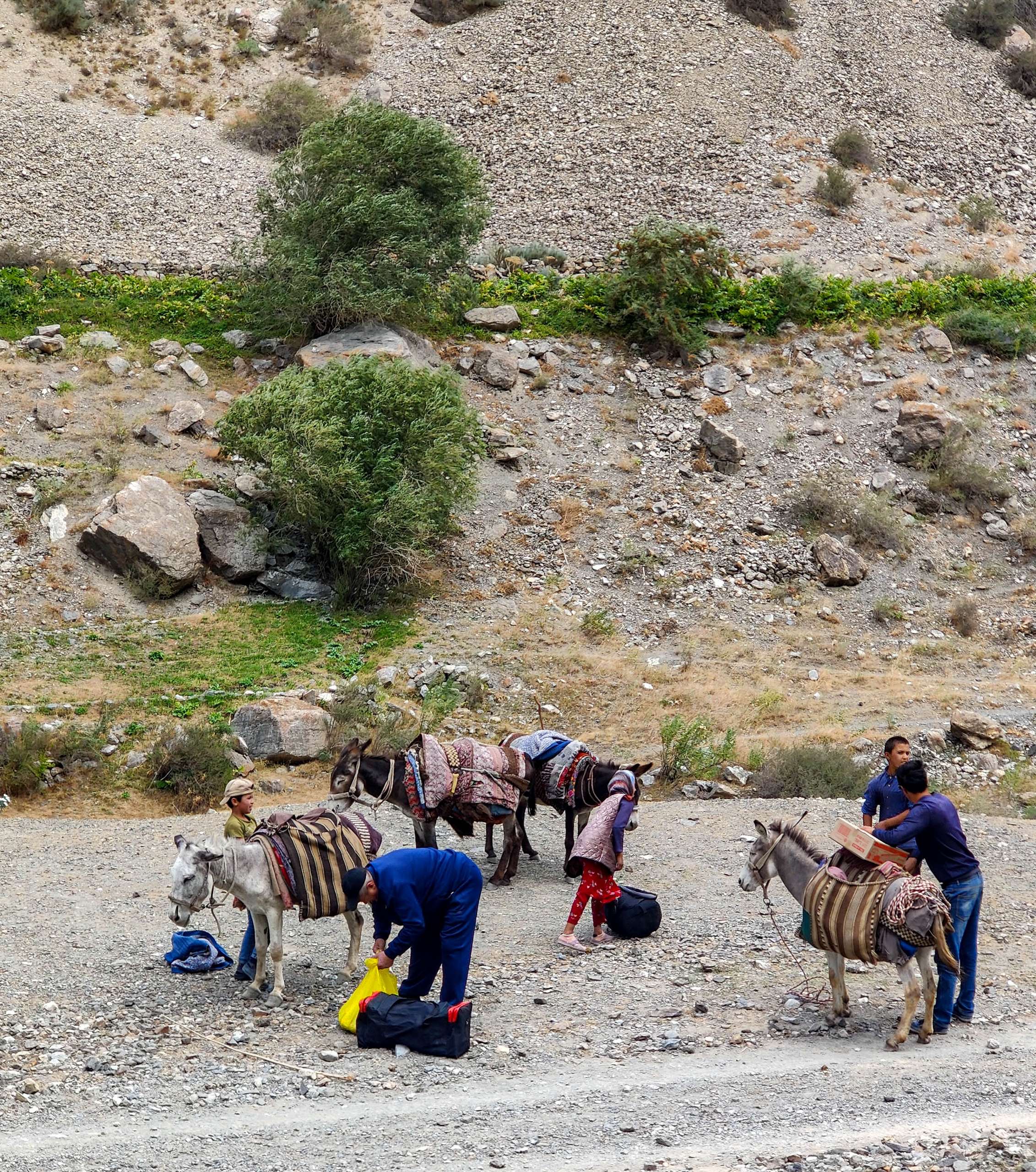
A jeep was driving up toward us in the mountains. The man stops, asks how things are going, and if we need a ride. We decline, telling him that our transfer should be arriving soon. A little higher up the road, there’s a small area, something like a stop. The jeep drops off a young man, an older man, and a young woman with their belongings. They stand there, waiting for something. They asked us how our rest was and what we thought of the mountains.
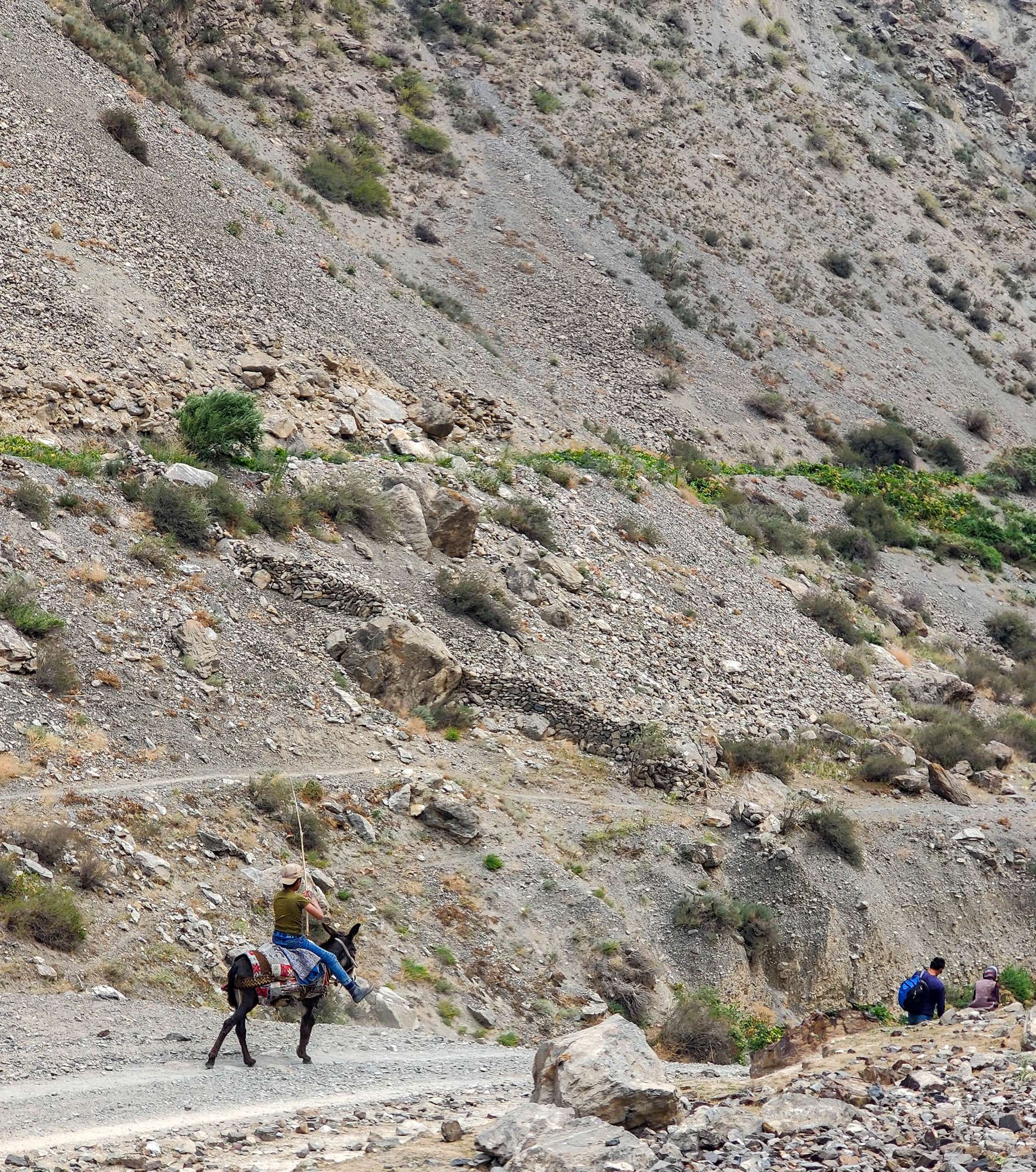
We climbed higher for a better view and to sit on the rocks. We waited. We watched as the two 12-year-old boys arrived on donkeys and began loading all the people and their belongings onto the donkeys, then set off back into the mountains. The boy waved and shouted, “Goodbye!” As they left, we were left alone on the deserted road.
It’s around 14:00. We’re sitting and reading. The wind here is absolutely wild — it’s warm but very strong, blowing nonstop. Half an hour later, the old man arrives on a donkey, unloads 3 boxes at the stop, and starts shouting something at us. We approach, and he barely speaks any Russian, just saying that the boxes need to be handed over to the car, and the driver knows. Well, we didn’t really understand exactly who to give them to, but we nodded.
Around 15:00, the same jeep that had met us earlier returned from the mountain side. The driver asked where our car was, and I said, “It should be here in about 5 minutes.” He nodded silently, loaded the boxes into his jeep — apparently part of a well-practiced routine — and drove off, honking at us as a farewell. Once again, we were left alone.
We decide to activate roaming with Megafon (it seems to have signal) and call the main contact for our transfer, Daler. The subscriber is unavailable. I had been in touch with him on Telegram, so we try to get internet working, but here we only have 2G, and it’s barely working, Telegram messages aren’t going through.
We spend time until 16:00 climbing around the rocks, searching for a more stable internet connection, and trying to make calls, but with no luck. After 16:00, we decide we need to head back to the stone huts to ask someone to arrange a transfer, as evening is approaching and the sun has already disappeared behind the mountains. We put on our backpacks and start heading out, and then, just as we approach the bridge, a young man on a donkey comes towards us. We stop and wait.
He approaches, and we explain the situation — we’ve been left without our transfer and need help getting to the border. He pulls out his phone, starts swapping SIM cards, and makes a call on speakerphone. He tells us, “Five thousand rubles”(~$85), which is fine, as that’s what our original transfer cost. He says the car will arrive in about an hour and a half. We ask for the transfer’s contact number in case something goes wrong, but he gives us his own number instead. He dismounts from the donkey and sits down with us to wait. Every so often, he calls his friend to check where he’s at and keeps us updated.
As we neared the end of our wait, he noticed me looking at the donkey and asked, “Do you want to try?” Of course, I said “yes”. He brought the donkey over, helped us climb on, and took turns giving us a ride. He even let us take some photos.
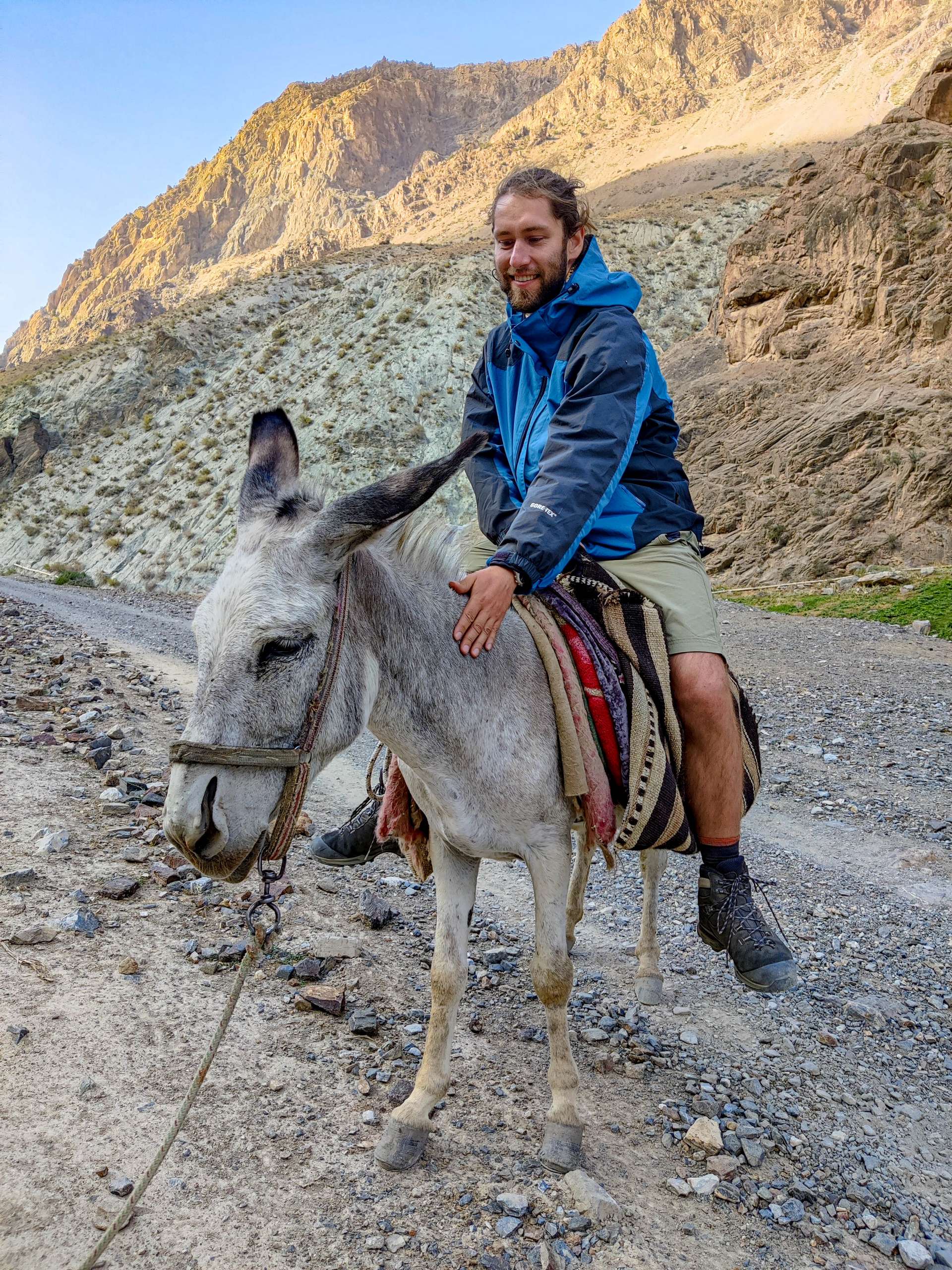
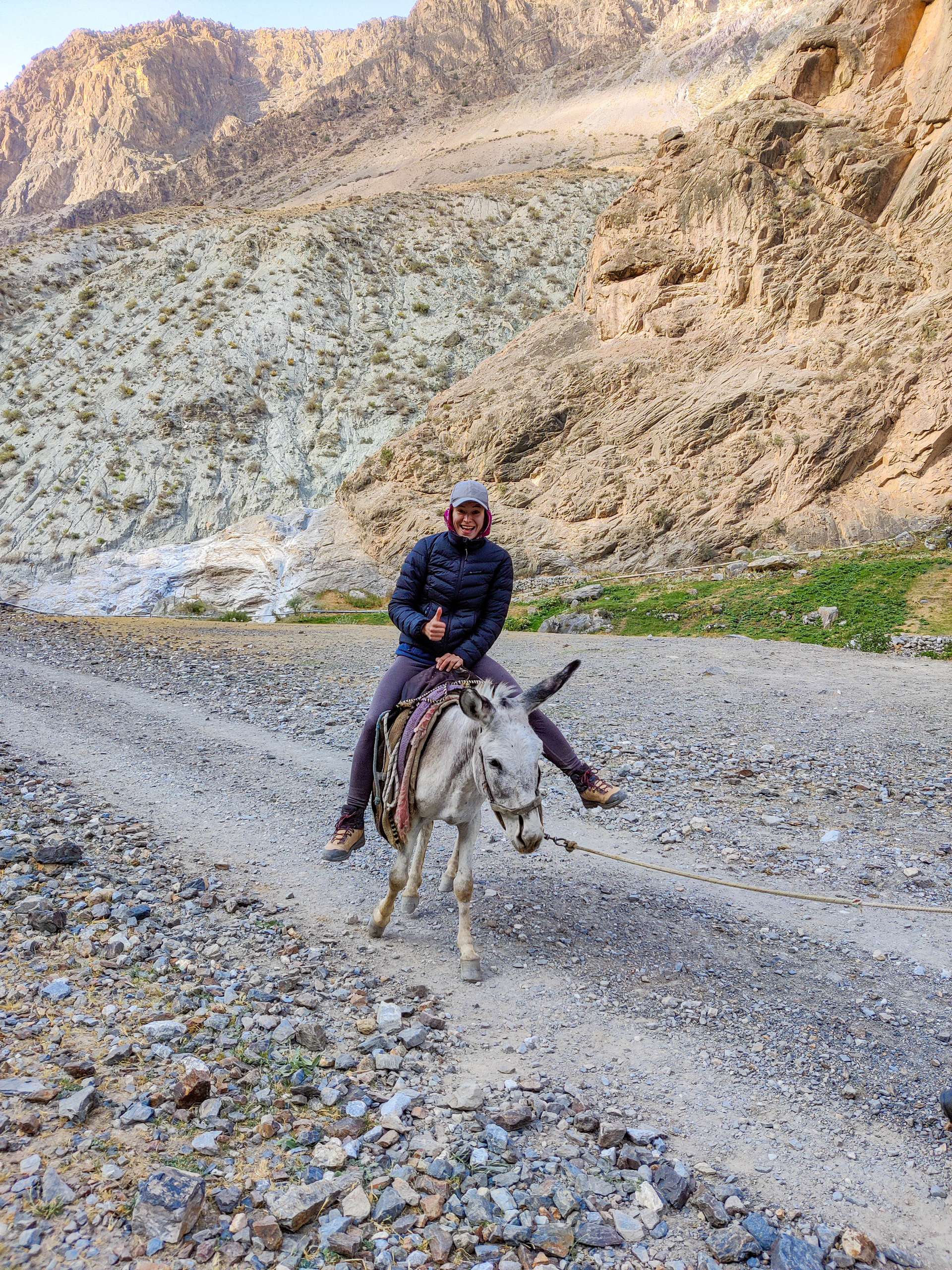
By 17:30, the jeep from his friend arrived — an old, beaten-up SsangYong with a shattered windshield. It was already getting dark and chilly, so we were grateful for anything that could take us to the border. We asked if we owed the guy anything, but he refused, so we jumped into the car and set off. The road was incredibly rough and bumpy, and we couldn’t imagine how our transfer, Daler, would have managed to drive a regular car here. But the road was absolutely beautiful.
Our driver’s name was Iram. He mentioned the names of places we were passing through and shared interesting facts along the way. He even stopped at an apricot plantation and brought us handfuls of apricots to snack on. He offered to take us to a dining hall for a meal, but we declined.
It was one of those frustrating moments when we realized that Daler still had our clean clothes for walking around Samarkand, and we knew that if we left Tajikistan, we’d probably never see them again. Throughout the mountainous journey, I kept trying to catch a signal to send Daler a message, using the last bits of battery on our phones. When we hit the asphalt and finally had 3G, I managed to message him. He replied that the driver had told him that we had agreed to send him a message a day before the meeting (which, of course, was impossible from the mountains without a signal). Since we didn’t, no one came to pick us up.
Well, I asked how to retrieve our clothes, and luckily they were in Penjikent, which was on the way. He gave me the driver’s number. Then, the magic of local customs kicked in — they love calling and chatting for ages while driving. I explained the situation to Iram, gave him the phone number, and they must have called each other about 20 times. But in the end, everything was sorted out.
Daler left our clothes somewhere at a car wash, and we had to go there to pick them up. There were no problems; at the empty car wash, there were about ten employees, and a lady sleeping on a couch, with our bag lying on it. After getting permission from the locals, we happily grabbed the bag and moved on. Our beaten-up car was driving slowly once we were out of the mountains. On the straight sections, Iram would switch to neutral, probably to cool the car down. Inside, it was unbearably hot. Just outside of Penjikent, we got stopped by the police, who asked for a technical inspection. After about 3 minutes of arguing, we were on our way again. I thought we would have to find another transfer from there, but no – Iram’s relative is the head of the police, so we were good to go. The views all along the road were spectacular, especially in the rays of the setting sun.
By around 20:00, we reached the border. Our ride was immediately intercepted by a family of locally dressed people, and it seemed like they didn’t quite realize what they were getting themselves into with this car…
We crossed the border on foot very quickly, in about 10 minutes. There were no people, only cars in the queues. It was fascinating to watch the cross-border migration of melons and watermelons. Many people were carrying cloth bags filled with melons and watermelons in huge quantities. One person could carry around 8 items at a time, making short sprints, moving the pile from one country to another. By the evening, the border control seemed even more chill than it was on the way here. On the Tajikistan side, the border guard was watching YouTube on his phone, and when we asked if we needed to put our things on the conveyor, he waved his hand and didn’t pay much attention to us.
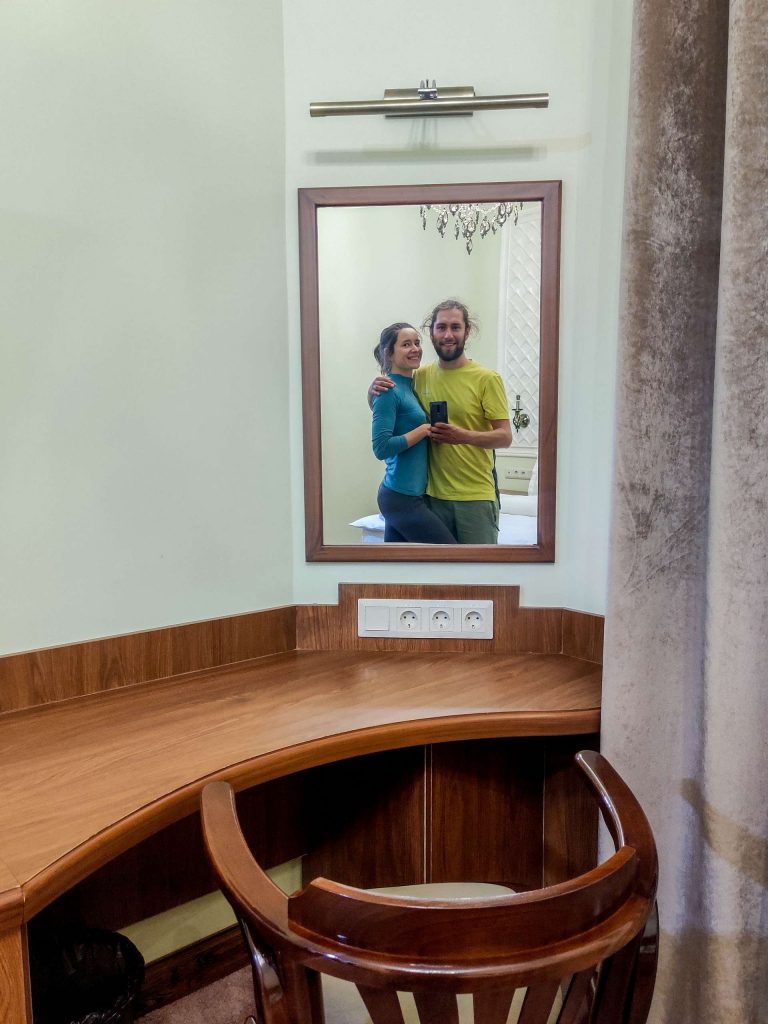
We stepped out, and immediately, Uzbek taxi drivers attacked us. We checked Yandex Taxi, but it doesn’t work here. We had to go with them. Our stories about arriving here for 100,000 (~$9) sums didn’t convince them — “250,000 and we go right now, or 190,000 and we wait for more people.” He asked which hotel, and we apparently chose a rather expensive one in Samarkand, which made them whistle and start calculating how much they could charge us. We tried to break free and look for other cars, but it was unsuccessful. However, our persistence paid off, and the price dropped to 150,000 sums, and we left immediately. Alright, that’s fine. The car was comfortable and the driver drove quickly. By 21:00 we were taking the standard post-hike photo in the hotel room mirror. Hooray! The route is now completely finished, and we’re waiting for new adventures!